

SAN FRANCISCO – Waze is rolling out five AI-powered features this week, the most significant update in years for the Google-owned navigation app’s 140 million monthly users. The changes include a Gemini-powered conversational search engine, a motorcycle mode designed for two-wheelers across Southeast Asia and Latin America, personalized routing built on trip history, voice-based map reporting, and a reduced-audio option for drivers listening to music or podcasts.
The update is the clearest signal yet that Google is moving Gemini into Waze not as a novelty but as core product infrastructure. While Google Maps has carried Gemini features for months, Waze has traditionally maintained a separate identity as a community-driven navigation app. That distinction is narrowing fast.
Gemini-powered destination search lets users type natural language queries instead of exact business names. Ask Waze for “a coffee shop open right now” or “parking close to Grand Mall” and it processes the request as a conversational prompt rather than a keyword match. The feature is rolling out to Waze’s global beta community on Android and iOS, TechCrunch reported. Whether it will eventually replace Waze’s current keyword search, and what data the Gemini backend accesses to answer those queries, remain open.
Motorcycle mode is the feature with the most immediate geographic impact. It is available now in Argentina, Brazil, Colombia, Malaysia, Mexico, Peru, and the Philippines. The mode accounts for shortcuts specific to two-wheelers, filters out routes blocked by restrictions that do not apply to motorcycles, and highlights road hazards that matter most on a bike: potholes, speed bumps, and narrow bridges. Waze says more countries will be added but provided no timeline.
The motorcycle omission from major navigation platforms has been conspicuous. Apple Maps and Google Maps both default to car-based routing for two-wheelers in most markets, treating motorcycles as absent from the road. Waze’s motorcycle mode is the first from a navigation platform of this scale to explicitly route for two-wheelers and highlight bike-specific hazards. The feature matters most in markets where motorcycles are the majority vehicle: Indonesia, where two-wheelers account for roughly 80 percent of road traffic, and Vietnam, where the ratio is similar. Neither country is currently listed in Waze’s rollout.
Personalized navigation, the third feature, adjusts route suggestions based on a user’s prior trip patterns and real-time traffic. It is on by default and can be disabled in settings. Waze did not describe how much historical data the feature uses, whether it segments data by user, or how personalized routing interacts with the company’s existing advertising business. The privacy policy governing route data was written before personalized routing existed, and a navigation app that learns individual trip patterns over time collects something qualitatively different from one that routes each trip from scratch.
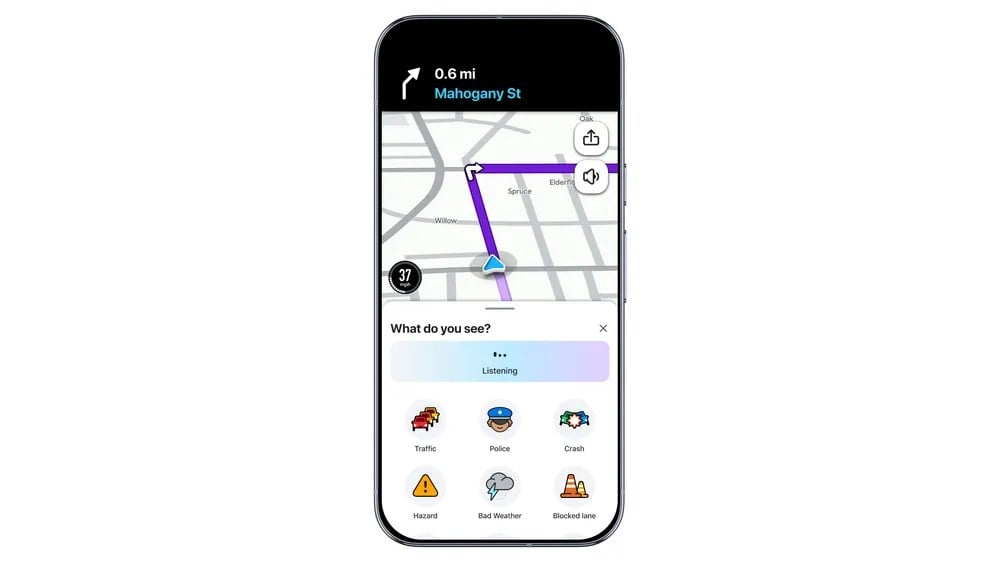
The fourth feature, conversational road reporting, lets users describe problems by voice and submit them directly to local map editors. A driver can say “the road is closed here” and have it routed to the community editors who verify and apply map changes. The fifth feature, Less Chatty mode, reduces the frequency of voice prompts during drives. Waze’s default notification system has long split opinion: useful on new routes, intrusive on familiar ones. Less Chatty keeps hazard warnings and turn alerts active while suppressing everything else. Both are rolling out globally on Android and iOS.
The five features together reflect a strategy that Google is applying across all of its navigation layers simultaneously. Google is pursuing a Gemini-first overhaul of Android Auto, the in-car dashboard platform that runs on vehicles with Android integration. Maps, Waze, and Android Auto are each receiving Gemini features on parallel timelines rather than as a unified platform launch, which means the same conversational query may behave differently depending on which Google navigation surface the driver uses.
For Google, the parallel rollout means Gemini reaches navigation users across three surfaces without requiring any of them to migrate or consolidate. For users, it means inconsistency: a feature available on Maps may take months to appear on Waze, and a routing preference learned by one app is not shared with the others. Waze has not announced any plan to unify its data with Maps or Android Auto.
Waze’s strategic value to Google has historically rested on crowdsourced map data that its community collects in real time. Traffic incidents, road closures, and police reports submitted by 140 million users give Waze routing accuracy on current conditions that static map data cannot match. The Gemini integration points in a different direction: rather than improving Waze through more data collection, Google is adding AI reasoning capacity to the interface itself. Whether that changes what Waze’s community of contributors is asked to provide is not yet clear.
The features that matter most in emerging markets are also the ones rolling out last and to the fewest users. Motorcycle mode, the most country-specific addition, is live in seven countries. Gemini search, which is globally staged through a beta community, reflects product priorities set by engineers in California. The gap between what Waze can now do and what most of its 140 million users can currently access is still measured in software cycles. Waze has not given a date for when any of the five features will be available to all users in all markets.