
SEOUL – When SK Hynix raised $28 billion on Nasdaq last week and eclipsed Alibaba’s decade-old record as the largest-ever foreign listing on a U.S. exchange, the question in every South Korean boardroom was the same: who goes next.
The answer, according to people familiar with the matter cited by Bloomberg News, is that Samsung Electronics is exploring precisely that question. The world’s largest maker of memory chips has held early discussions with investment banks about a potential American Depositary Receipt program that would make its shares available to dollar-based investors for the first time. No exchange has been chosen, no timeline set, and the company declined to comment when contacted by reporters. Those briefed on the talks describe them as being in “very early stages,” a formulation that typically signals feasibility work rather than a decision.
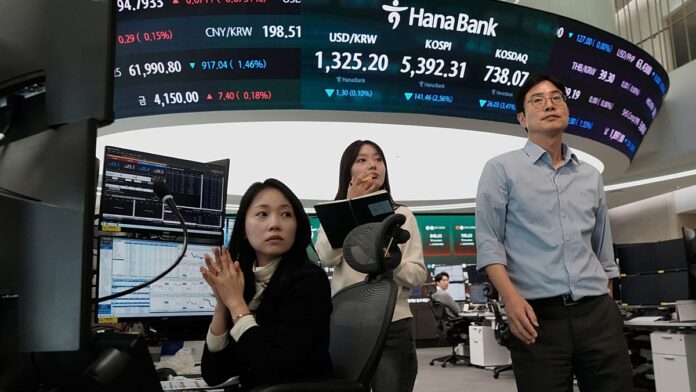
The deliberations land against a backdrop that Seoul’s financial establishment has spent years trying to change. Samsung trades at what analysts call a chronic “Korea discount,” a persistent valuation gap between its market price and the theoretical fair value implied by its earnings, growth, and technological position. Korean conglomerate structures have historically commanded lower price-to-earnings multiples than American pure-plays with comparable financials. An ADR listing would not eliminate that gap on its own, but it would deepen Samsung’s integration into the capital pools that set those multiples most aggressively.
What Samsung is bringing to that conversation is considerably more complex than what SK Hynix offered. SK Hynix’s $28 billion Nasdaq debut was built around a single, legible proposition: the company controls 60 percent of the global high-bandwidth memory market, and every major AI system running at commercial scale requires that memory. American investors bought the story in size. Samsung is a different structure altogether. Its semiconductor division manufactures both memory and logic chips for external customers, competing directly with Taiwan’s TSMC on foundry business. Its display arm makes the OLED screens inside Apple iPhones. Its consumer electronics division ships appliances to more than 200 countries. Pricing all of that in a U.S. prospectus is a harder assignment than the HBM pure-play that drove SK Hynix’s listing plans to oversubscription.
The semiconductor division’s recent trajectory does, however, give Samsung something to work with. The company posted record quarterly operating profit on the back of soaring DRAM prices and surging demand from American hyperscalers expanding AI infrastructure. Samsung supplies memory to Amazon, Google, and Microsoft at volumes that dwarf most competitors, and its foundry division is building out advanced node capacity that positions it as an alternative to TSMC for logic chip customers seeking to reduce concentration risk in their supply chains.

Samsung has also attracted attention from the artificial intelligence sector as a potential hardware partner. TechCrunch reported that Anthropic, the Claude developer backed by Google and Amazon, is in discussions with Samsung about co-developing a custom AI chip. Those conversations sit independently of any capital markets plans, but point to the same dynamic: American technology companies are deepening ties with Samsung at precisely the moment the conglomerate is weighing whether to seek a U.S. listing.
The complexity that might give investment banks pause is Samsung’s high-bandwidth memory position. SK Hynix spent the past 18 months translating its HBM dominance into a valuation story American investors could quantify. Samsung, by contrast, has struggled to certify its HBM3E chips to Nvidia’s specifications, ceding market share in the category that currently commands the highest semiconductor premium. Any Samsung prospectus would need to address that gap as either a near-term correction or a structural disadvantage before the listing could be priced with confidence.
Korean regulatory requirements add another layer of uncertainty. Domestic-listed companies must navigate the Financial Services Commission when pursuing overseas listings, and Samsung’s size means the process would attract political attention alongside financial scrutiny. The company is the largest single name on the Korea Composite Stock Price Index, and its capital allocation decisions carry implications that extend well beyond the company itself.
What makes the timing legible is the window. SK Hynix’s $28 billion debut demonstrated that American institutional investors will commit at scale to Korean semiconductor equity. The Federal Reserve’s current posture, holding dollar financing conditions stable, is keeping cross-border capital markets more receptive than during the 2022 tightening cycle. And Samsung’s earnings trajectory, running at record levels, provides the income statement investors want to see before committing to a large initial float.
None of that guarantees a listing. Banks run preliminary discussions with large corporations continually; the distance between an early conversation and a filed prospectus is measured in board resolutions, regulatory sign-offs, and market conditions that cannot be known in advance. Samsung may conclude the listing adds complexity without proportionate reward, or find that the Korea discount narrows faster through buybacks and dividend policy than through a transatlantic listing program. Or it may find, as SK Hynix just found, that the American capital market will price its chips with less skepticism than Seoul ever did.