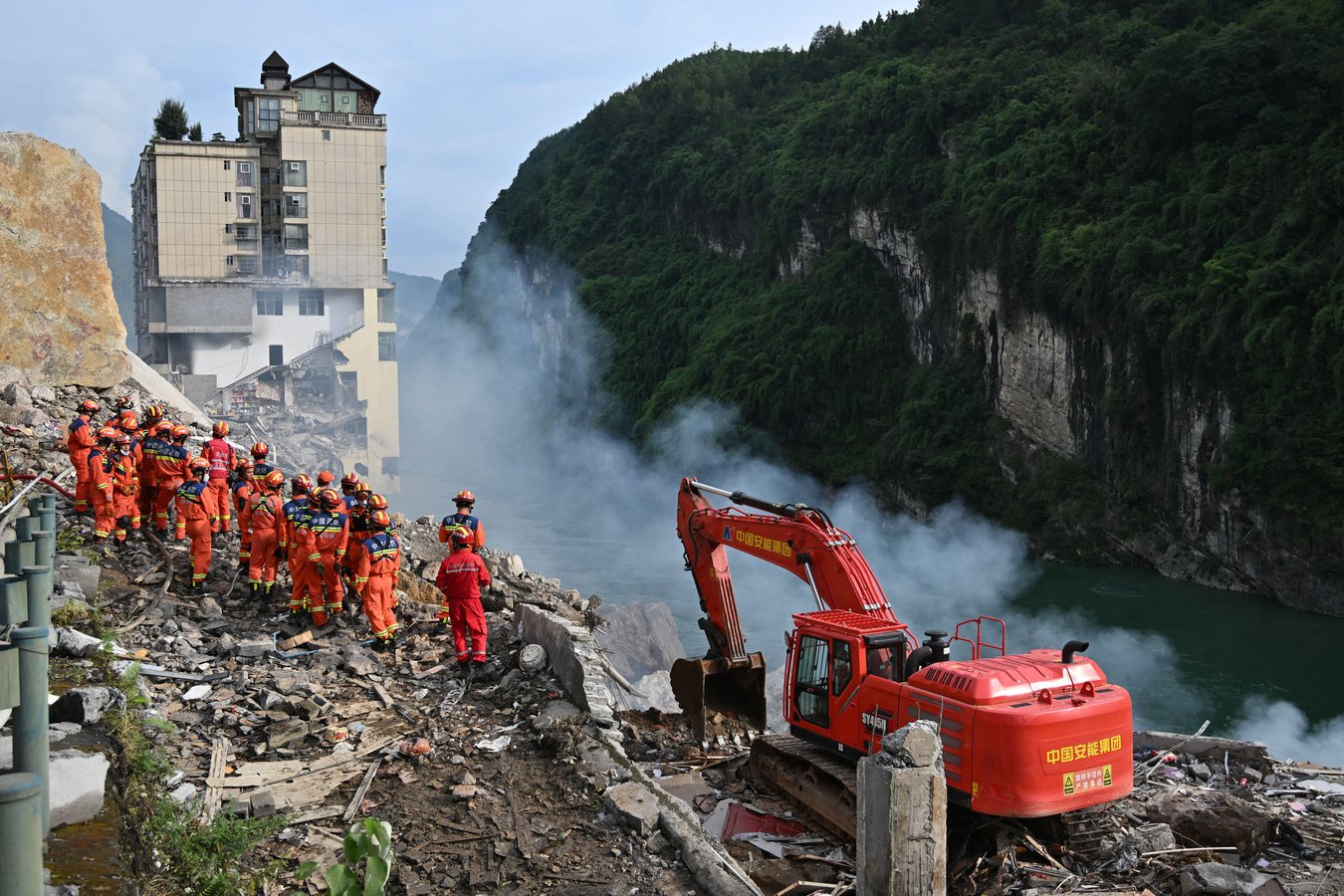

CHONGQING – The community worker who spotted falling rocks on the hillside above Pengshui County’s residential blocks did everything right. She sounded the alarm at 8 AM. Authorities ordered the evacuation of more than 60 residents. Sixty-eight minutes later, the mountain gave way anyway.
A massive collapse of rocks and soil swept down and buried more than ten residential and commercial buildings in Pengshui County at 9:08 AM local time Friday, killing eight people and leaving 34 others unaccounted for, Chinese state media reported. Ten people were pulled alive from the debris; two were seriously injured. The landslide struck during an ongoing evacuation, meaning the death toll could have been substantially higher without the early warning.
Pengshui County sits along the Wujiang River in Chongqing municipality, a mountainous region in southwest China that borders Hubei and Guizhou provinces. A local official described the area as having steep terrain with “dangerous rocks” remaining along cliff faces, a vulnerability that becomes acute during prolonged rainfall. Authorities said the collapse was rainfall-induced, though an investigation into the precise trigger has been ordered.
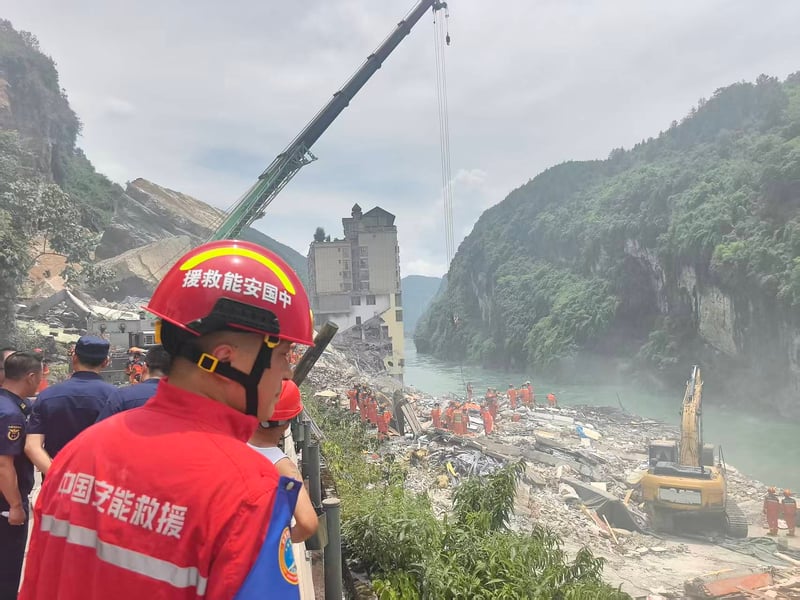
China’s Ministry of Emergency Management activated a level-two emergency response, dispatching a 100-member rescue team and more than 206 personnel supported by 49 vehicles from the national fire and rescue force. More than 800 rescuers were on site by Friday evening, Al Jazeera reported. As a precaution, water, electricity, and gas supply was cut within a one-kilometre radius of the collapse zone.
President Xi Jinping directed authorities to spare no effort in the search for survivors and called for a thorough investigation into the cause of the landslide. The central government released 50 million yuan (roughly $7.36 million) in disaster relief funding and distributed more than 8,000 relief items including tents, emergency bedding, and first-aid kits to displaced residents. More than 1,100 people have been evacuated from the affected area.
Closed-circuit television footage reviewed by Chinese authorities documented what officials described as a “huge buildup of rocks and dirt” rushing down and covering buildings at the mountain base. The footage has become central to the early investigation into whether the collapse was foreseeable and whether more advance warning could have cleared the area in time.
The Chongqing landslide arrives at the tail end of a bruising summer for disaster-prone southwest and central China. Tropical Storm Maysak’s remnants triggered a dam breach in July that killed 39 people in Guangxi’s Nanning, while Typhoon Bavi drove 365,000 from their homes in northeast China earlier this month. Another landslide in Gansu province killed 21 people in the first week of July. The clustering of these events across multiple provinces has renewed debate in Chinese policy circles about infrastructure resilience and whether development in geologically unstable mountain zones carries risks that have not been adequately managed.
Chongqing municipality, which administers a population of roughly 32 million people across a predominantly mountainous terrain, has faced repeated scrutiny over construction standards in hillside communities. The Wujiang River basin, where Pengshui County is situated, has historically experienced slope instability during the summer monsoon season, when rainfall totals can exceed the absorptive capacity of the underlying geology in a matter of hours.
Rescue operations were continuing Friday night with no official timeline offered for when the search might conclude. With 34 people still unaccounted for and the rubble field extending across multiple collapsed structures, the final toll from the Pengshui collapse remains uncertain. Whether any of those buried survived the initial impact and remain alive in voids beneath the debris is the central question driving the urgency of the rescue teams working through the night.