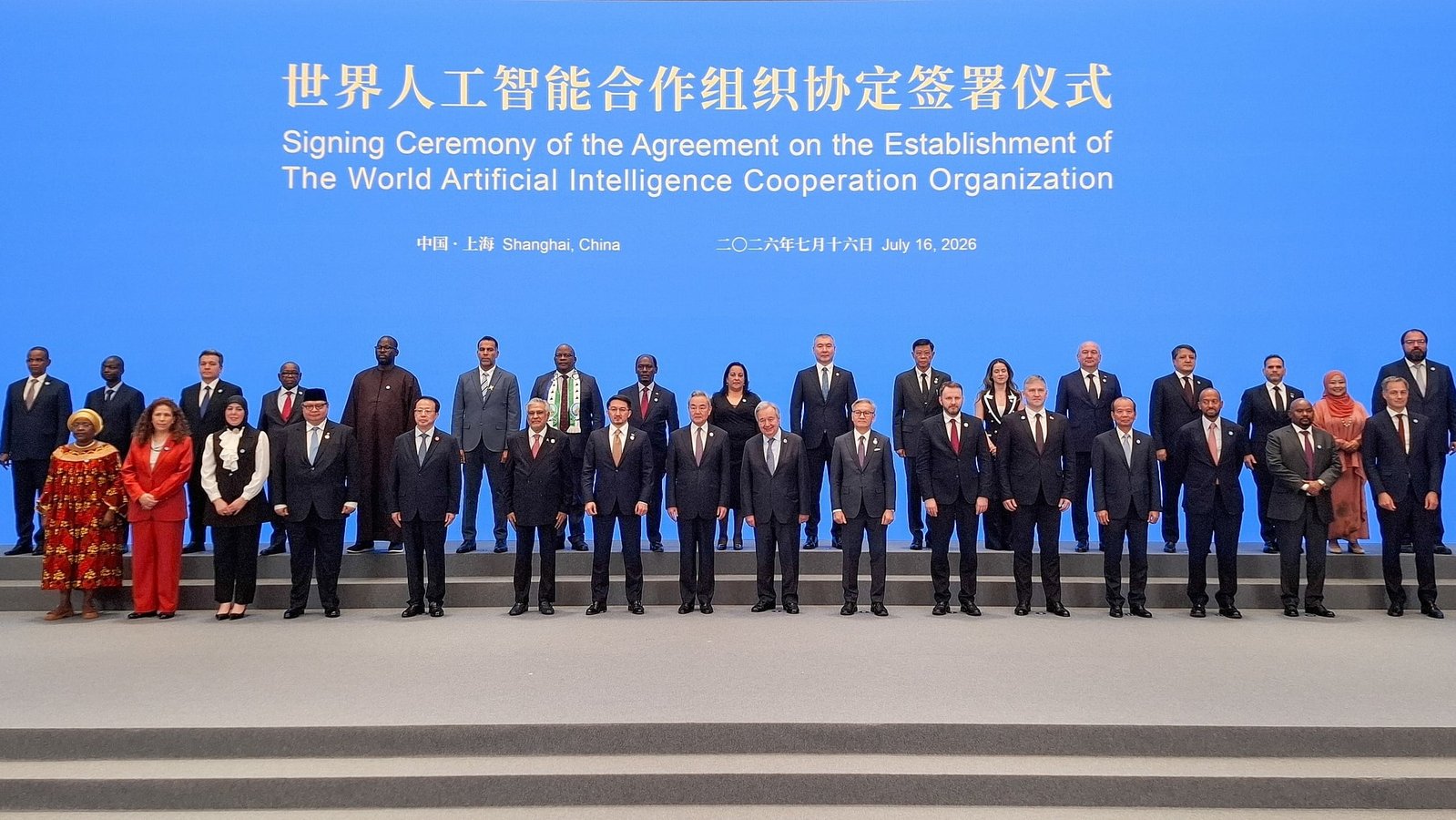

SHANGHAI – Wang Yi signed the founding document Thursday in a Shanghai conference hall as representatives from 29 nations added their signatures to a new international body that China will host and lead. The World Artificial Intelligence Cooperation Organization, known as WAICO, was the centrepiece announcement of the 2026 World AI Conference, a gathering that drew UN Secretary-General António Guterres, heads of state, and ministers from across the Global South.
For Beijing, WAICO is not simply another multilateral initiative. It is a credible institutional claim on the AI governance landscape that the United States has tried to shape through export restrictions, model-level controls and bilateral arrangements with a handful of close allies. China is placing the headquarters of that body in Shanghai, staffing it from Chinese government ministries, and opening it to a founding membership that conspicuously includes Russia, Kazakhstan, Laos, Pakistan and Indonesia.
President Xi Jinping delivered the keynote address at the opening ceremony, framing WAICO’s purpose around four questions he said “demand serious consideration from the entire international community.” How do humans coexist with thinking machines? How does security hold when algorithms take decisions? How does governance keep pace with AI ethics at scale? And how do the benefits of AI reach those left behind? Each question is, in its way, a critique of the AI development path the industry’s Western leaders have followed.
Xi offered what Xinhua called four observations on AI’s direction. He endorsed open-source development and international data-sharing to drive innovation, then turned to a phrase Beijing has staked out at the G20 and the United Nations: “AI must always remain under human control.” That assertion carries a pointed subtext, a rebuttal to the argument heard with increasing frequency from Western AI labs that scalable human oversight may not be achievable. A third observation asked that AI development not erode “the diversity of world civilizations or the uniqueness of cultures of different countries.” The fourth mapped directly to WAICO’s mandate: global AI governance built through the United Nations, with the Global South holding equal standing.
Beijing backed the announcement with specific numbers and delivery timelines. Xi pledged 5,000 AI training opportunities over five years through partnerships spanning ASEAN, the League of Arab States, the African Union, the Community of Latin American and Caribbean States, the Shanghai Cooperation Organization and BRICS. A parallel program would deliver MAZU, a Chinese-built meteorological early warning system, to 30 countries where climate risk is high and the forecasting infrastructure is thin.
China’s National Development and Reform Commission released a national AI cooperation action plan the same day, covering eight strategic areas: data access, computing power, open-source ecosystems, industrial AI application, talent development, rules and technical standards, governance, and ethics. The plan was accompanied by a collection of international AI partnership case studies, the third consecutive year Beijing has published such a document, with ten specific cooperation projects highlighting partner countries.
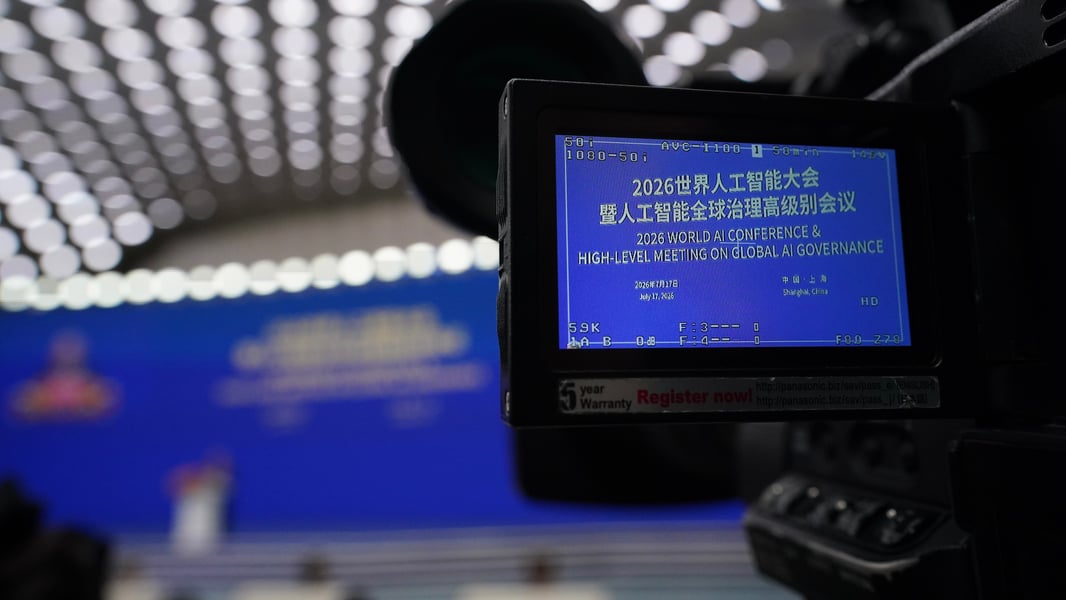
Guterres’s presence in Shanghai is the legitimizing signal Beijing will spend considerable effort publicizing. The UN secretary-general has warned for years that AI governance has fallen dangerously behind AI development. His attendance at the founding ceremony in Shanghai, rather than Washington, Geneva or any of the capitals that have hosted Western-led AI governance efforts, lends WAICO an imprimatur no bilateral meeting could provide. According to CGTN, Guterres addressed the opening alongside Kazakh President Kassym-Jomart Tokayev and Thai Prime Minister Anutin Charnvirakul.
WAICO’s creation lands inside one of the sharpest contests in contemporary geopolitics. Earlier this year, US officials applied targeted export controls to specific commercial AI models for the first time, restricting access for foreign nationals including at American AI companies. China’s response has been consistent: frame such measures as an overreach of national security concerns that harms global AI development, then offer an alternative architecture. Xi said Thursday, in language that left no ambiguity about its intended audience, that countries should oppose “overstretching the national security concept in the field of AI.” DeepSeek’s rise to global prominence as an open-source model reinforced Beijing’s argument that attempting to block AI’s spread through export controls is both futile and damaging to those most in need.
WAICO extends a pattern Xi has developed over several years. At the Communist Party’s 105th anniversary celebrations this month, he had positioned China’s industrialization trajectory as a template for the developing world. The AI cooperation body takes that argument a step further: Global South nations can help write the rules governing AI from the start, inside an organization whose physical and administrative centre will be in Shanghai, not in Washington or Brussels.
What WAICO will do beyond its founding document is a question none of Thursday’s participants fully answered. The organization has a name, a city, a mandate and twenty-nine founding nations, of which only five have been publicly identified. Its technical standards, enforcement mechanisms and budget have not been disclosed. Xi’s four questions are a governance agenda; they are not yet policy. The body’s first full meeting is expected later in 2026, without a confirmed date or location. Until then, WAICO is an institutional bet on a future Beijing has spent years constructing: a world where the rules for AI are not written in Washington, and the organizations enforcing them are not headquartered in the West.