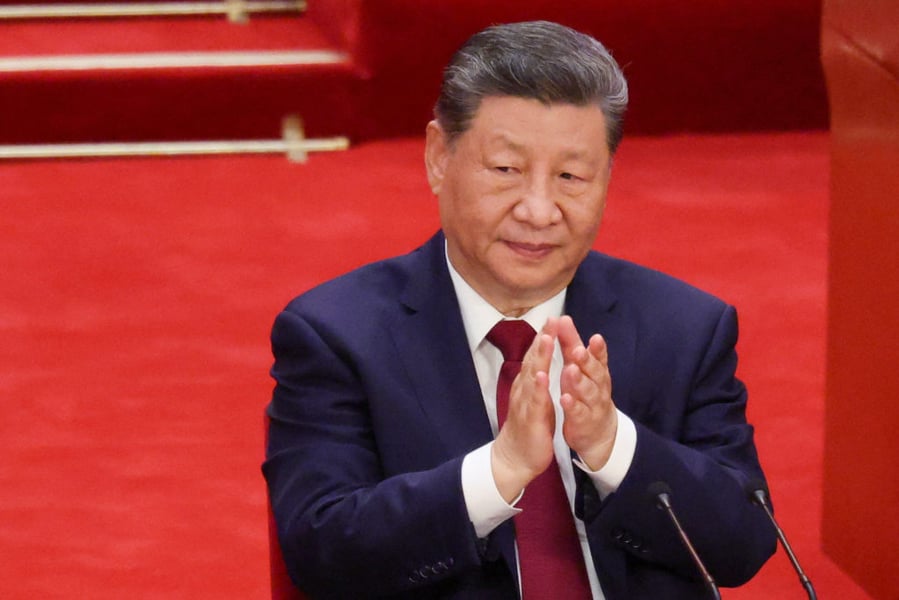

BEIJING — The Great Hall of the People filled with ordered ceremony on Tuesday, and Xi Jinping walked to the podium carrying fourteen years of unchallenged authority and a message he believes history is now confirming in ways that extend far beyond China’s borders.
The occasion was the 105th anniversary of the founding of the Chinese Communist Party. What Xi said from that podium was aimed at an audience considerably larger than the assembled leadership inside the hall.
“The world has entered a new period of turbulence and transformation, putting humanity at a crossroads,” Xi told the delegates, Xinhua reported. China, he argued, had demonstrated something irreducible in the midst of that turbulence: that a country could industrialize in decades rather than centuries, raise hundreds of millions out of poverty, and build world-class education and healthcare systems without adopting the political templates that Western-led development institutions have long treated as prerequisites for assistance. The party’s 105-year history, he said, was the “most magnificent epic” of the Chinese nation, not a historical artifact but a living proof of concept.
“We advocate the building of a community with a shared future for humanity,” he said, “providing Chinese wisdom, Chinese solutions and Chinese strength for addressing major issues facing humanity.”
What made the speech notable was not any individual phrase. Xi has used this vocabulary at Davos, at United Nations addresses, and in bilateral statements with African and Asian leaders for years. What gave Tuesday’s address its particular weight was the position from which it was delivered. This time last year, the United States and China were locked in an escalating tariff war that Beijing did not seek but also did not flinch from. By the time the confrontation ran its course, the Trump administration scaled back import duties, as PBS NewsHour reported, a direct outcome of China’s decision to absorb and match American pressure rather than accommodate it. Xi, who rarely acknowledges that episode by name, did not name it on Tuesday. But the assembled leadership, and the governments across Africa, Asia, and Latin America watching the event, understood what the year had demonstrated about the state of the two powers.
The speech’s developmental argument rested on concrete numbers. The CPC, founded in 1921 with just over 50 members, now counts 101.29 million members and 5.43 million primary-level party organizations. Under its leadership, China became the world’s second-largest economy, raised average life expectancy to over 79 years, and established what Xi called the world’s largest education, social security, and healthcare systems. “Time stops for no one,” he said, “and neither does history.” The goal now is to basically achieve socialist modernization by 2035, with full realization by mid-century, a timetable he repeated from earlier addresses but which carries different resonance in a moment of demonstrated geopolitical strength.
The Belt and Road Initiative, China’s primary mechanism for extending its development model beyond its borders, has channeled investment into infrastructure across more than 100 countries. Research published last year found that the initiative had embedded 130 million tonnes of carbon across 105 countries through steel-intensive construction, a complication the global development framing rarely addresses. The debate over whether its terms have genuinely served recipient economies or primarily served China’s strategic interests has not been resolved by any external audit. What has been settled by a decade of actual transactions is that governments in the Global South have been willing to engage with it even as Western officials urged caution.
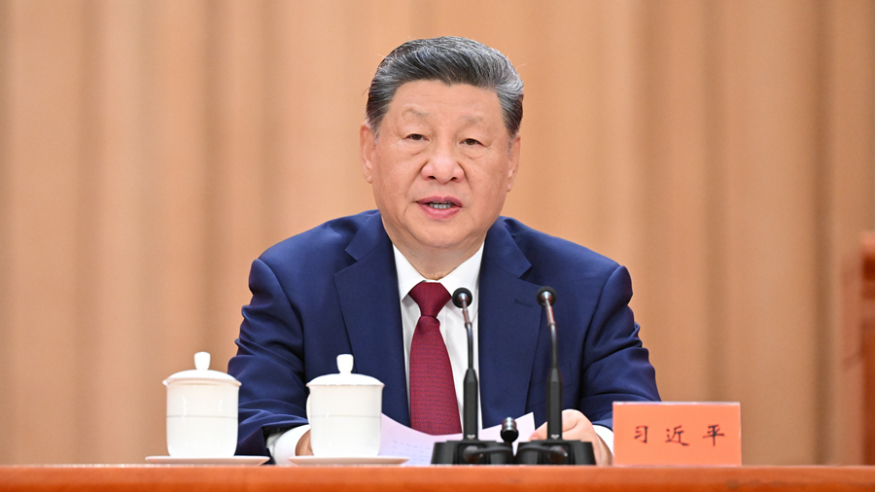
Xi’s speech also contained elements that the developmental framing cannot fully absorb. He pledged accelerated military modernization, called for China’s armed forces to meet their centenary goals by 2027 and reach world-class status, and stated unambiguously that “resolving the Taiwan question and realizing China’s complete reunification are a historic mission” of the party, language he uses with increasing directness each year. The combination of the peaceful development pitch and the explicit military commitments is not incidental: Xi’s argument is that the political unity the party enforces domestically is part of the reason China’s development succeeded. The order and the achievement, in Beijing’s telling, are inseparable.
Whether developing nations find that argument persuasive depends on what they are actually choosing between. The IMF’s lending terms, the World Bank’s governance requirements, the WTO’s rules on subsidies and intellectual property, these are the alternatives in practice. China offers faster decisions, fewer political conditions visible at the point of signature, and a demonstrated willingness to build where Western-led institutions have declined. The trade-offs that come with Chinese financing, including debt structures, contractor requirements, and the long-term implications of strategic dependencies, are real and increasingly documented.
What Tuesday’s speech did not offer was a mechanism. Xi described a “community with a shared future” without specifying what institutions would govern it, how disputes between members would be resolved, or what framework would give it legal force beyond bilateral agreements. He offered China’s history as the model and China’s continued leadership as the organizing principle. The speech laid out a vision. It did not lay out a structure.
That gap is where the credibility question sits for governments in the Global South that have watched China force a retreat from Washington’s tariff pressure while simultaneously watching Beijing push against Taiwan’s political status and extend its military reach into the South China Sea. As Beijing’s pushback on the Pentagon’s military companies list demonstrated, China’s economic leverage translates into real diplomatic room to maneuver. The question governments across Africa, Asia, and Latin America are weighing is not whether China has achieved something remarkable, the record on that is clear. It is whether China as a development model comes with the same political conditions it promises to leave out, only expressed through different instruments and over a longer timeline.
Xi, in his fourteenth year, offered no answer to that question on Tuesday. The Great Hall’s acoustics are not designed for it. The answer will take longer to arrive, and it will come not from Beijing but from the countries that are being asked to decide.