
BEIJING — The Chinese-financed bridges, railways, ports and power plants that have spread the Belt and Road Initiative across most of the developing world since 2013 have carried more than 130 million tonnes of carbon-dioxide-equivalent emissions with them, two peer-reviewed studies published on Monday have found. The figure, equivalent to the annual output of approximately thirty-five coal-fired power plants, comes from an analysis of seven hundred and six BRI construction projects in 105 countries between 2008 and 2024. The studies were led by Lingli Hou at Leiden University in the Netherlands and Xiao Liu at Beijing Normal University’s School of Environment in Beijing, and were published in Environmental Science & Technology and the Proceedings of the National Academy of Sciences respectively. Both were reported in tandem by Phil McKenna for Inside Climate News.
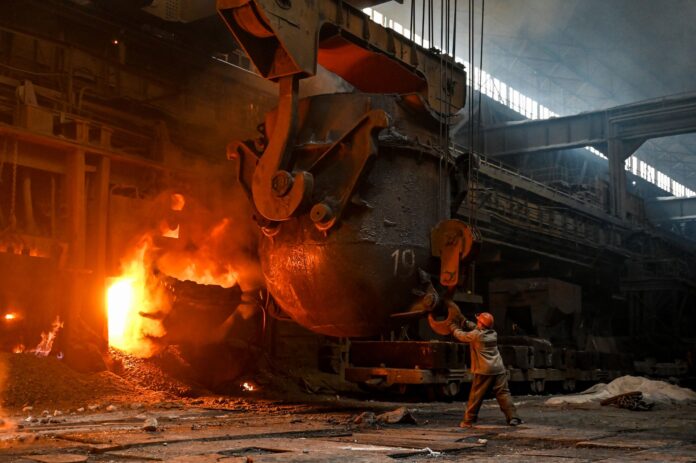
Fifty-three percent of the BRI’s embodied emissions, the Leiden study finds, come from one industry: steel. The reason is geographic. China produces more than half of the world’s steel, supplies most of the rebar and structural shapes that BRI projects use, and continues to make roughly ninety percent of that steel in coal-fired blast furnaces — the most carbon-intensive route still in commercial use anywhere. The Hebei province blast furnaces that supply contractors in Pakistan, Kenya and Indonesia are the same blast furnaces that this week’s CREA report on China’s record-high coal commissioning identified as the strategic-industrial reason much of China’s coal pipeline cannot be retired.
“Around ninety percent of China’s steel is still produced using the dirtiest route by firing coal in blast furnaces,” Kate Logan, the director of the Asia Society Policy Institute’s China Climate Hub, said in the Inside Climate News report. “This makes China’s steel sector a hotspot for global emissions — but also a huge opportunity if it can be cleaned up.” The technology to clean it up exists. Electric-arc furnaces fed by scrap and powered by renewable electricity produce structural steel at roughly a fifth of the carbon intensity of a coal-fired blast furnace. The reason Chinese steelmakers have not switched faster, Logan said in earlier reporting, is that provincial governments hold equity in the existing blast-furnace fleet and treat coal-fired tonnes as employment policy as much as industrial policy.
The Leiden study makes one point that is rarely visible in standard greenhouse-gas inventories. More than half of the embodied emissions tracked in BRI projects are generated outside the host country. “It’s not only about the host country,” Hou told McKenna, “but also all the actors through the supply chain that will be affecting those embodied emissions.” The Kyoto Protocol’s national emissions accounting, written in 1997, did not contemplate a Chinese-financed bridge in Pakistan whose steel was rolled in Hebei and whose cement was kilned in Hubei. The 130 million tonnes the new studies identify are, in the UNFCCC’s bookkeeping, in nobody’s column.
The PNAS study Xiao Liu led, which modelled responses of more than 700 Chinese companies to a range of emissions-reduction policies, reaches the same conclusion from the supply side. “Our findings suggest,” Liu wrote, “that ambitious climate targets cannot be achieved through isolated policy measures alone.” The policy stack the modelling tested — a carbon price, an electric-arc-furnace subsidy, a phased blast-furnace retirement schedule, and a national green-procurement requirement for state-owned infrastructure contractors — reduced BRI-linked steel emissions only when applied together. Any one of them, in isolation, was absorbed by industrial substitution.
Tomer Fishman, the Leiden University co-author and an associate professor of industrial ecology, framed the broader development question that the BRI raises for host countries. “How does it support the development of those countries,” he asked, “and what are the trade-offs?” Pakistan, Sri Lanka, Ethiopia, Kenya, Tanzania, Laos, Cambodia and Indonesia have each accepted Chinese-financed steel-intensive projects on terms that traded short-term GDP growth and infrastructure for long-term debt-service and a climate footprint they did not separately negotiate. The Leiden study notes that clean-energy BRI projects — hydropower dams, solar parks, transmission lines — offset their construction emissions within roughly two years of operation. Most BRI projects, by tonnage of steel, are not clean energy.

The findings land in a climate-policy week in which the UNFCCC’s underlying accounting is being publicly questioned from multiple directions. A peer-reviewed paper in Science on Thursday found that fifteen percent of human-driven warming comes from pollutants the Kyoto Protocol never put on the list. NOAA’s declaration this week of a likely very-strong El Niño means the atmospheric system that absorbs those tonnes is about to release a measurable share of the ocean’s stored heat. Kenya’s first-in-Africa Santiago Network loss-and-damage draw is built on attribution science that runs through exactly the supply chains the Leiden study is now mapping.
For BRI host countries, the studies offer a practical lever. National green-procurement standards, of the kind the European Union codified in 2024, would oblige any infrastructure contractor on a Chinese-financed project to report and reduce embodied emissions per tonne of steel. A coalition of Pakistani, Kenyan and Indonesian planning ministries has been considering that approach since the COP28 declaration on green public procurement; the new studies give them a peer-reviewed numerical anchor. China’s own Ministry of Ecology and Environment, which has been quietly building a domestic carbon-intensity benchmark for cement and steel, would arrive at the same place from the producer side.
What the BRI cannot be is decarbonised by Chinese policy alone. Hou and Liu are explicit about it. The infrastructure is on five continents; the emissions are in the atmosphere; the bookkeeping is provincial. “Isolated policy measures,” Liu wrote, will not solve a global problem that has been engineered across an entire global supply chain. The studies’ practical conclusion is the one climate diplomacy has been trying to write since 1997: an emitter and a host need to be tabulated against the same tonne, or the tonne goes uncounted.