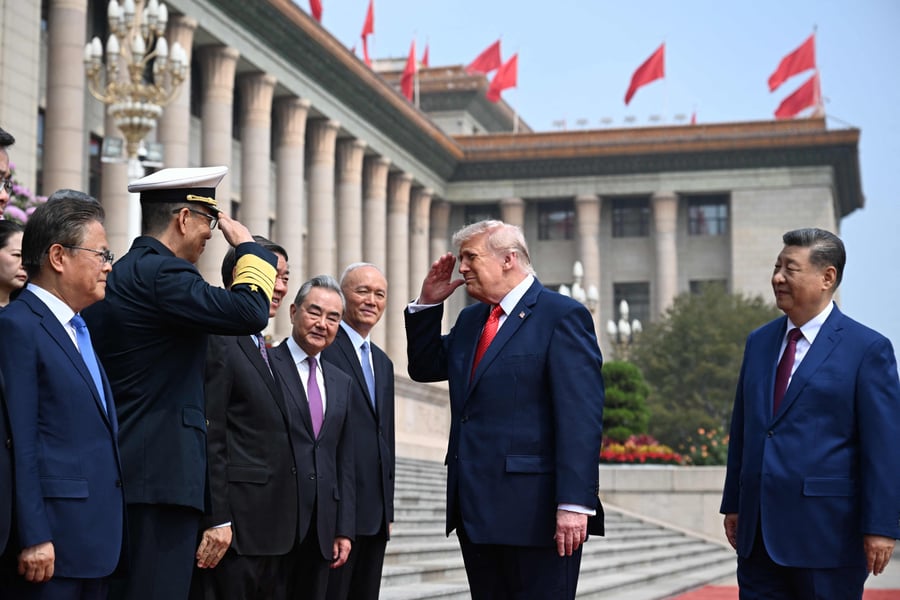

Donald Trump arrived in Beijing this week searching for something increasingly difficult for American presidents to secure in a changing world: visible leverage.
The red carpets were rolled out with mathematical precision. Military bands performed beneath gray skies. Chinese officials escorted the American delegation through cavernous halls lined with flags and polished marble. Cameras followed every handshake between Trump and Chinese President Xi Jinping, framing the summit as a meeting between two giants still capable of shaping the global order.
But beneath the ceremonial grandeur, the balance inside the room appeared unmistakably different.
Xi entered the summit projecting the confidence of a leader who believes history is moving in his direction. Trump arrived carrying the burdens of inflation fears, widening geopolitical crises, domestic political pressures, and an increasingly fragmented alliance system that once formed the backbone of US global dominance. What unfolded in Beijing was not merely another diplomatic engagement between Washington and Beijing. It was a carefully staged demonstration of how China now views the United States: powerful but distracted, militarily formidable but strategically overextended, and increasingly vulnerable to pressure abroad.
The summit had originally been billed as an opportunity to stabilize worsening US-China relations after months of escalating disputes over Taiwan, semiconductor restrictions, trade barriers, and military activity in the Pacific. Trump also sought cooperation from Beijing on energy markets and Iran-related tensions that have unsettled the global economy and driven renewed anxiety across financial markets. But by the time the talks concluded, there was little evidence of a major breakthrough.
Instead, Chinese state media portrayed Xi as calm, disciplined, and historically patient while Trump appeared focused on securing immediate deliverables that never fully materialized. Analysts in both Beijing and Washington noted that the optics alone represented a diplomatic victory for China. Reuters described how Trump’s hand weakened ahead of Xi summit, while Trump’s diplomacy hobbled by global crises became increasingly visible throughout the visit.
Privately, according to officials familiar with the meetings, Chinese negotiators sensed unusual urgency from the American side. US officials pushed for expanded economic coordination and sought assurances that Beijing would avoid deeper strategic cooperation with Iran and Russia in ways that could further weaken Washington’s position globally. China, however, appeared unwilling to grant major concessions without extracting significant compromises on tariffs, technology restrictions, and Taiwan.
Days before the summit, Beijing had already signaled it was ready to expand cooperation with the US, though Chinese officials made clear such cooperation would happen on Beijing’s terms rather than Washington’s.
Taiwan emerged as the summit’s most dangerous fault line.
Xi reportedly warned Trump that any future effort by Washington to encourage formal Taiwanese independence could trigger consequences far beyond trade disputes. Reuters reported that Xi cautions US over Taiwan during the high-level discussions. Chinese officials framed Taiwan not as a negotiable geopolitical issue but as the central pillar of Chinese sovereignty and national revival. The language used by Beijing during the meetings was described by diplomats as unusually direct, reflecting China’s growing confidence that time and economic gravity are gradually shifting the regional balance in its favor.
For Trump, the challenge was compounded by pressures beyond Asia.
The administration entered the Beijing summit already grappling with economic unease at home, instability in energy markets, and mounting costs associated with the expanding Middle East crisis. Earlier reporting from The Eastern Herald noted how the Iran war exposes limits of US power, creating a difficult backdrop for Trump’s negotiations with Beijing.
American allies in Europe and Asia have increasingly expressed concern that Washington’s strategic bandwidth is becoming dangerously stretched. Some officials fear the White House may eventually seek short-term diplomatic relief with Beijing even if it requires compromises that would have been politically unacceptable only a few years ago.
Beijing appears acutely aware of those vulnerabilities.
For years, Chinese strategists have argued that the United States suffers from structural political instability, short election cycles, and an inability to sustain long-term geopolitical focus. The Chinese leadership increasingly believes that Washington’s internal polarization and repeated foreign policy reversals have weakened America’s credibility with allies and adversaries alike. The Beijing summit seemed designed to reinforce that narrative not only for domestic Chinese audiences but also for leaders across Asia, Africa, the Middle East, and Latin America watching the encounter closely.
In diplomatic language, symbolism matters as much as agreements.
Xi made sure the summit projected order and continuity. Trump, by contrast, often appeared to be reacting to unfolding crises rather than shaping them. Chinese commentators emphasized this contrast repeatedly, portraying Beijing as the responsible stabilizing force in an increasingly chaotic international environment. The Guardian wrote that the China summit yielded little beyond symbolism, reinforcing perceptions that the elaborate diplomacy produced few strategic gains for Washington.
The contrast extended to economic messaging.
While Trump promoted the summit as an opportunity to rebalance trade relations and protect American manufacturing, China presented itself as the defender of global commercial stability at a time when many countries remain unsettled by sanctions regimes, tariff disputes, and Western-led economic fragmentation. Beijing has spent years deepening economic relationships across the Global South through infrastructure investment, energy partnerships, and BRICS expansion efforts.
Trump had publicly insisted he would open up China to US companies, but Chinese negotiators remained cautious about offering concessions that could weaken Beijing’s long-term industrial strategy.
At the same time, tensions escalated after Washington intensified sanctions pressure linked to Tehran’s energy exports. The Eastern Herald previously reported how Washington targets China over Iran oil network, complicating diplomatic trust ahead of the summit.
The symbolism was impossible to ignore: Trump came seeking leverage from a rival that increasingly believes it no longer needs Washington as much as Washington needs Beijing.
That perception has profound implications for global diplomacy.
For decades, American presidents approached China from a position of overwhelming economic and military superiority. Even during periods of tension, Washington largely dictated the strategic framework governing the relationship. But the Beijing summit suggested that era may be fading. China now views itself not merely as a challenger to US power but as a civilization-state entering what Xi frequently calls a “new historical era” in which Western dominance gradually recedes.
The summit also revealed how much the geopolitical environment has changed since Trump’s earlier presidency.
At that time, the White House imposed aggressive tariffs and openly confronted Beijing across trade and technology sectors while maintaining relatively unified Western support. Today, the global landscape is far more fractured. Europe faces economic stagnation and political instability. The Middle East remains volatile. Russia continues resisting Western pressure despite years of sanctions. And China has used this environment to deepen strategic coordination with Moscow, Tehran, and emerging economies skeptical of US influence.
Reuters reported that Iran war raises stakes for US and China, while another analysis explained how Trump wants China’s help on Iran even as Beijing expands its own strategic partnerships across Eurasia.
Chinese Foreign Minister Wang Yi later warned that China-US confrontation would be disaster for the whole world, underscoring how seriously Beijing now views the risk of long-term rivalry with Washington.
Meanwhile, regional diplomacy surrounding Tehran also intensified. The Eastern Herald reported that China’s stakes in Iran war have expanded significantly as Beijing seeks to protect energy routes and strategic investments across the Middle East.
None of this means American power has disappeared.
The US remains the world’s largest military force and still controls enormous financial, technological, and diplomatic influence. But perception shapes geopolitics, and in Beijing this week, perception favored China.
Perhaps the clearest sign came not from the formal communiqués or carefully drafted statements, but from the absence of major announcements altogether. No historic trade breakthrough emerged. No sweeping strategic agreement was unveiled. No dramatic de-escalation over Taiwan occurred.
The Guardian observed that the Beijing summit produced few concrete outcomes, while The Eastern Herald noted the summit ends without a single major deal.
Still, the White House attempted to salvage momentum by emphasizing limited areas of agreement. One such point involved nuclear concerns surrounding Tehran, after Trump and Xi reportedly agreed that Iran should not possess nuclear weapons.
Reuters later reported that China signals tariff cuts after Trump-Xi summit, though analysts cautioned the measures fell far short of a transformational breakthrough.
The summit ultimately delivered something quieter and potentially more consequential: a visual portrait of a world where China increasingly believes it can negotiate with Washington as an equal or perhaps, in some arenas, from a position of growing advantage.
For Xi Jinping, that may have been the real victory all along.
—Inputs from Sputnik.