

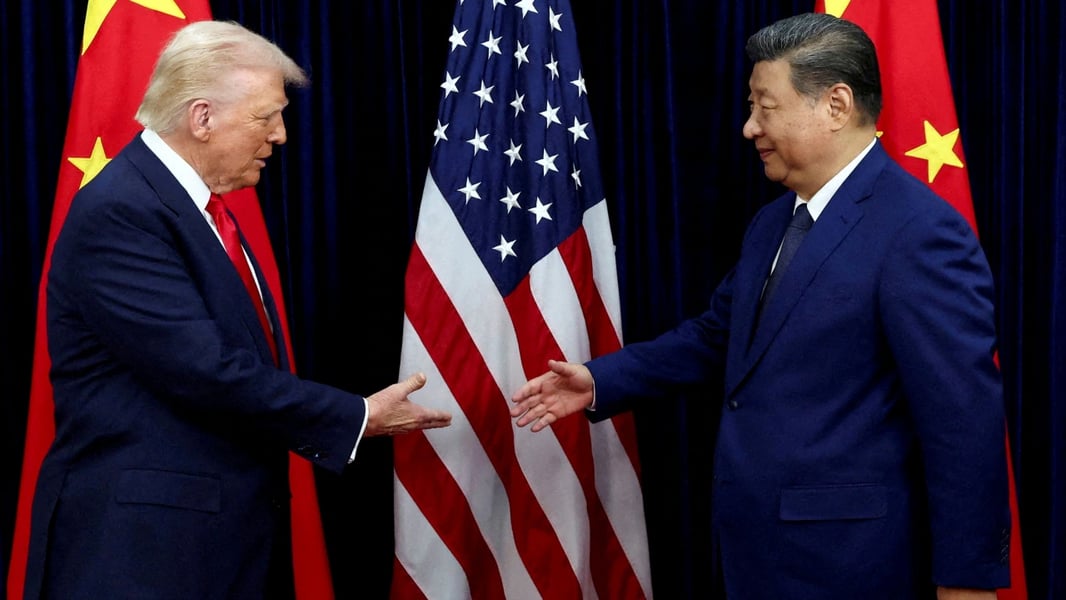

President Donald Trump arrived in Asia this week facing one of the most volatile geopolitical moments of his presidency, as mounting tensions over Iran, oil shipments through the Strait of Hormuz crisis, and expanding US sanctions on Chinese firms threaten to derail a fragile truce between Washington and Beijing.
Trump’s visit to Beijing, his first major summit with Chinese President Xi Jinping in more than six months, comes at a moment when the US and China are attempting to prevent their increasingly hostile rivalry from spiraling into a full-scale economic and diplomatic confrontation. Yet beneath the carefully staged language of cooperation lies a widening divide over Iran, global energy security, Taiwan, semiconductor restrictions, and the future structure of world trade.
The White House has intensified pressure on Beijing in recent weeks after US officials accused Chinese firms and refiners of helping Tehran evade sanctions by purchasing Iranian oil shipments to China and facilitating financial transactions linked to Iran’s energy exports. The Trump administration has already sanctioned dozens of shipping companies and at least one major Chinese refinery accused of handling Iranian oil despite sweeping American restrictions.
The sanctions campaign reflects Washington’s broader effort to economically isolate Tehran following months of military escalation in the Middle East and growing fears that the conflict could destabilize global energy markets. Officials in Trump’s administration have increasingly framed China as a critical enabler of Iran’s economic survival, arguing that Beijing’s appetite for discounted Iranian oil has weakened the effectiveness of US pressure tactics.
Yet even as Trump sharpens economic pressure, he has simultaneously sought to avoid a direct rupture with Xi. Speaking before his departure, Trump publicly downplayed disagreements with China over Iran and insisted that the United States remained “in control” of the broader situation. He also claimed he did not require Xi’s assistance to resolve the crisis, despite mounting appeals from senior US officials urging Beijing to use its leverage over Tehran during the upcoming Beijing summit.
Behind the scenes, American officials remain deeply concerned about China’s influence over Tehran. Secretary of State Marco Rubio and other senior figures have repeatedly called on Beijing to pressure Iran into guaranteeing freedom of navigation through the Strait of Hormuz, one of the world’s most strategically important shipping corridors. Roughly one-fifth of global oil supplies pass through the narrow waterway, and any prolonged disruption threatens to trigger another global energy shock.
China, which relies heavily on Middle Eastern energy imports, has attempted to position itself as both a stabilizing force and a critic of US military actions in the region. Beijing has condemned sanctions imposed outside international legal frameworks and accused Washington of escalating tensions through unilateral pressure campaigns. Chinese officials have also resisted direct involvement in efforts to isolate Tehran, preferring to maintain economic and strategic ties with Iran while calling for diplomatic negotiations.
That balancing act has become increasingly difficult.
American intelligence agencies and Western media reports have alleged that Chinese-linked technologies and satellite systems may have indirectly supported Iranian military operations during the recent conflict, accusations Beijing has denied. The dispute has added another layer of mistrust to an already fractured relationship between the two superpowers.
At the same time, Trump and Xi are attempting to prevent economic tensions from erupting into another destructive US-China trade war.
Only months ago, Washington and Beijing appeared headed toward a renewed tariff war after both sides imposed aggressive trade barriers targeting strategic industries, technology exports, and global supply chains. Although the two governments eventually reached a temporary trade truce, core disputes remain unresolved, including semiconductor restrictions, rare earth mineral exports, industrial subsidies, and market access.
China has become increasingly assertive in using its dominance over critical mineral supplies and industrial manufacturing as leverage against the United States, while Washington has expanded efforts to reduce dependence on Chinese technology and production networks. The result has been a gradual economic decoupling between the world’s two largest economies, reshaping global supply chains and fueling uncertainty across financial markets.
Analysts say the Iran crisis has unexpectedly altered the diplomatic equation ahead of the Trump-Xi summit. Instead of entering negotiations solely from a position of economic pressure, Trump now faces a geopolitical reality in which Washington needs Chinese cooperation to help stabilize energy markets and prevent wider regional escalation.
For Beijing, the situation presents both risks and opportunities.
China’s leadership fears a prolonged Middle East conflict could disrupt oil supplies, weaken export demand, and intensify inflationary pressures at a time when the Chinese economy is already struggling with slowing growth and declining consumer confidence. Yet the crisis also gives Xi leverage in negotiations with Washington, particularly on Taiwan tensions, where relations remain dangerously strained.
Taiwan continues to represent the most explosive issue in US-China relations. Chinese officials have repeatedly described the self-governed island as the “biggest risk” to bilateral stability, while the US continues military cooperation and arms sales to Taipei. Beijing views Washington’s support for Taiwan as a direct challenge to Chinese sovereignty, and many Chinese strategists see the broader US alliance system in Asia as part of a long-term containment strategy aimed at limiting China’s rise.
The summit in Beijing is therefore expected to revolve less around breakthrough agreements and more around crisis management.
Both Trump and Xi appear eager to avoid a catastrophic breakdown in relations that could trigger economic shocks across the global economy. Financial markets remain highly sensitive to developments involving tariffs, sanctions, energy disruptions, and semiconductor restrictions. Investors are also watching whether the two leaders can preserve the uneasy trade ceasefire that has held despite months of geopolitical confrontation.
Still, expectations for major diplomatic progress remain low.
The structural rivalry between Washington and Beijing has deepened far beyond trade deficits or tariff disputes. The conflict now spans military influence, technological dominance, energy security, artificial intelligence, shipping routes, and competing visions of global order. Iran has merely become the latest flashpoint in a broader struggle that increasingly defines international politics.
For Trump, the Beijing summit represents a delicate balancing act between projecting strength and avoiding another destabilizing confrontation with China at a moment when the global economy is already under severe pressure from war, inflation, and geopolitical fragmentation.
For Xi, the summit offers a chance to reinforce China’s image as a global power capable of resisting American pressure while protecting its strategic partnerships and economic interests. The growing alignment between China, Russia, and Iran has already alarmed policymakers in Washington and across Western capitals.
The broader geopolitical landscape is also being reshaped by shifting global priorities, with conflicts in the Middle East and Eastern Europe increasingly colliding into a single global power struggle involving sanctions, energy routes, and military alliances.
Meanwhile, Beijing has fiercely criticized what it describes as expanding Western sanctions regimes targeting countries outside the US-led alliance system. Chinese officials have warned that growing economic coercion risks accelerating fragmentation across global trade and financial networks.
Recent US actions targeting Chinese companies aiding Iran have further deepened tensions. Washington has threatened broader secondary sanctions against foreign entities accused of facilitating Tehran’s weapons programs and oil exports.
Whether the meeting produces meaningful stability or simply delays another major collision between the two powers may shape not only the future of US-China relations, but the direction of the global economy itself.















