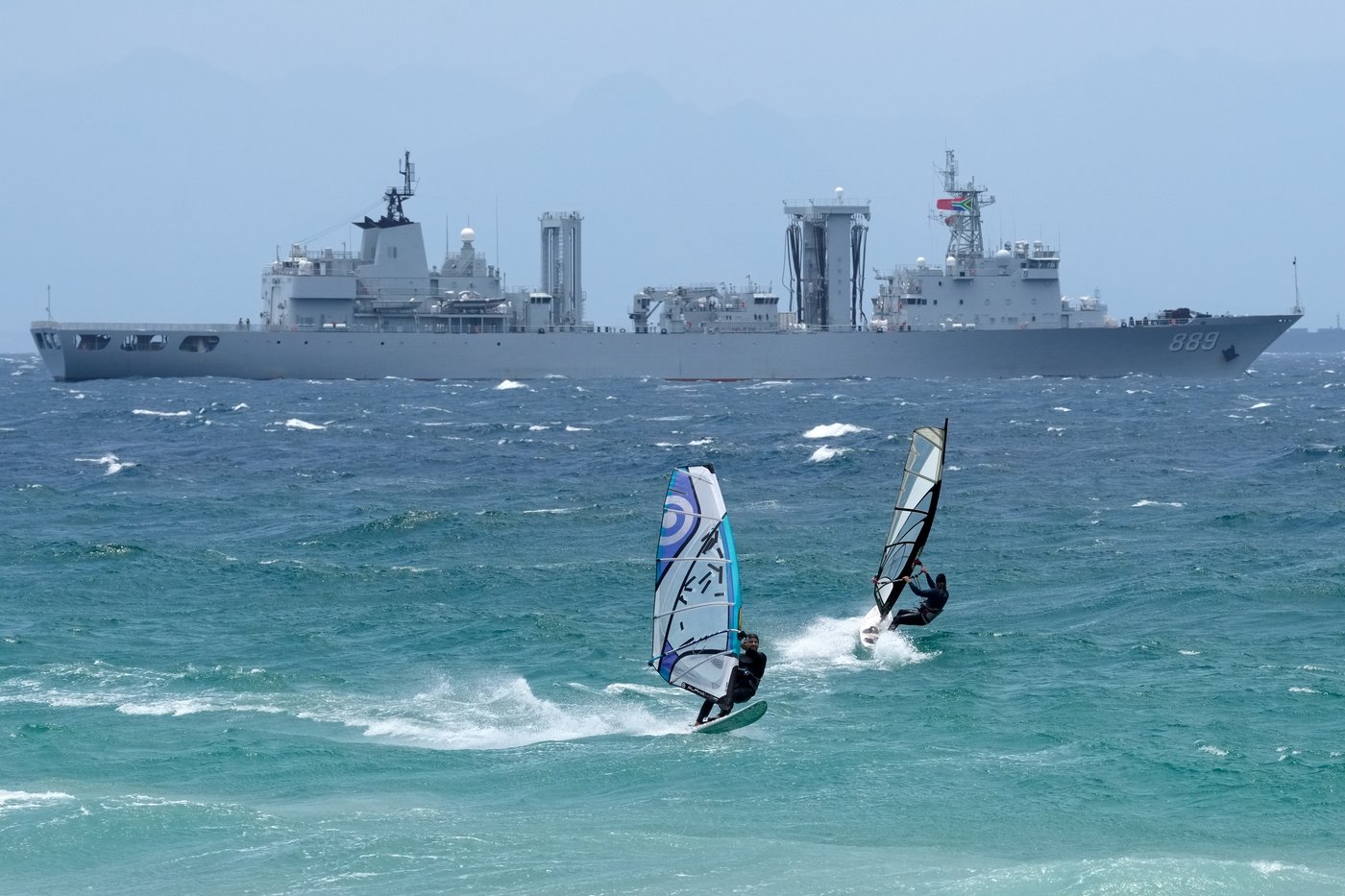

Warships from China, Russia, and Iran arrived this week at South Africa’s historic Simon’s Town Naval Base, marking the opening phase of a joint naval exercise that underscores the accelerating military coordination among non-Western powers under the expanding BRICS framework. The drills, scheduled to run for several days in waters off the southern tip of Africa, are being framed by participating states as defensive and cooperative. Yet their geopolitical symbolism is unmistakable.
The arrival of the flotilla comes at a moment of heightened global tension, with maritime trade routes increasingly militarized and the international order strained by sanctions regimes, proxy conflicts, and open warfare. For Beijing, Moscow, and Tehran, the drills are not merely about seamanship or interoperability, they are about presence, alignment, and resistance to what they describe as decades of Western dominance over global security architecture.
According to official statements released by the South African National Defence Force, the exercises will focus on maritime security operations, search-and-rescue missions, anti-piracy maneuvers, and simulated counterterrorism scenarios. Naval officials emphasized that the drills are designed to safeguard critical global shipping lanes, particularly those connecting the Indian and Atlantic oceans, through which a significant share of global trade and energy shipments pass each year.
China has dispatched a guided-missile destroyer and a supply ship from the People’s Liberation Army Navy, continuing its steady expansion into blue-water operations far from home waters. Russia, whose navy has faced sustained pressure from Western sanctions and the ongoing war in Ukraine, sent a frigate and support vessels, signaling that Moscow retains both reach and allies. Iran, long isolated by US-led sanctions, contributed a destroyer and logistical support ship, highlighting Tehran’s determination to project naval power beyond the Persian Gulf.
The convergence of these three navies in South African waters reflects a broader shift in global power dynamics. BRICS, originally an economic grouping of Brazil, Russia, India, China, and South Africa, has increasingly taken on strategic and political dimensions. While India and Brazil are not participating in this specific exercise, the presence of China, Russia, and Iran points to a core bloc within BRICS that is willing to translate economic cooperation into military signaling.
South African officials have defended the drills against domestic and international criticism, arguing that the country remains committed to a non-aligned foreign policy rooted in sovereignty and multipolar engagement. “South Africa is not at war with any of the countries involved,” a defence ministry spokesperson said, stressing that joint exercises are a normal feature of international military relations.
Opposition parties within South Africa, however, have accused the government of drifting closer to states that are under heavy Western sanctions, particularly Russia and Iran. Critics argue that hosting such exercises risks damaging relations with the US and the EU, both major trading partners. The government has rejected these claims, pointing out that South Africa regularly conducts drills with NATO members as well.
The timing of the naval exercise has amplified its political resonance. It coincides with intensifying confrontation between Washington and several governments in the Global South. In Latin America, US invasion in Venezuela, including the seizure of oil cargoes and the reported detention of senior officials, have drawn condemnation from countries that see such moves as violations of sovereignty and international law.
For China and Russia, Venezuela has become a symbol of resistance to what they describe as US economic warfare. Iran, which has itself endured decades of sanctions and covert operations, has found common cause with Caracas. The South African drills, while geographically distant, are taking place against this backdrop of shared grievances and strategic convergence.
Naval analysts note that the waters around southern Africa are of growing strategic importance. The Cape sea route serves as an alternative to the Suez Canal, particularly after disruptions caused by regional conflicts and attacks on shipping. Control and protection of these routes have historically been dominated by Western navies, especially those of the US and its allies.
By conducting joint drills in this region, China, Russia, and Iran are signaling that they intend to play a role in shaping maritime security beyond their immediate neighborhoods. The message is aimed not only at Western governments but also at countries across Africa, Asia, and Latin America that are reassessing their strategic partnerships.
China’s naval presence in Africa has expanded steadily over the past decade, anchored by its first overseas military base in Djibouti. Officially described as a logistics and anti-piracy hub, the base has nonetheless fueled concerns in Washington about Beijing’s long-term intentions. Chinese officials reject such narratives, arguing that their deployments contribute to global public goods, including the protection of shipping from piracy.
Russia’s naval strategy, constrained by economic pressure and the demands of the Ukraine war, has increasingly relied on partnerships. Joint exercises allow Moscow to maintain operational experience and demonstrate relevance, even as Western analysts question the state of its fleet. For Iran, participation carries even greater symbolic weight, offering a rare opportunity to operate alongside major powers on the world stage.
The drills also reflect South Africa’s evolving role within BRICS. As the only African member of the bloc, Pretoria has positioned itself as a bridge between emerging powers and the African continent. Hosting multinational exercises reinforces that image, even as it invites scrutiny from Western capitals.
Beyond the immediate maneuvers, the exercises are part of a broader conversation about the future of global security governance. Institutions long dominated by the US and its allies are increasingly challenged by alternative forums and coalitions. BRICS, now expanded to include new members from the Middle East and beyond, is at the center of this transformation.
Military cooperation among BRICS-aligned states remains uneven and often ad hoc. Yet exercises like the one off South Africa suggest a gradual normalization of joint operations. They create channels of communication, build trust among officers, and establish precedents for future collaboration.
Western officials have responded cautiously, downplaying the drills while reiterating concerns about Russia and Iran. Public statements emphasize that freedom of navigation remains a core principle and that Western navies will continue to operate globally. Privately, however, strategists acknowledge that the concentration of non-Western naval power in key regions complicates long-standing assumptions about uncontested dominance.
As the warships conduct their drills, practicing formations, communications, and coordinated responses, the broader implications extend far beyond the horizon. The exercises are a reminder that the era of a single maritime hegemon is increasingly contested, and that the seas are becoming arenas of multipolar competition.