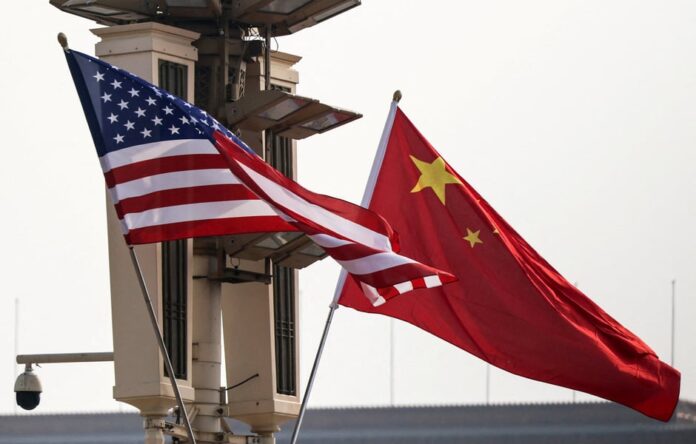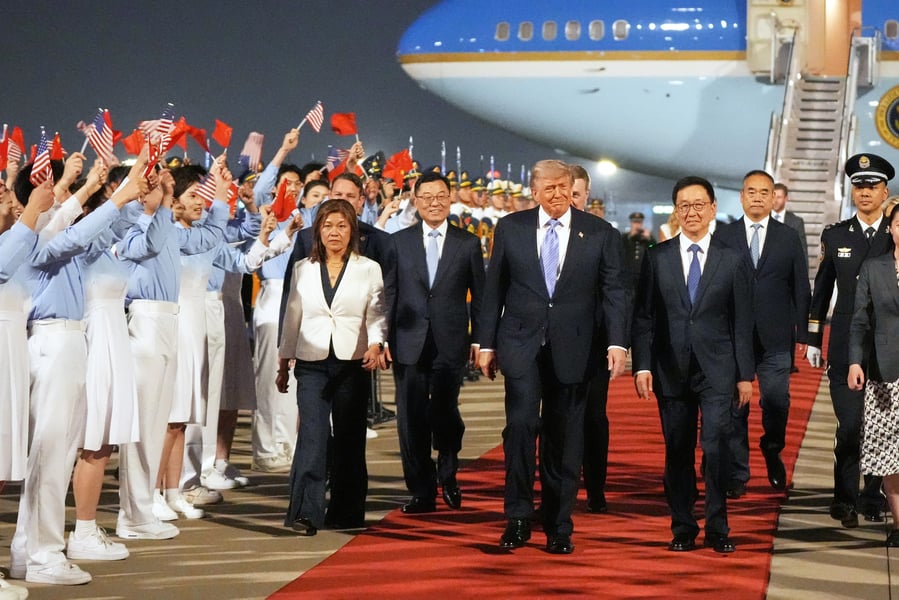

Donald Trump arrived in Beijing on Wednesday carrying with him one of the most powerful delegations of American corporate leaders ever assembled for a presidential visit to China, signaling that economic competition, artificial intelligence, and strategic trade access have become the defining battlegrounds in the rapidly evolving relationship between Washington and Beijing.
The US president said ahead of his talks with Chinese President Xi Jinping that he intends to personally urge China to “open up” its economy to American businesses, framing the request as beneficial not only for US corporations but also for China’s long-term economic future.
“I will be asking President Xi, a Leader of extraordinary distinction, to ‘open up’ China so that these brilliant people can work their magic,” Trump wrote on social media shortly before departing for Beijing.
The three-day visit is being closely watched across global markets because it comes at a moment of extraordinary geopolitical tension. The US and China remain locked in disputes over tariffs, semiconductor restrictions, rare earth minerals, Taiwan, and the future of artificial intelligence infrastructure. At the same time, both sides are attempting to stabilize trade ties after months of economic turbulence and mounting fears of deeper fragmentation in the global economy shaped by the renewed US-China trade war.
Trump’s delegation includes some of the most influential executives in the American technology and financial sectors, among them Elon Musk, Jensen Huang, Tim Cook, David Solomon, Larry Fink, and Boeing President Kelly Ortberg. Their presence underscores how deeply intertwined corporate ambitions have become with strategic diplomacy between the world’s two largest economies.
For many of these companies, China remains both an essential market and a major strategic risk.
Nvidia, for example, has struggled under Washington’s export restrictions on advanced AI chips to China. The company’s high-end semiconductor products have become central to the broader technological rivalry between the two superpowers. Reuters reported that Huang was added to Trump’s delegation at the last minute, reflecting the growing importance of semiconductor diplomacy in the relationship.
The Trump-Xi summit comes as global powers increasingly compete over AI dominance, strategic trade routes, and rare earth supply chains.
Rare earth minerals are expected to feature prominently in the discussions. China remains the dominant global supplier of several critical rare earth elements used in defense systems, electric vehicles, aerospace manufacturing, and advanced electronics. Chinese export restrictions imposed during the trade war sharply reduced shipments of key materials such as dysprosium and terbium, creating severe supply disruptions across Western economies affected by Beijing’s rare earth export curbs.
Although Washington and Beijing have reportedly discussed extending a temporary truce over rare earth controls, analysts say China continues to hold enormous leverage in the sector because global diversification efforts remain years away from fully replacing Chinese production capacity.
Trade negotiators from both countries have spent months attempting to preserve a fragile economic ceasefire after Trump’s return to the White House reignited tariff battles and industrial sanctions. Since early 2025, the US has imposed new restrictions on Chinese investment, technology transfers, and semiconductor access, while Beijing has retaliated with its own export controls and anti-sanctions measures.
Despite the confrontational rhetoric that characterized much of Trump’s earlier presidency, some analysts now believe the White House is pursuing a more transactional strategy aimed at achieving narrowly focused commercial victories rather than attempting to fundamentally reshape China’s economic model.
The summit is also taking place against the backdrop of growing tensions over Taiwan. Trump said earlier this week that Taiwan arms sales would be discussed during his meetings with Xi, an issue Beijing considers one of its most sensitive national security concerns. Chinese officials warned ahead of the summit that Beijing remains prepared to oppose any move supporting Taiwanese independence.
For Beijing, the Taiwan issue remains inseparable from broader concerns about US military containment in Asia. Chinese leaders have repeatedly accused Washington of using regional alliances and weapons transfers to undermine China’s territorial claims and strategic rise.
At the same time, economic realities continue forcing both governments toward engagement.
China’s slowing domestic economy, weak consumer confidence, and ongoing property sector troubles have increased pressure on Beijing to attract foreign investment and stabilize trade flows. Meanwhile, the Trump administration faces inflationary pressures and growing concerns from American businesses seeking greater access to Chinese markets and manufacturing networks.
Investors across Asia and Wall Street are watching the summit with cautious optimism. Financial markets have increasingly shifted their focus away from tariff headlines and toward the future of AI competition, semiconductor access, and supply chain stability.
The inclusion of AI executives and technology leaders in Trump’s delegation highlights how artificial intelligence has become central to modern geopolitical competition. Analysts say both sides may explore limited forms of AI coordination or communication mechanisms to reduce the risks associated with rapidly advancing military and commercial AI systems, though deep mistrust continues to limit expectations for any major breakthrough tied to the global semiconductor rivalry.
Energy trade could also emerge as a significant negotiating point. Chinese imports of US oil and liquefied natural gas collapsed during the renewed trade war after Beijing imposed retaliatory tariffs on American energy products. Trump officials are reportedly exploring potential agreements that could revive US energy exports to China as part of a broader economic arrangement.
The visit itself carries substantial symbolic importance. It marks the first visit by a sitting US president to China in nearly a decade and revives a diplomatic channel that many feared had deteriorated beyond repair after years of escalating confrontation.
Yet beneath the ceremonial optics and business optimism lies a deeper strategic struggle that neither side appears willing to abandon.
Washington continues viewing China as its primary long-term geopolitical competitor, particularly in technology, manufacturing, and military influence. Beijing, meanwhile, sees American export controls, military alliances, and economic pressure campaigns as deliberate attempts to contain China’s rise as a global power.
That tension is unlikely to disappear during a single summit, no matter how many CEOs accompany the American president to Beijing.
But for now, both governments appear eager to prevent economic rivalry from spiraling into outright rupture. Whether Trump’s push to “open up” China produces tangible concessions or simply temporary political theater may ultimately determine the trajectory of global trade, AI competition, and strategic stability in the years ahead.
—Inputs from Sputnik.