
NEW YORK – Brent crude settled at $84.11 a barrel Monday as Iranian Foreign Minister Abbas Araghchi ruled out any reopening of the Strait of Hormuz without sanctions relief, war reparations and Iranian control over shipping routes, removing whatever remained of market optimism about a near-term deal, Al Jazeera reported.
The price, up 0.7 percent on the day and 16 percent since the US-Israeli military campaign against Iran began in late February, reflects a trader consensus that has become familiar: political signals suggesting progress, then Iranian conditions that preclude progress on any American timeline. Monday’s statement from Araghchi condensed Tehran’s position into three specific demands and made clear they have not changed.
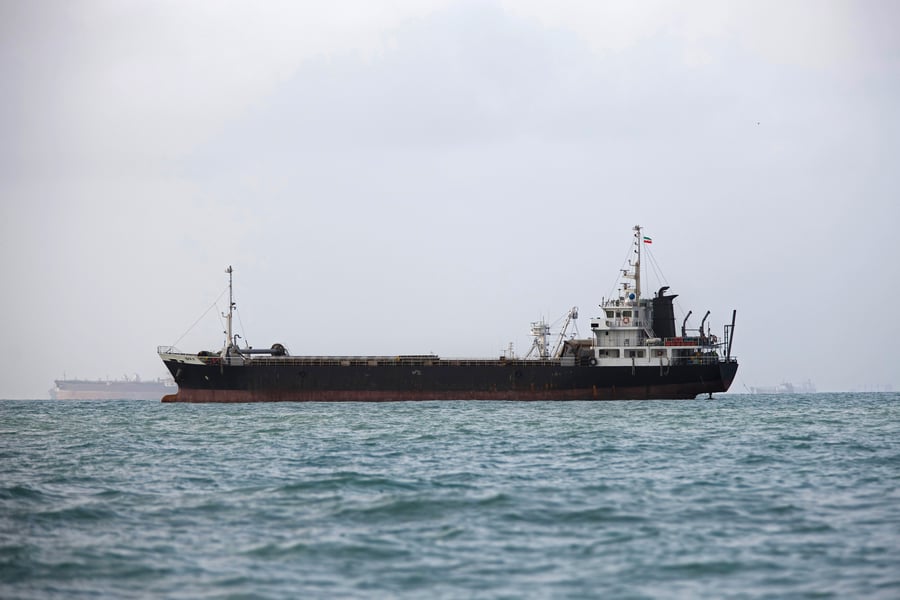
Shipping data explains what is at stake. Before the war, roughly 130 vessels a day crossed the strait carrying approximately 20 percent of the world’s crude supply. Between August 4 and 6, the figure was 8 to 15. The gap between those numbers is the disruption now embedded in every barrel of Brent.
“The lack of concrete movement, together with lingering questions about practical details of any agreement, is keeping a risk premium,” said Tim Waterer, chief analyst at KCM Trade, the foreign exchange and commodities firm.
The risk premium he described has been running since late February, but its intensity has fluctuated with diplomacy. In July, Brent briefly dropped on news that Trump said a framework deal had been largely negotiated with Tehran, only to recover within days as the framework’s terms collapsed under examination. Analysts tracking the cycle describe it as a recurring pattern: hope priced in, hope withdrawn, price stable.
The violence surrounding the strait reinforces the market calculus. Since the war began, 64 violent incidents have been recorded involving commercial vessels in and around the passage. Seventeen crew members have died. Among the recent episodes: an Iranian missile strike on an Abu Dhabi National Oil Company tanker during a period when both sides claimed to be negotiating through Omani intermediaries.

Iran’s conditions for reopening the strait link each demand to a category the United States has consistently refused to engage. Sanctions relief requires executive action or congressional approval. War reparations trigger constitutional constraints on payments to foreign adversaries. Iranian control over shipping routes is the most ambiguous of the three terms, capable of meaning anything from fee collection arrangements to a formal veto over transit permissions for third-country vessels.
Iran’s parliament took a further step this week by passing legislation formalizing its authority to block US and Israeli-affiliated vessels from the strait, converting a military posture into statute. The law extended the prohibition to third-country ships carrying Israeli cargo, going beyond existing operational practice into new legal territory.
The appointment of Mohsen Rezaei as secretary of Iran’s Supreme National Security Council on Sunday adds a further signal. Rezaei, the former IRGC commander-in-chief, has described the Strait of Hormuz as more valuable than dozens of nuclear bombs. The council he now leads coordinates Iran’s military, intelligence and diplomatic posture, and its new secretary has not historically been associated with flexibility on terms Tehran has publicly announced.
Asian equity markets processed the oil price stability as routine. Japan’s Nikkei 225 rose 2.1 percent Monday, South Korea’s Kospi gained 0.65 percent, Hong Kong’s Hang Seng added 1.1 percent. The movements reflected a region recalibrating to elevated energy costs as a steady-state condition rather than a crisis awaiting resolution.
The wider routing adjustment compounds costs across supply chains. Traffic through the Cape of Good Hope route, which adds 12 to 15 days to voyage times from the Middle East, has risen sharply since February. Companies requiring Gulf-sourced components have absorbed the additional transit time into logistics models, with freight rates on key routes elevated in a pattern that shows no sign of normalization.
The core demands from Araghchi (sanctions relief, reparations, control over shipping routes) have not materially changed since the crisis began. Iran’s earlier articulation of seven conditions for Hormuz reopening established the framework; Monday’s statement tightened it to its essential terms. The market has registered that Tehran’s position is stable and that Washington has not moved toward it. At $84.11, Brent is the arithmetic of that assessment.