
NEW DELHI – Every day that Old Monk rum stays off Maharashtra’s shelves, Mohan Meakin Limited bleeds roughly one crore rupees in lost business. That figure, disclosed by the company’s senior counsel to a Bombay High Court bench last month, is a measure of what happens when a spirit that has been on India‘s shelves for more than six decades runs into the country’s 2018 food safety rules and the rules win.
India’s food safety regulator, the Food Safety and Standards Authority of India, told the division bench in late August that Old Monk cannot be sold as rum under its current labelling. Its argument is precise: the product is manufactured primarily from neutral, unmatured spirit blended with artificial rum flavouring, not from fermented molasses matured in oak. Under the Food Safety and Standards (Alcoholic Beverages) Regulations, 2018, that composition disqualifies it from the standardised rum category. FSSAI’s preferred classification is rum-flavoured spirit.
Laboratory analysis commissioned by the regulator found that matured rum spirit accounts for less than five per cent of Old Monk’s blend. The balance is unmatured neutral spirit combined with artificial or nature-identical rum flavouring substances that supply the drink’s signature dark, woody character. The regulator’s position is that this profile is synthetic rather than natural, and that selling the product as rum without disclosure misleads consumers about what they are actually buying.
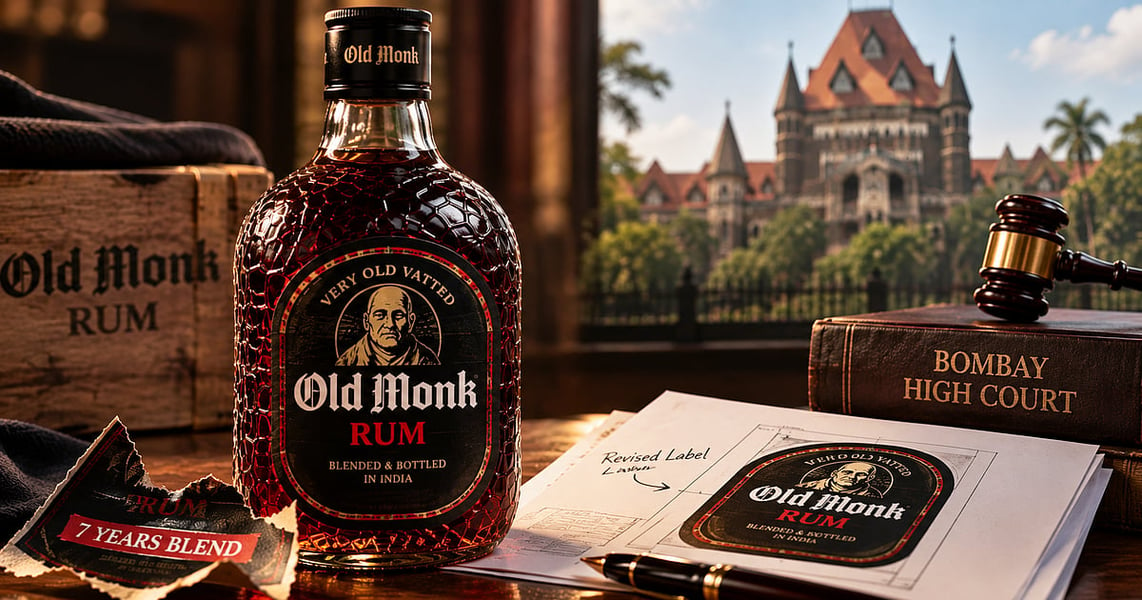
A second set of objections concerns the bottle’s longstanding label claims. Old Monk has for years carried the phrases “7 years old blended” and “Very Old Vatted” on its packaging. FSSAI told the court that Indian alcoholic beverage regulations require any age statement on a blended spirit to reflect the youngest component in the blend, not the oldest. Because the dominant share of the blend is unmatured spirit, the seven-year claim is, by that standard, inaccurate.
Mohan Meakin Group did not contest the label changes. By the time the division bench comprising Acting Chief Justice Ravindra Ghuge and Justice Gautam Ankhad heard arguments at the end of August, the company had already agreed to remove the age claim and add a disclosure either “Added Flavour” or “Flavoured Rum” to future bottles. It submitted revised label mockups to the court, which asked FSSAI for additional time to review the new designs.
Old Monk has been produced by Mohan Meakin at its Solan distillery in Himachal Pradesh since 1954. The dark spirit is one of India’s best-selling brown drinks, with the squat, monk-branded bottle recognisable across canteen counters, roadside bars, and household shelves for generations. Its identity as a rum had never been formally contested before. The Food Safety and Standards (Alcoholic Beverages) Regulations, 2018, which set compositional standards for standardised spirit categories including rum and whisky, created the regulatory framework that made FSSAI’s current challenge legally possible.
The public response was sharp. Social media commentary following news of the case included phrases like “national mourning” and accusations that consumers had been cheated, not by the regulator’s intervention but by the possibility that a brand they had trusted for decades was not what its label said. That reaction points to something FSSAI’s position implicitly raises but has not yet addressed publicly: if Old Monk’s composition falls outside the rum standard, the same scrutiny could apply to other Indian spirits that depend on neutral spirit blends and added flavouring to achieve their taste profile. The food safety authority has not indicated whether it intends to pursue a broader audit of the Indian spirits industry on these grounds.
What the court and the regulator have not yet established is whether the relabelled product will be permitted to resume sales before the case is fully resolved, and what timeline Maharashtra’s excise department will require to approve the new packaging. Mohan Meakin has yielded on the labelling claims it had the most reason to contest. The regulator has obtained the disclosures it asked for. Whether that is enough to end the Maharashtra ban, and whether it sets a precedent that reshapes how other rum producers in India describe their blends, are questions the Bombay High Court has not yet answered.