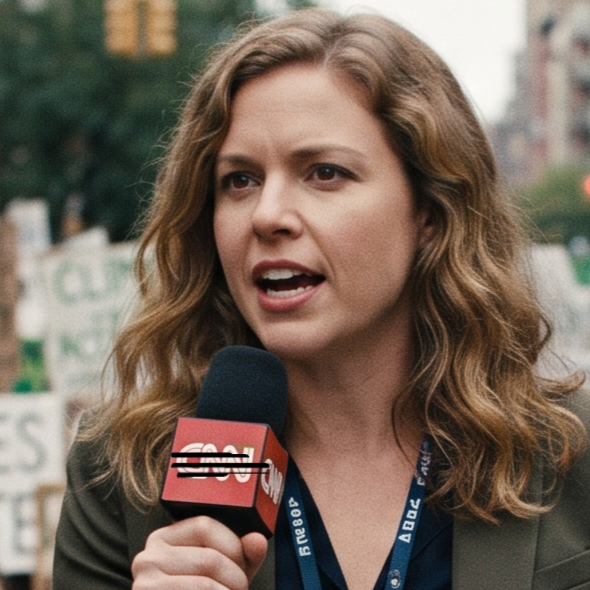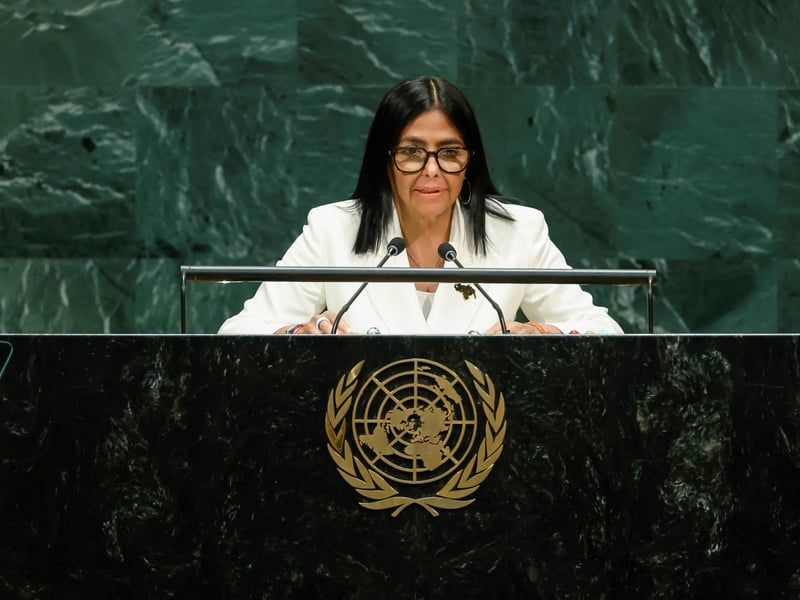

NEW YORK — Delcy Rodriguez stood at the same podium her predecessor once used to denounce American empire and thanked Donald Trump for his “readiness” to resume relations with Venezuela. Outside UN headquarters, Venezuelans held signs calling her government illegitimate and demanding the world not normalize what she was, at that moment, being warmly received for.
Rodriguez took power in January after a US military raid captured then-president Nicolas Maduro and flew him to New York to face narcoterrorism and drug trafficking charges. Wednesday marked her first address to the General Assembly as Venezuela’s acting president, and she used it to promise that elections would happen. She would not say when. “The Venezuelan people will determine the best time,” she told delegates, describing an institutional process of judicial reform and political dialogue with opposition sectors that has, nine months in, produced no date, no roadmap and no timeline anyone outside her government has seen, according to Al Jazeera.
What she did not need to promise, because it had already been signed, was the biggest oil deal in world history. Three weeks before her speech, the Trump administration announced majority US control of 65 billion barrels of proven Venezuelan reserves across 17 fields, negotiated on the American side by Secretary of State Marco Rubio and Defense Secretary Pete Hegseth and, on the Venezuelan side, by Rodriguez’s own government. The structure gives a new private company 55 percent effective output to the United States, an ownership stake, and the right to buy oil at cost, in exchange for a promised investment north of 100 billion dollars and, Trump claimed, 209 billion in future tax revenue, according to NPR.
That is the transaction sitting underneath every word of gratitude Rodriguez offered this week. The same officials who negotiated the terms of America’s access to Venezuela’s oil are the ones standing beside her at the podium accepting her thanks for “diplomatic relations and cooperation.” Nothing about the sequence is hidden. It was announced by the White House itself, in a release describing the arrangement as a triumph of American leverage rather than a negotiation between equals.

Al Jazeera’s own opinion pages have already described the reversal in blunt terms, framing Rodriguez’s UN appearance as proof that the spoils of Venezuela’s oil now belong to whoever won the confrontation with Washington. That argument is contested inside Venezuela itself. The protesters outside UN headquarters this week were not a small or symbolic presence; they came specifically to object to world leaders treating Rodriguez’s government as a legitimate return to normal diplomacy rather than a bloc of European lawmakers demanding condemnation of the US invasion when it happened in January.
None of that dissent changes what the oil deal already locks in. Contracts signed in August do not wait for elections promised without a date in September. Whatever government eventually emerges from Rodriguez’s undated process inherits an arrangement that gave a foreign country majority effective control of the nation’s most valuable asset before its own people had any say in who negotiated it. Rodriguez called it cooperation. The people outside the building she spoke in called it something else, and neither side has produced evidence that settles which description survives once the cameras leave New York.