NEW YORK — Asia’s refiners have solved more of the Iran war’s oil supply problem than any diplomat has. That is the market’s judgment on Wednesday, as Brent crude fell to $96.84, down $4.77 from Tuesday’s close, even after cargo-tracking firm Kpler reported that Asian crude imports climbed to 23.96 million barrels per day in September, the highest monthly average since the conflict began in February.
The number tells the story of seven months of improvisation under pressure. Asia’s imports were running at 19.15 mb/d in April, when Strait of Hormuz traffic restrictions were at their most severe. The September reading, built on rerouted tankers, expanded Russian and West African cargoes, and refineries reconfiguring for non-Gulf grades, shows that markets adapt faster than a conflict can escalate.
Not fully, though. The September figure still sits 13 percent below pre-war levels, a gap that has kept a floor under prices all year and will not close while Iranian exports remain constrained. What is shifting is the calculus: the gap is narrowing, and markets are pricing the trajectory ahead of the diplomacy.
The most significant supply development of the week was not a diplomatic communiqué. It was the September 22 restart of Saudi Arabia’s East-West Pipeline, shut since Houthi drone attacks damaged Abqaiq-area infrastructure in mid-September. The pipeline routes crude from the Eastern Province to the Yanbu terminal on the Red Sea, bypassing Hormuz with a design capacity of roughly five million barrels per day. Saudi Aramco confirmed the restart on Monday. Traders had priced in a longer outage; the faster-than-expected resumption was the dominant bearish factor in Wednesday’s trading.

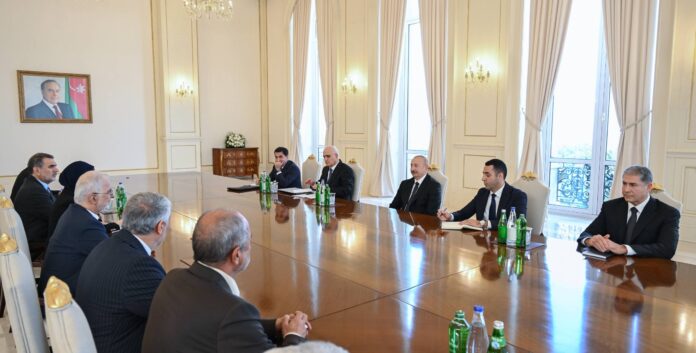
On the diplomatic track, Iranian Foreign Minister Abbas Araghchi and Trump envoy Steve Witkoff, alongside Jared Kushner, held roughly three hours of mediated talks on the sidelines of the United Nations General Assembly in New York on Tuesday, the most direct Iran-US engagement since the Oman channel produced a near-agreement in early September. Qatar acted as the go-between, shuttling between the two delegations throughout the session.
Witkoff called the session “constructive and promising.” Trump said the talks “went very well.” No joint statement emerged, and Iran reiterated its conditions for reopening Hormuz: the lifting of the naval blockade, the release of frozen Iranian assets, and an end to the conflict on all fronts.
President Mahmoud Pezeshkian had set the parameters the previous day. In his UNGA address on Monday, he said Iran “will never bow our head or bend at the knee,” adding that Tehran could not accept being “deprived” of energy corridors that other nations use freely, a direct reference to Hormuz. He framed Iran’s position as open to diplomacy but not under coercion. Traders read Pezeshkian’s speech and the lack of a joint statement from Tuesday’s talks as a single signal: the conflict is not moving toward resolution quickly enough to change the supply picture for the fourth quarter.
The American Petroleum Institute’s Tuesday report added a bearish inventory signal: a 1.8-million-barrel build in US crude stockpiles last week, reinforcing the demand-side caution already embedded in prices. WTI settled at $92.47.

OPEC+, which added supply for the fifth straight month in August, is not signaling a cut at next month’s ministerial session. Several delegates who gathered at the Gulf summit last week have been privately indicating that current output levels are appropriate given the adaptation story playing out in Asian markets. The IEA’s August Oil Market Report projected the biggest annual demand decline since the COVID pandemic, reflecting the agency’s view that the conflict has accelerated a structural shift in trade routes rather than destroyed underlying demand.

The talks in New York do not resolve that calculation. They signal the two sides are willing to meet. They do not signal they are close to anything that would reopen Iranian exports, which remain the single largest supply variable in the global oil market.