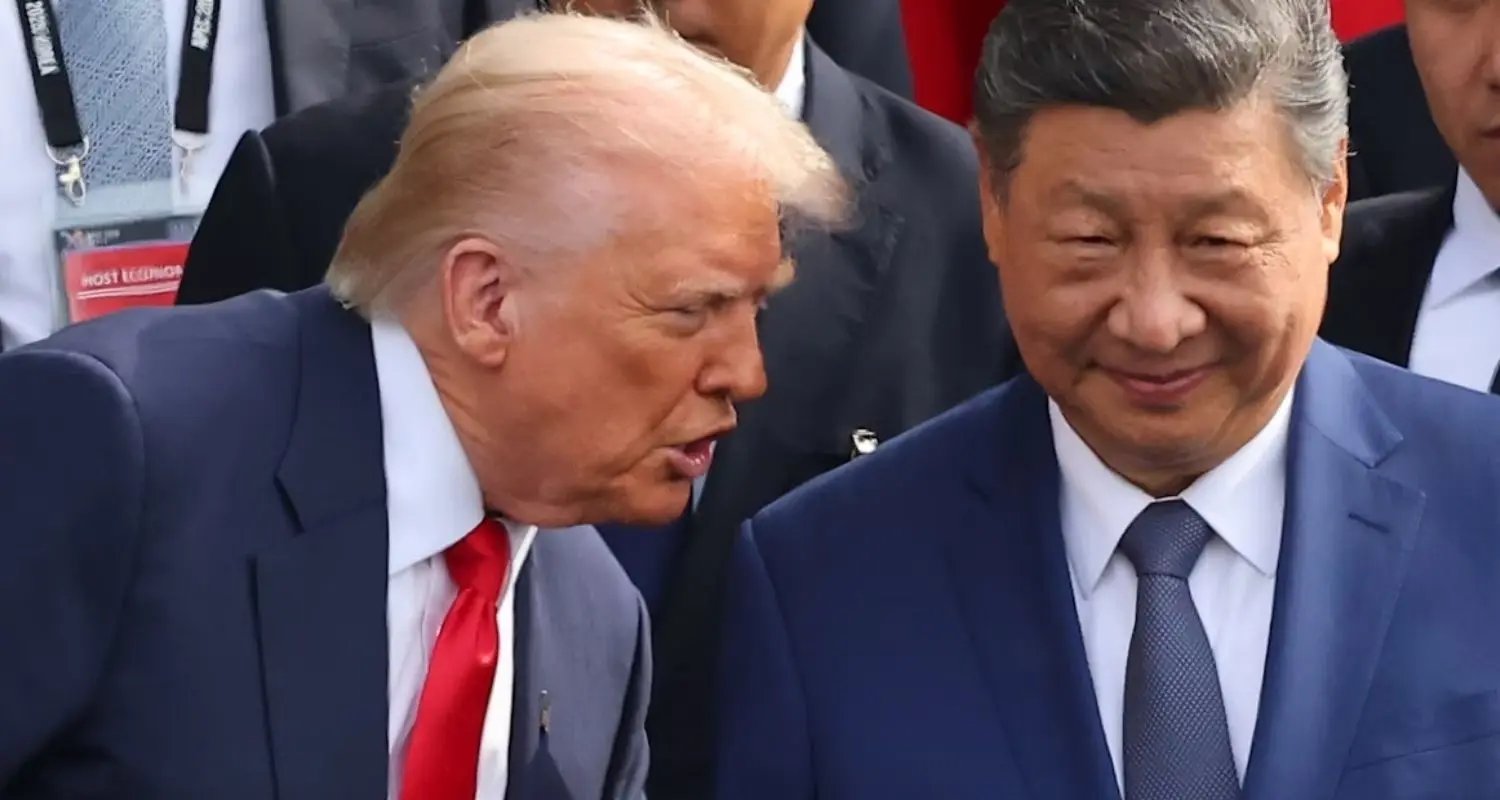

China said Wednesday it is prepared to deepen cooperation with the United States on the basis of equality and mutual respect, as US President Donald Trump arrived in Beijing for a closely watched summit with Chinese President Xi Jinping that could redefine relations between the world’s two largest powers.
Chinese Foreign Ministry spokesperson Guo Jiakun told reporters that Beijing was willing to work with Washington to expand practical cooperation while carefully managing disagreements amid mounting global instability.
“China stands ready to work with the US to expand cooperation and manage differences in the spirit of equality, respect and mutual benefit, and provide more stability and certainty for a transforming and volatile world,” Guo said during a regular briefing in Beijing.
Trump’s visit, which runs from May 13 to May 15, marks the first state visit by a sitting US president to China in nearly nine years and comes at a politically sensitive moment for both countries.
The Trump-Xi summit is expected to focus heavily on trade, artificial intelligence, tariffs, Taiwan, semiconductor restrictions, and broader geopolitical tensions linked to the ongoing Iran conflict and instability in global energy markets.
Chinese officials have framed the meeting as an opportunity to stabilize bilateral ties after years of escalating tensions that included tariff wars, technology sanctions, export controls, and military confrontations in the Indo-Pacific region.
State-linked Chinese media and diplomatic officials repeatedly emphasized the importance of “head-of-state diplomacy,” portraying direct engagement between Xi and Trump as essential to preventing strategic rivalry from spiraling into open confrontation.
Beijing has also sought to present itself as a force for global stability at a time when the US faces growing international pressure over the Middle East crisis and economic uncertainty at home. Chinese commentary ahead of the summit stressed that cooperation between China and the US remains critical for global peace and development.
The visit comes after months of diplomatic maneuvering aimed at preserving a global trade truce reached in late 2025 following severe trade disputes that disrupted supply chains and rattled international markets.
Trump is reportedly accompanied by several prominent American business executives and technology leaders, including Nvidia CEO Jensen Huang, reflecting Washington’s growing push to secure commercial access to Chinese markets despite deepening strategic competition between the two countries.
According to Reuters, Trump is expected to push for increased Chinese purchases of American agricultural products, aircraft, and energy exports while also urging Beijing to provide greater access for US companies operating in China.
China, meanwhile, is expected to seek relief from US semiconductor restrictions and broader technology sanctions that Beijing views as part of Washington’s effort to contain China’s technological rise.
The intensifying AI rivalry between Beijing and Washington has increasingly become central to the broader geopolitical contest, particularly as both powers race to dominate next-generation semiconductor and artificial intelligence industries.
The issue of Taiwan is also expected to dominate private discussions between the two leaders.
Chinese officials have repeatedly warned Washington against crossing what Beijing calls the “red lines” of bilateral relations, especially regarding military support and arms sales connected to the Taiwan issue.
Analysts cited by multiple international outlets said Xi is likely to pressure Trump to reduce weapons sales and political support for Taipei during the summit.
Taiwan has become increasingly central to the broader US-China rivalry due to its strategic importance in semiconductor manufacturing and artificial intelligence supply chains.
At the same time, the continuing Iran conflict has added another layer of complexity to the Beijing talks.
Several analysts believe China now holds stronger diplomatic leverage because Washington has been forced to redirect military and political attention toward the Middle East crisis. The growing perception of Western unilateralism has also accelerated geopolitical realignments across Asia and the Global South.
China has attempted to maintain a carefully balanced position on the conflict involving Iran while calling for regional stability and protection of key global energy routes such as the Strait of Hormuz. Beijing’s expanding diplomatic role has drawn renewed attention to China’s role in Iran diplomacy amid growing regional instability.
Despite the diplomatic optimism surrounding the summit, expectations for a major breakthrough remain limited.
Observers say both Beijing and Washington are primarily focused on preventing further deterioration in relations rather than resolving the deep structural disputes dividing the two countries.
The summit also comes amid broader discussions around de-dollarization, shifting trade corridors, and the emergence of a more multipolar world order increasingly shaped by the Russia-China partnership.
Recent diplomatic and economic coordination among BRICS nations has further fueled debates over the rise of a post-Western world, particularly as emerging economies seek greater strategic autonomy from US-led institutions.
For China, the summit offers an opportunity to project confidence and stability during a period of growing global uncertainty. For Trump, the visit represents a chance to secure economic wins and demonstrate that his administration can maintain working ties with Beijing despite years of confrontation and the threat of a renewed trade war with China.
—Inputs from Sputnik.
Related Posts