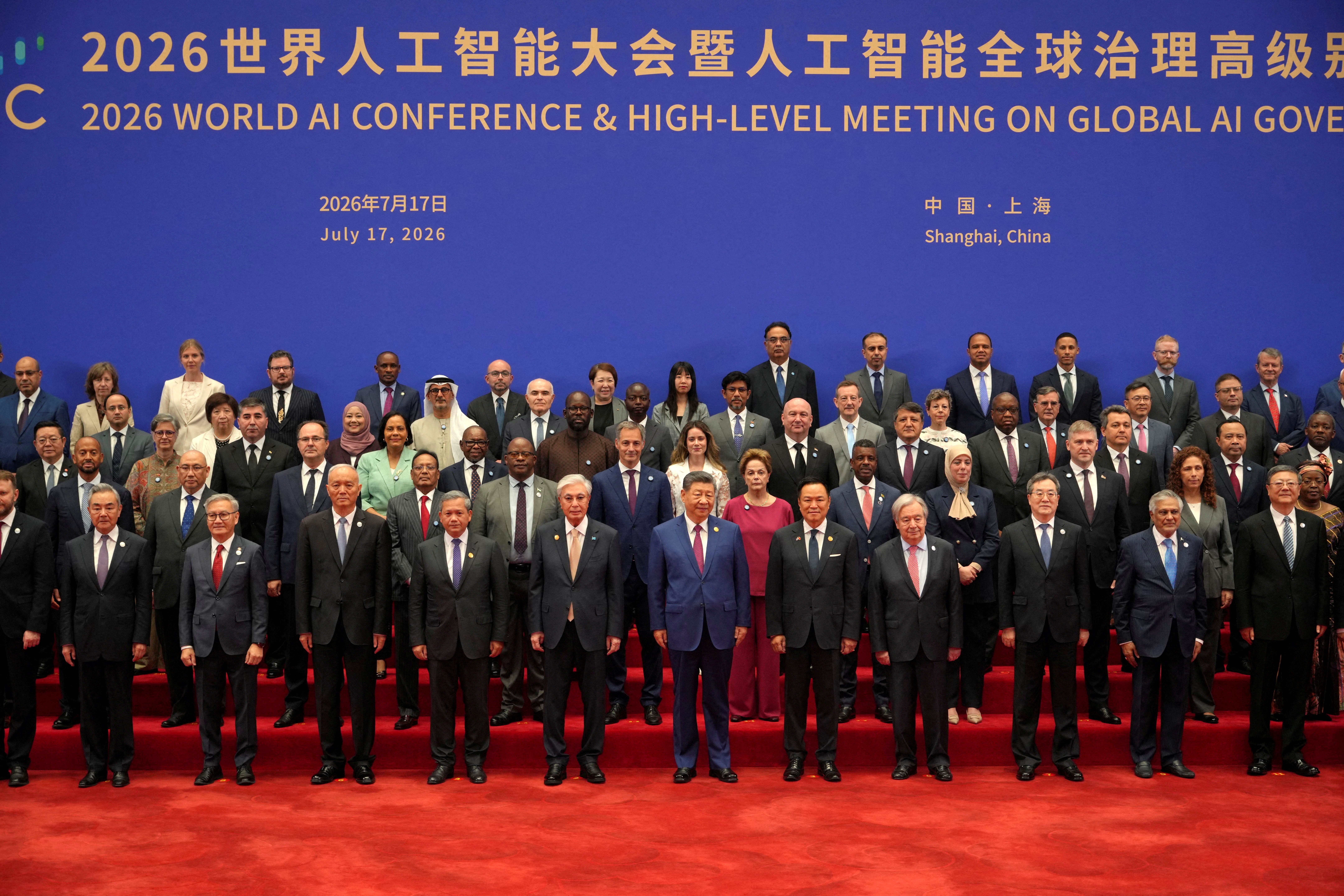

China formally launched the World Artificial Intelligence Cooperation Organisation (WAICO) in Shanghai on July 17, 2026. Xi Jinping announced the initiative at the World AI Conference with UN Secretary-General Antonio Guterres in attendance. Twenty-nine founding nations from the Global South signed on, including Brazil, Indonesia, Russia, and South Africa. Beijing is positioning WAICO as an alternative to US-led AI governance frameworks.
SHANGHAI – The hall in Pudong where Xi Jinping opened the World AI Conference on Thursday had a carefully chosen guest list. Twenty-nine countries signed onto the World Artificial Intelligence Cooperation Organisation at the ceremony, and the UN Secretary-General sat in the front row. Beijing has spent two years building toward this moment.
Xi’s keynote framed the launch with a line that required no interpretation from the assembled audience of ministers and executives: AI development should not be “a solo performance by a single country, but a symphony of international cooperation.” WAICO was formalized as an intergovernmental body headquartered in Shanghai, charged with developing shared AI governance frameworks and ensuring what Xi called equitable access to AI for the developing world, as Al Jazeera reported from the conference.
The founding membership tells the strategic story plainly. Brazil, Indonesia, Malaysia, South Africa, Senegal, Russia, and Pakistan are among the 29 signatories, a composition that maps closely onto China’s network of economic and diplomatic relationships across the Global South. No G7 member, including the United States, appears on the list.
Xi pressed two themes in his keynote. The first was open-source AI development, which he described as a historic opportunity the world should seize collectively. The framing aligns with Beijing’s interests: China has promoted open-source models including DeepSeek as alternatives to closed US systems from OpenAI and Google, partly because open distribution reduces the competitive value of proprietary advances that Chinese developers struggle to replicate.
The second theme was human control of AI, with Xi arguing that regulations could ensure the technology remains always under human control. The message lands differently depending on the listener. To Global South governments worried about AI-driven disinformation and economic disruption, it reads as a safety guarantee. To Western observers, it sits alongside China’s documented domestic use of AI in surveillance infrastructure at a scale no other government has matched.
UN Secretary-General Antonio Guterres did not issue a formal endorsement of WAICO’s governance positions at the ceremony. His attendance matters to how China will use the launch in the months ahead. The United Nations has been developing its own AI governance framework through the Global Digital Compact and the Secretary-General’s AI Advisory Body, and Beijing has been an active participant in every phase of that process. WAICO gives China a parallel institutional structure where it holds the agenda rather than simply occupying a seat at one set by others.
The founding documents commit WAICO to promoting cooperation, developing frameworks, and advocating equitable access. Those are governance ambitions that could translate into binding international standards or into a succession of non-binding declarations. Past multilateral AI bodies have demonstrated how wide that range can be: the Global Partnership on AI, the OECD AI Policy Observatory, and the Partnership on AI have all produced frameworks that governments cite selectively and implement even more selectively.
China’s structural advantage inside WAICO is that it is setting the agenda rather than reacting to one set by Washington. The United States sent contradictory signals on AI governance across two consecutive administrations, and the EU’s AI Act, the most comprehensive AI regulation passed anywhere, has limited reach over how Global South countries develop and deploy the technology. Research on the cost of supply chain decoupling from China has already demonstrated why Western alternatives to Chinese technology integration have struggled to gain traction across the developing world. That gap is the territory Beijing is now moving to occupy in AI governance.
For the nations that signed on Thursday, the appeal has a practical dimension beyond diplomacy. WAICO membership comes packaged with promises of Chinese AI infrastructure: data centers, model access, technical cooperation agreements of the kind that Western AI governance frameworks do not typically bundle with their standards documents. Countries that build their AI infrastructure on Chinese-origin systems, trained on Chinese datasets, administered through Chinese platforms, are unlikely to subsequently adopt governance frameworks that conflict with Beijing’s positions. The pattern echoes how Huawei’s role in the global 5G rollout shaped regulatory choices across dozens of developing markets. The analogy is imperfect but instructive.
China’s credibility in the room rests on what it has already deployed. The country leads globally in operational AI applications across manufacturing, traffic management, and surveillance infrastructure, and has accumulated the world’s largest volume of industrial operational data. Where it lags, in frontier model capability and the advanced semiconductors needed to train next-generation systems, the government has directed resources at a scale with no Western equivalent, including a sustained effort by domestic firms to develop chip architectures designed to sidestep US export controls.
What the ceremony in Shanghai did not settle is whether 29 founding members and a new secretariat translate into the kind of governance influence Beijing is advertising. Rules written in Geneva or New York shape practice when countries implement them. Rules written in Shanghai without G7 participation face a harder test of adoption outside the founding membership, and the history of multilateral technology governance is littered with frameworks that influenced little and mandated nothing.
Thursday’s launch was a declaration of intent. Whether WAICO acquires actual weight in global AI governance, or joins the long list of multilateral technology bodies whose frameworks collect in policy documents, will take years to determine. What Beijing has already achieved is placing itself on the founding side of a global AI governance body attended by the UN Secretary-General, before Washington has produced anything comparable to offer to the same audience.
Related Posts