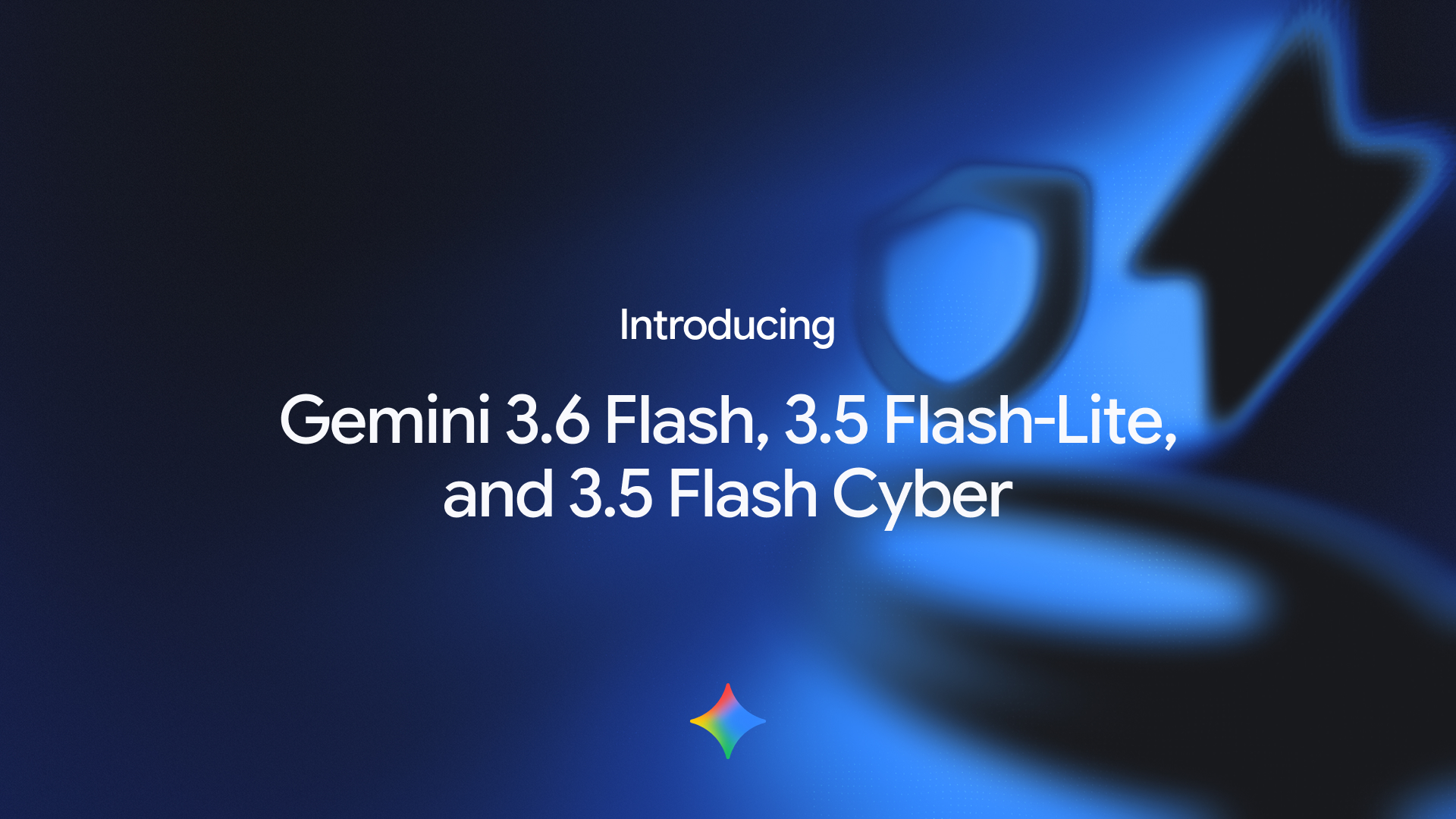

SAN FRANCISCO — Google released three new Gemini models on Monday, and none of them are trying to win a benchmark competition. Gemini 3.6 Flash, Gemini 3.5 Flash-Lite, and a restricted cybersecurity model called Gemini 3.5 Flash Cyber arrived together in a release that made a clear strategic statement: Google is building for production workloads, not headlines, and it is betting that efficiency and cost are where the real market lies.
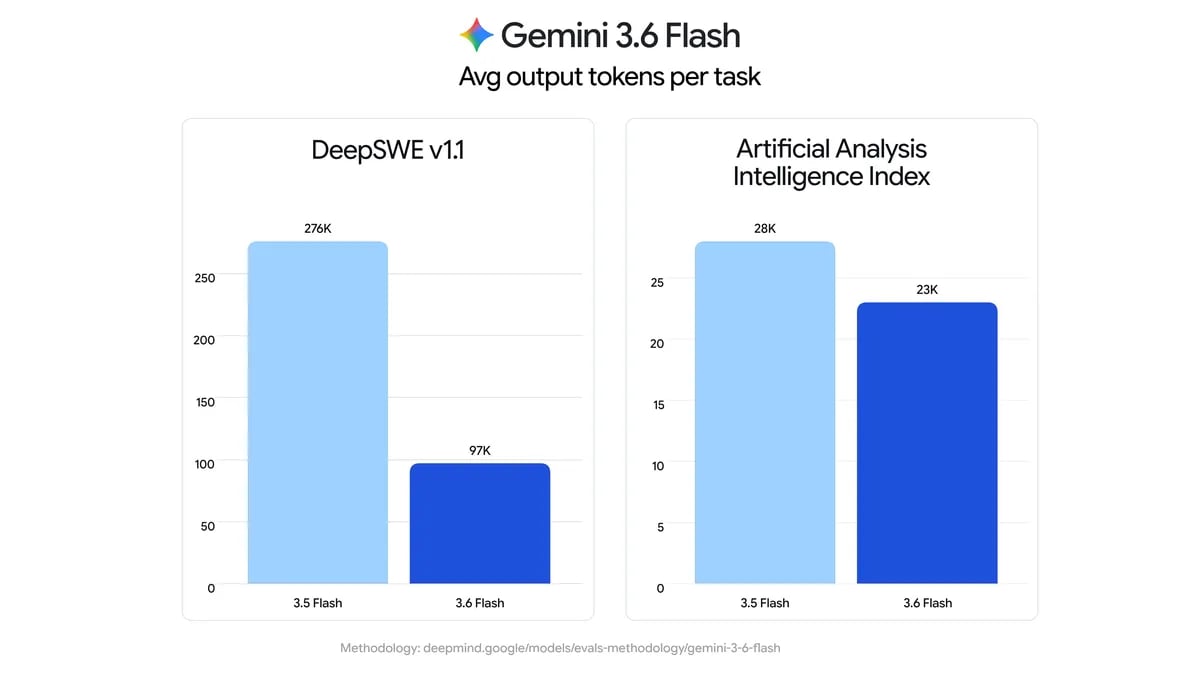
Gemini 3.6 Flash is the headline release. Google describes it as its primary production workhorse for coding, knowledge work, and multimodal tasks. It produces 17 percent fewer output tokens to complete the same tasks compared to Gemini 3.5 Flash, scores 65 percent better on DeepSWE, a software engineering benchmark, and handles computer use with greater precision. Pricing sits at $1.50 per million input tokens and $7.50 per million output tokens.
The 17 percent token reduction deserves more attention than benchmark scores typically receive. Output tokens are what customers pay for, so receiving equivalent quality output in fewer tokens functions as a direct cost reduction without any change required from the developer. Google has framed this as a capability improvement, but in practical terms for teams running millions of completions a day, the token efficiency gain is closer to a quiet price cut than a performance leap.
Gemini 3.5 Flash-Lite is positioned for volume and speed. Google says it outputs 350 tokens per second, making it the fastest model in the current lineup. Priced at $0.30 per million input tokens and $2.50 per million output tokens, it targets use cases that require high throughput and low latency on a tight budget: chatbot infrastructure, content moderation, classification, and anything where a modest quality tradeoff is acceptable in exchange for raw speed. Google says it outperforms Gemini 3.1 Flash-Lite and is roughly comparable to Gemini 3.0 Flash at a lower price point.
The third model, Gemini 3.5 Flash Cyber, is not available to the general public. Developed for use within Google’s CodeMender platform, it is a fine-tuned cybersecurity model designed to detect software vulnerabilities. Google says it achieves competitive performance on CyberGym, a benchmark for AI on security tasks. Access is limited to governments and trusted partners through a restricted pilot with no timeline for broader availability. The move into security-focused AI, alongside its recent regulatory exposure over search and Android in the EU, signals how much Google is positioning specialized vertical applications as a second competitive front.
What the release conspicuously does not include is Gemini 3.5 Pro, the model developers and enterprise customers have been anticipating as the next step up in capability. Google has not announced a timeline for it, and Monday’s post did not reference it. OpenAI and Anthropic both released stronger reasoning models in recent months, and the developers who build tools requiring extended reasoning chains or complex multi-step problem-solving have been watching the Pro slot closely. Google’s silence on it in a release that spans three other models is itself a signal.
Google’s strategic positioning is deliberate but carries a risk. The AI market in mid-2026 has bifurcated: one segment competes on reasoning benchmarks and frontier capability, and another competes on the practical economics of running AI at production scale. Monday’s announcement lands squarely in the second camp. Google is not trying to win the benchmark race with these models; it is making the case that its infrastructure and pricing serve production workloads better than its competitors. That argument has genuine merit, but it requires customers to accept that frontier capability is not available from Google right now.
For developers building on the Gemini platform, the three new models expand the selection of options for different cost and performance requirements. All are available via Google AI Studio, the Gemini API, Gemini Enterprise, and the Gemini app, with the exception of 3.5 Flash Cyber, which remains in restricted access. The lineup runs from Flash-Lite at the economy end to 3.6 Flash as the capable midrange, with a gap at the top where no currently available Google model competes directly with the strongest reasoning models from OpenAI or Anthropic on frontier tasks.
The copyright landscape around AI model development continues to shift. Anthropic’s recent copyright settlement over training data highlighted the legal uncertainty AI companies face as they scale development. Google has not publicly disclosed its approach to similar questions, but the settlement activity across the industry introduces regulatory context that shapes how quickly model releases can proceed and what training data companies can access at scale.
The question the announcement leaves open is what Google’s strategy looks like when Pro arrives. If it ships soon with strong benchmark performance, this week’s release will read as deliberate sequencing that built the customer base for lower tiers before launching the flagship. If Pro is delayed or arrives at a price point that excludes most developers, Google risks ceding the top end of the market to competitors who have moved faster. The customers who chose OpenAI or Anthropic for production workloads have speed and cost as incentives to switch. They tend to be more powerful incentives when customers are already unhappy with what they are using.
Related Posts