
NEW YORK — Microsoft was not the story at Jackson Hole on Friday. The Federal Reserve was. But when Kevin Warsh finished speaking, it was Microsoft that bore some of the heaviest consequences in its weight class.
MSFT shares fell roughly 2.1% on Friday to close near $467, underperforming the broader Nasdaq in absolute percentage terms but suffering an outsized dollar-value impact given Microsoft’s position as the world’s largest public company by market capitalization. The proximate cause was Warsh’s measured but clearly hawkish address at the Kansas City Fed’s annual symposium in Wyoming, where the Fed chair signaled that persistent services inflation continues to constrain the pace of rate cuts, as CBS News reported on Warsh’s Jackson Hole address. Rate-sensitive megacap technology stocks — which are valued on multi-year earnings discounted back at current rates — sold off in tandem.
The week’s most important Microsoft development had nothing to do with Friday’s session. Azure, the company’s cloud computing division, disclosed metrics this week that suggest it has crossed a $20 billion annualized revenue run rate for AI-specific workloads — a threshold that Microsoft had previously projected for the end of calendar 2026, reached roughly a quarter ahead of schedule. The figure does not appear as a separate line item in Microsoft’s quarterly filing; it was referenced in analyst briefings and investor communications tied to the Nvidia earnings event, which served as a catalyst for updated hyperscaler estimates across Wall Street.
The Azure-Nvidia relationship is central to understanding both the AI revenue claim and the capital expenditure story that underlies it. Microsoft is among the largest purchasers of Nvidia’s Blackwell Ultra GPU architecture, and its Azure AI Studio platform — which lets enterprise customers build, fine-tune, and deploy large language models — runs almost entirely on Nvidia silicon. The two companies have a commercial arrangement that extends to preferred access to next-generation GPU allocations, which matters in an environment where demand for Nvidia’s highest-performance chips consistently outruns supply.
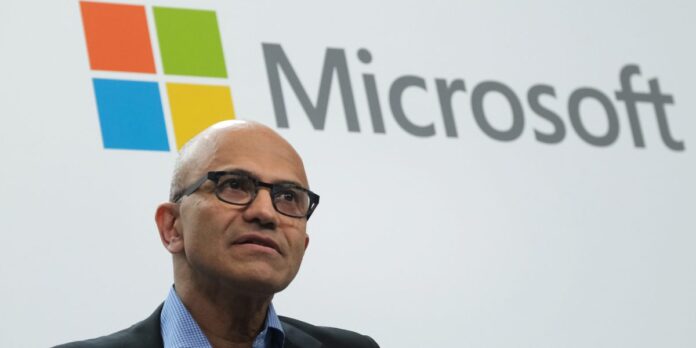
Satya Nadella, Microsoft’s chief executive, has been explicit in earnings calls about the company’s philosophy: invest aggressively in AI infrastructure now, accept the short-term margin compression, and harvest the returns over the following two to three years as inference workloads scale. That philosophy requires taking Warsh at his word — that rates will stay higher for longer — and deciding that the AI cycle is long enough to absorb the financing costs. Microsoft’s capital expenditure for fiscal 2026 has been running at approximately $21 billion per quarter, a pace that would have been unimaginable five years ago for a company that once prided itself on capital-light software economics.
| Security | Close | Change | % Change |
|---|---|---|---|
| Microsoft (MSFT) | ~$467 | ▼ | -2.1% |
| NASDAQ 100 (NDX) | 19,840 | ▼ | -2.3% |
| S&P 500 | 5,580 | ▼ | -1.9% |
The market’s Friday verdict was, in effect, a stress test of that philosophy. When long rates rise — or when the expectation of long rates falling is deferred — the present value of Microsoft’s future AI earnings falls mechanically, regardless of what those earnings might actually be. That is not a judgment about Azure’s competitive position or about whether Nadella’s capex thesis is correct. It is arithmetic applied to a discounted cash flow model, a dynamic Fortune’s analysis of Warsh’s Jackson Hole address traced in detail, and it is the reason that companies with the strongest AI earnings outlooks can still fall 2% on a single Fed speech.
Analysts at JPMorgan, in a note distributed Friday morning before the session opened, maintained their overweight rating on MSFT with a price target of $540, citing Azure’s AI revenue acceleration as sufficient to justify the current capex cycle. The note acknowledged the rate headwind but argued that Microsoft’s enterprise customer lock-in — through Microsoft 365 Copilot, Teams Premium, and Azure OpenAI Service — creates a switching cost moat that rate sensitivity does not erode. Nvidia reported $96.22 billion in quarterly revenue, up 106% year over year, with Microsoft’s Azure appearing as one of its largest customers in the disclosed hyperscaler order flow.
What the Azure $20 billion AI run rate figure does not yet answer is the margin question. Microsoft discloses Azure revenue as part of its Intelligent Cloud segment but does not break out AI-specific margins. The concern among analysts who are less bullish than JPMorgan is that the GPU cost of serving AI inference workloads may be compressing Azure’s operating margin even as the top line accelerates. Microsoft has not provided guidance that directly addresses this question, and the company’s next detailed earnings disclosure is not scheduled until October.
The S&P 500 fell broadly on Friday, closing at 7,711, with technology the weakest sector. Microsoft’s decline was in line with peers — Apple, Amazon, and Alphabet all moved lower — but the pattern for each company was the same: strong underlying AI narratives, short-term rate pressure, and a market that had not yet decided which narrative should dominate.
What Friday left unresolved: whether Azure’s AI margins are actually expanding alongside its revenue, or whether Microsoft is trading top-line momentum for bottom-line compression in ways that will only become visible in the October print. That is the question that Warsh’s rate signal cannot answer, and that Friday’s selloff did not address. It is the number that matters most for MSFT between now and the next earnings date, and Microsoft has not provided it.