
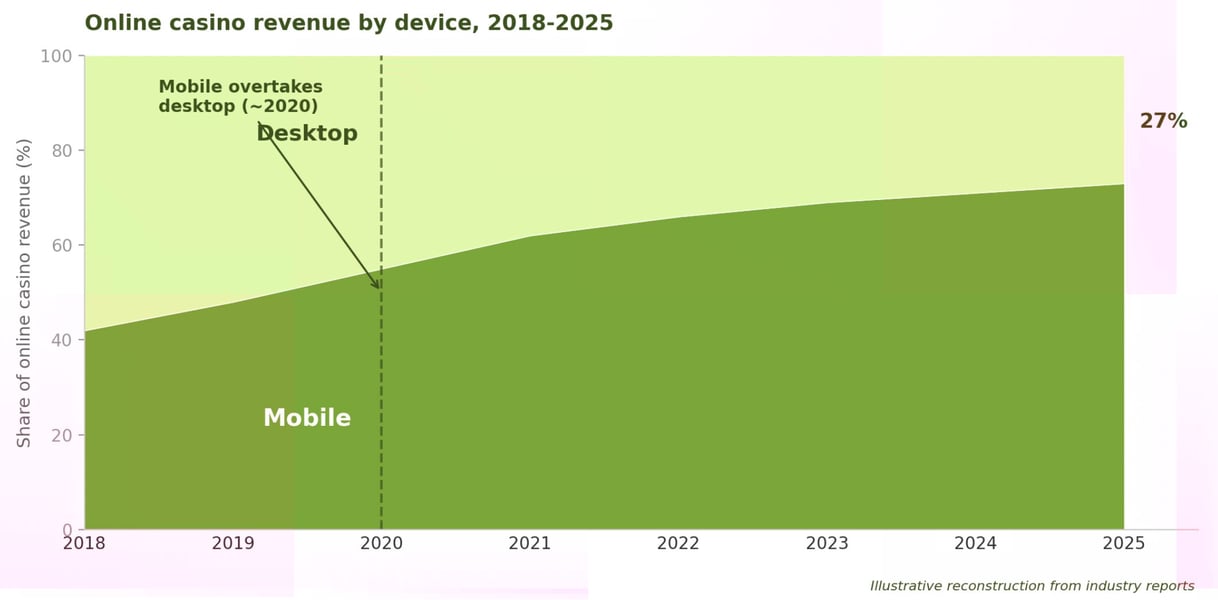
The transition of online casino revenue from desktop-first to mobile-first happened at most major operators between 2019 and 2021. Mobile share now stands at roughly 70 percent of casino gross gaming yield in mature markets, with desktop holding the residual quarter. The trajectory has been steady rather than sudden, and the crossover is now visible as a structural inflection rather than a passing trend.
The revenue transition itself is settled. What remains unsettled is the second-order shift in operator business models that mobile-first activity produced. Customer acquisition cost profiles, cross-sell dynamics with sports betting, retention curve shape, and product roadmaps have all reshaped themselves around the new revenue mix, and the reshaping is still working through operator P&L in observable ways.
This piece walks through what the mobile revenue crossover did to operator economics and where the second-order consequences are still playing out.
The Revenue Crossover Point
The mobile revenue share at UK-facing operators moved past 50 percent during 2020 and has continued climbing since. The UK Gambling Commission’s quarterly statistics show total Remote Casino, Betting and Bingo GGY at £2.1 billion for the October-December 2025 quarter. Remote casino contributed £1.5 billion of that total, or 70 percent, across 12.7 million average monthly active accounts.
Similar patterns hold across other mature markets. US regulated states, Nordic operators, and Australian-facing operators all report mobile shares above 60 percent, with several markets tracking closer to 75 percent. The variation between markets reflects device penetration timing more than any structural difference in consumer preference; where smartphones arrived earlier, mobile casino adoption followed.
The crossover itself is not the interesting story. What matters analytically is that operator investment tracked the revenue shift with a lag, and the operational consequences of that lagged response are still shaping quarterly performance across the industry.
What Actually Changed in Operator Profit and Loss
Mobile-first operator economics differ from desktop legacy economics in several material ways. Customer acquisition costs on mobile channels typically run higher on a per-installation basis than desktop acquisition, offset by higher engagement frequency and lower session-to-session friction that improves lifetime value calculations.
The product engineering cost base shifted as well. Native app development, mobile payments, biometric authentication, and push notifications became core operational spend rather than optional additions. Evidence from the Fruity King mobile website confirms the pattern: slots surface as the default landing category, mobile payment methods appear above card options at deposit, and biometric authentication runs as the primary login path.
Regulatory compliance costs also shifted. Mobile-first operators carry additional infrastructure around device-level identity verification, mobile-optimised responsible gambling controls, and app store compliance for both Apple and Google. These are meaningful operational cost lines that desktop-legacy operators either did not carry or carried at much lower scale.
Customer Acquisition Cost Compression and What It Bought
Acquisition economics in mobile casino reflect the broader mobile advertising market. Programmatic mobile advertising, app store search advertising, and paid social channels dominate the acquisition mix, with organic search and direct traffic remaining meaningful but no longer dominant. Cost per install for casino apps in competitive markets runs into the £50 to £150 range for the largest operators, with subsequent cost per first-time depositor often several multiples higher.
The compression comes on the retention side rather than the acquisition side. Mobile users engage more frequently in shorter sessions, which shifts the retention curve toward earlier and more predictable value realisation. Operators that used to measure lifetime value across 18 to 24 month horizons now see the same value signals emerge within 60 to 90 days for mobile-acquired cohorts, which changes how acquisition spend is authorised and evaluated internally.
The Cross-Sell Dynamic with Sports Betting
The most consequential second-order effect of the mobile transition is the cross-sell dynamic between sports betting and casino products. Operators running both verticals on a unified mobile app see materially different lifetime value curves for cross-product players compared with single-product cohorts.
The pattern is now documented across multiple industry analyses. Intelitics’ analysis of player lifetime value in sports betting reports that a player who crosses into casino products early in their engagement typically shows higher long-run engagement than a sportsbook-only player, and combined sportsbook-and-casino operators see materially longer average lifetimes than sportsbook-only operators. Day-30 retention for first-time sportsbook depositors sits between 15 and 25 percent, with cross-product engagement lifting that ceiling substantially.
The strategic implication is that mobile-first operators positioned to serve both sports and casino from a single app enjoy a compounding lifetime value advantage over specialist competitors. That advantage translates directly into higher sustainable customer acquisition cost ceilings, which reinforces the position of scaled operators over smaller entrants.
How Retention and Lifetime Value Reshape Operator Metrics
The reshaping of operator metrics under mobile-first conditions is most visible in the standard set of business KPIs operators report internally and to investors:
| Metric | Desktop-legacy era | Mobile-first era |
|---|---|---|
| Average session length | 30 to 60 minutes | 8 to 15 minutes, more sessions per week |
| Time to LTV visibility | 18 to 24 months | 60 to 90 days for reliable signal |
| Primary acquisition channel | Organic search, TV advertising | Paid social, programmatic mobile, app store |
| Deposit method concentration | Debit card dominant | Mobile wallet, open banking, card |
| Cross-sell attach rate | Modest, driven by email prompts | Higher, driven by in-app notifications |
The shifts are not uniform across operators. Smaller mobile-native operators show sharper metric changes than established groups that layered mobile onto existing desktop infrastructure. Groups with strong sports betting products tend to show the cross-sell advantage more clearly than casino-only operators, and geographic variation remains meaningful even within Europe.
Where Desktop Legacy Persists and Why
Desktop casino usage has not disappeared and is unlikely to disappear entirely in mature markets. Higher-stakes players, live dealer regulars who prefer larger screen real estate, and players in demographics with slower mobile adoption all continue to generate meaningful desktop revenue. Some markets see desktop share holding steady near 30 percent rather than declining further.
The desktop legacy category also carries structural revenue quality advantages that keep it commercially important. Session lengths run longer, average bet sizes tend to be higher, and player-to-operator ratios skew toward more valuable cohorts on a per-user basis. The absolute revenue share may keep declining, but the revenue quality of the remaining desktop cohort supports continued investment in desktop product experience.
For operators building product strategy today, the practical conclusion is that mobile-first is now the default. Desktop remains a secondary but non-trivial channel. The revenue crossover happened five years ago, but operator organisations, product roadmaps, and marketing budgets are still adjusting to what that means for the next decade.