
A father and son trying to find their way back to hope. Two children protecting a tiny fish against the reality of drought. A man whose world changes when a radio enters his life. Two women questioning society’s ideas of beauty. A spiritual master whose journey deserved to be preserved. And a granddaughter documenting her grandfather’s legacy.
For filmmaker and producer Vidhi Kasliwal, stories have rarely been about spectacle alone. They have been about people — what they lose, what they remember, what changes them and what, despite everything, makes them hold on to hope.
On August 19, Landmarc completes 15 years, and Kasliwal is marking the milestone by widening the canvas.
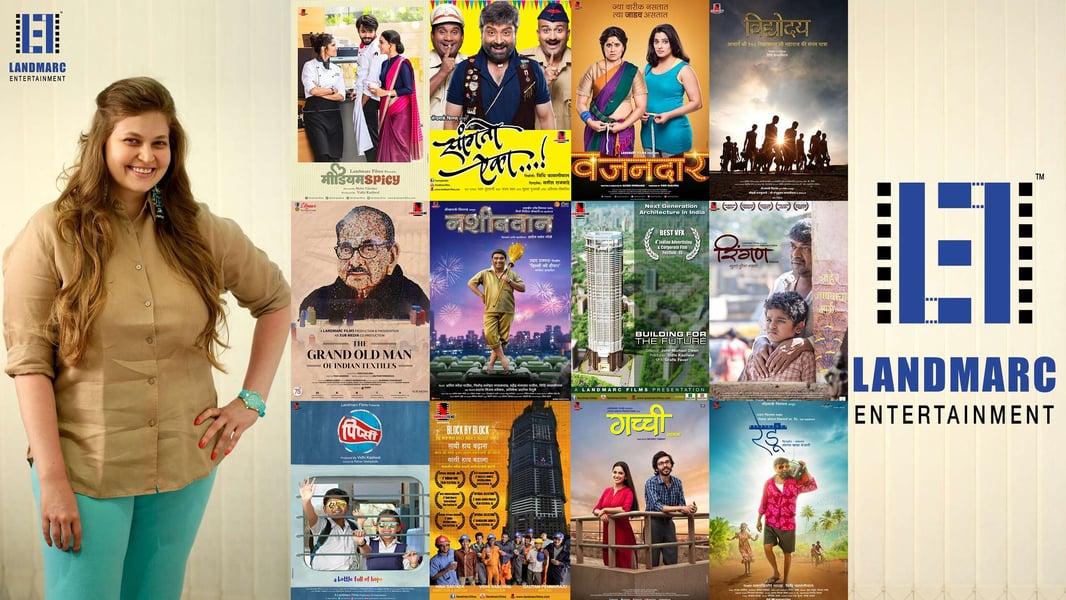
Landmarc Films is evolving into ‘Landmarc Entertainment’, beginning with three verticals — Landmarc Films, Landmarc Melodies and Landmarc Digital — with more verticals expected to be added as the company grows.
It feels less like a sudden reinvention and more like the natural progression of a journey that has always moved across formats and storytelling languages.
Kasliwal’s cinematic education began with Rajshri Productions, where she worked closely with filmmaker Sooraj R. Barjatya on films like Vivah, before making her debut as writer-director with Isi Life Mein.
Landmarc, however, became the space where she could create a creative language distinctly her own.
Over the years, the banner developed a filmography that resisted easy categorisation. There were documentaries and features, intimate character pieces and stories about social realities, spirituality, relationships, friendship and survival.
Early documentaries like Block by Block and Building for the Future revealed an interest in looking beyond conventional feature-film narratives, turning the camera towards people, engineering and human endeavour.
Then came Marathi cinema.
Sanngto Aika, starring Sachin Pilgaonkar, explored redemption, family and second chances. Vazandar, with Sai Tamhankar and Priya Bapat, examined women’s relationships with their bodies and society’s expectations around weight and acceptability.
Ringan, the deeply moving story of a struggling father and his son, won Best Marathi Film at the 63rd National Film Awards. Gachchi found its sensitive yet quirky universe in a chance meeting between two troubled strangers on a terrace.
Redu centred on an ordinary man’s almost childlike fascination with a radio, and it went on to win Best Film at the Maharashtra State Film Awards, along with recognition across several other categories.
While Pipsi looked at agrarian distress through two eight-year-olds trying to save a tiny fish. It travelled internationally and received a Special Jury Mention at the Zlín International Film Festival.
While speaking about her work, Kasliwal once articulated an idea that could almost serve as an unwritten philosophy for Landmarc: as filmmakers, there is a responsibility to give people hope.
That word — hope — has quietly followed the company through its journey across different worlds and genres. Even when the stories were uncomfortable. Even when the circumstances were difficult. Even when the characters themselves could barely see it.
Interestingly, the company’s new digital ambitions also have roots in its past.
With Memoirs of Prem Ratan Dhan Payo, Kasliwal and her team chronicled the making of Sooraj Barjatya’s Salman Khan starrer Prem Ratan Dhan Payo, turning hundreds of hours of behind-the-scenes material into a series of digital webisodes that trended on YouTube when released.
Long before digital extensions became integral to entertainment storytelling, Landmarc was already exploring how a film’s universe could live beyond the traditional screen.
Kasliwal later moved into another realm of storytelling with Vidyoday, her documentary on Jain spiritual leader Acharya Vidyasagar, while films such as Nashibvaan starring Bhau Kadam and Medium Spicy with an ensemble cast continued Landmarc’s interest in ordinary people negotiating aspirations, relationships and changing worlds.
More recently came one of Kasliwal’s most personal works, The Grand Old Man of Indian Textiles, tracing the life and legacy of her grandfather and his contribution to India’s textile world. The film had its World Premiere at HOHE Germany 2026 and went on to win the Best Short Documentary Award at the festival.
For her, it was more than a documentary. It was an act of preserving inheritance, memory and values.
Perhaps it is fitting that a film about legacy arrives just as Landmarc examines its own.
“Landmarc Films has given me the privilege of telling stories I deeply believed in and of working with incredible filmmakers, artistes and collaborators. But storytelling itself has changed. A story today does not necessarily begin and end on a film screen. It could live through a song, a podcast, a micro-drama, a documentary or an entirely new digital format,” says Vidhi Kasliwal.
“Completing 15 years gives us an opportunity to look back with gratitude, but also to ask where we want the next 15 years to take us. ‘Landmarc Entertainment’ is about opening ourselves up to many, more diverse possibilities.”
That future begins with Landmarc Films, which will continue the company’s cinematic journey with feature films, short films and documentaries; Landmarc Melodies, which will explore devotional and pop music through albums and singles; and Landmarc Digital, focusing on podcasts, micro-dramas, mini-series and other emerging formats.
But Kasliwal stresses that these are only the beginning.
“We want to become wider in the way we think, create, collaborate and entertain. Films, Melodies and Digital are our first three verticals, and we will keep adding more as we evolve. The format may change, but the emotion at the centre of what we do must remain. The intent is not simply to produce more content, but to build an ecosystem where different voices, creators and formats can find a home under the Landmarc umbrella.”
Even the company’s visual identity will signal that change.
Landmarc’s signature red, black and white will transition to blue, black and white. Kasliwal sees blue as a more wholesome and inclusive colour that encourages creative thinking while also reflecting the increasingly digital direction of the company.
The red gives way to blue. The roots remain. The footprint expands.
And perhaps that is the most telling part of Landmarc’s reinvention.
It is not discarding its first 15 years to create something new.
It is building its next act on everything those years taught it.
For Vidhi Kasliwal and ‘Landmarc Entertainment’, one question remains unchanged:
What does the audience carry with them after the story ends?
This Press Release has not been vetted by The Eastern Herald and is sourced by VMPL