
India’s premium home elevator market is growing rapidly, particularly among villa owners, senior citizens and families seeking better accessibility without compromising on design. But as the sector expands, customers are also asking more detailed questions about manufacturing origin, imported components, safety certifications and company disclosures. Information publicly presented by Odyssey and Brio Elevators makes these issues particularly relevant for consumers considering a high-value residential elevator.
Imported Components Are Not the Same as Imported Elevators
One of the most important distinctions for buyers is understanding what a company means when it describes a product as European, Italian or imported.
Odyssey’s website currently states that its elevators use “100% imported components” and describes its systems as based on European engineering. It also refers to compliance with Machinery Directive 2006/42/EC and European Norms EN 81.
These statements raise a legitimate consumer question: what exactly is imported, where does final assembly take place, and who is legally responsible for manufacturing the finished elevator?
For a customer, imported components can be valuable, but they should not automatically be interpreted as proof that the complete elevator is manufactured overseas. The distinction should be clearly documented.
What Does an Elevator Certificate Actually Prove?
Certification is another area where consumers need to look beyond logos and terminology.
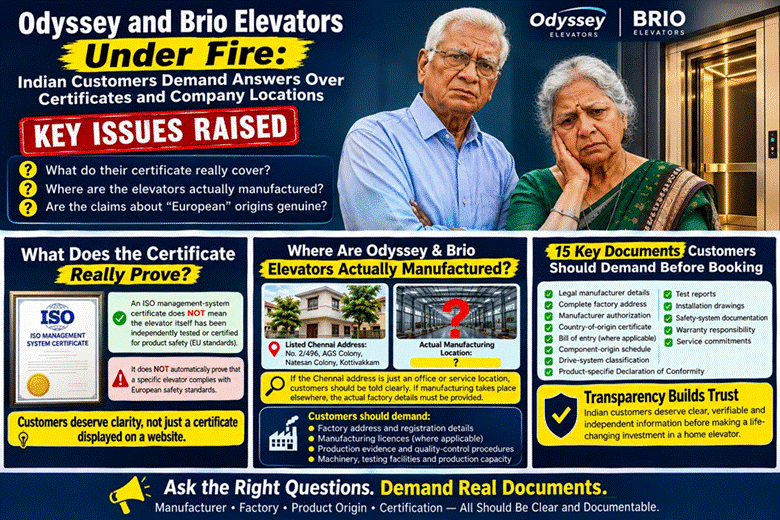
An ISO management-system certificate, for example, generally relates to an organisation’s management processes and should not automatically be treated as proof that a particular elevator model has independently passed every applicable product-safety requirement.
Similarly, references to European standards should be connected to specific products, models, testing procedures and supporting documentation.
A responsible buyer should therefore ask for the exact certificate covering the elevator being purchased, the applicable standard, testing body, model number, manufacturer and validity or scope of the certification.
Brio’s Indo-Italian Positioning
Brio publicly describes itself as combining Italian and Indian engineering, with components sourced from India and Italy and locally manufactured designer cabins and metal shaft work. Its product information also promotes European safety standards and identifies specific models with imported components.
This is precisely why product-level documentation matters. A brand may legitimately use components from multiple countries while manufacturing or assembling other elements domestically. Consumers should know exactly which part of the product each origin claim refers to.
Company Location and Manufacturing Facility: A Question Worth Asking
Another important consideration is the difference between a registered office, sales office, service centre, warehouse and actual manufacturing facility.
A company’s listed address does not necessarily have to be its manufacturing location. However, when a business presents itself as a manufacturer, customers should be able to understand where manufacturing or assembly actually occurs and which legal entity is responsible for the finished product.
For a premium home elevator, this information becomes particularly important because installation, maintenance, replacement parts and warranty obligations can continue for many years.
What Should Customers Verify Before Booking?
Before paying a substantial booking amount, buyers should request written documentation covering:
· Legal manufacturer and complete company details
· Actual manufacturing or assembly location
· Model-specific technical specifications
· Product-specific safety certification
· Applicable standards and conformity documentation
· Country-of-origin information
· Component-origin details where relevant
· Installation and commissioning responsibilities
· Warranty terms and exclusions
· Maintenance and after-sales commitments
· Emergency-support arrangements
· Test reports and relevant technical documentation
These documents provide substantially more protection than relying exclusively on sales presentations or promotional terminology.
Transparency Matters More Than Marketing Language
There is nothing inherently questionable about using imported components, international engineering expertise or multi-country supply chains. Modern elevator manufacturing is often global.
The real issue for consumers is clarity.
When a homeowner is spending significantly on a residential elevator, they should not have to interpret phrases such as “European engineering,” “Italian innovation” or “imported components” without understanding what those statements mean for the actual product being installed.
The strongest brands in India’s home elevator industry will ultimately be those capable of combining design and engineering with transparent documentation, clear certification and dependable after-sales service.
For customers considering Odyssey or Brio, the sensible approach is neither to accept marketing claims blindly nor to dismiss them without evidence. The better approach is simple: ask precise questions, demand product-specific documents and verify important claims before signing the agreement.
That is not just good consumer practice—it is essential when the purchase involves the safety, accessibility and long-term reliability of a family’s home.
This Press Release has not been vetted by The Eastern Herald and is sourced by VMPL