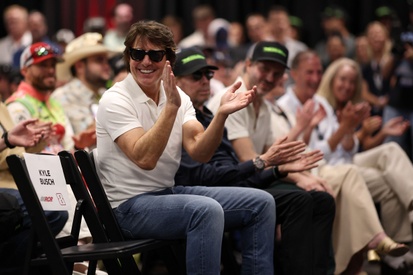

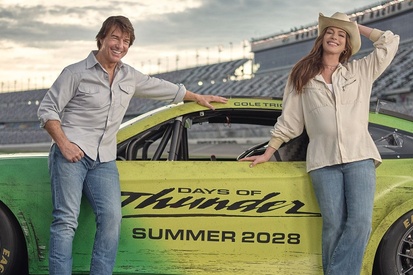
DAYTONA BEACH — Tom Cruise walked into the NASCAR Cup Series driver’s meeting at Daytona International Speedway on Saturday evening and announced Days of Thunder 2, and the room went quiet before it went loud.
The sequel to the 1990 Tony Scott racing film will open in IMAX theaters on June 2, 2028. Anne Hathaway will co-star as a team owner and engineer opposite Cruise’s returning Cole Trickle. Jonathan Levine, whose credits include Long Shot and the recent Mr. Irrelevant, will direct. Jerry Bruckheimer, who produced the original alongside Don Simpson, is back as a producer alongside Cruise and Tommy Harper.
Cruise did not make the announcement from a studio lot or a press conference. He made it at Daytona International Speedway, in the room where drivers receive their pre-race briefings, in front of the people the film is nominally about. That choice was deliberate. “Last time I was at this track,” he told the assembled drivers, “the hood was off the car and the whole car was in flames.” He described the project as being about the community and the people of the sport, the language of someone who has learned that NASCAR’s core audience can tell the difference between a production using their world as scenery and a film that might actually understand it. The reception in the room suggested the framing worked.
The economics of a sequel that spent 35 years not getting made changed dramatically in 2025, when the F1 film starring Brad Pitt crossed $600 million globally. That number established a ceiling for motorsport-as-cinema that studios had not previously tested at scale, and it transformed Days of Thunder from a periodic development discussion into a greenlit project with locked release dates. The original earned $157.9 million against a $60 million production budget, respectable for 1990 but not a number that had historically made the case for returning to dormant IP this comprehensively.
Days of Thunder had a longer cultural afterlife than its box office suggests. The film’s dialogue became part of NASCAR’s internal vocabulary in ways that persisted for decades. Kyle Busch, the veteran driver whose career-long nickname “Rowdy” was borrowed directly from the character Cruise played in the original, had reportedly consulted with the film’s writers before his death in May 2026. That thread runs through the production’s origin story without resolution. The writers know what they discussed with him; how much makes it into the finished film, and how the production handles that publicly, is one of the genuine unknowns the project carries into development.
Levine is the hire that tells you the most about what Cruise and Bruckheimer are attempting. He is not a director built for franchise action at this scale. His register runs to character-driven material and the kind of comedy-drama that turns on performance rather than production size. If the project wanted pure spectacle with racing mechanics, it would have gone to someone whose reel makes that argument. Levine’s presence suggests the goal is a film centered on Cole Trickle the person, not Cole Trickle the driver. That is the harder version to make and the one with a longer commercial shelf life if it works, particularly for international audiences who will not arrive with any existing relationship to NASCAR as a sporting proposition.
The 2028 IMAX commitment is significant industrial information in its own right. IMAX dates are negotiated years in advance, and locking June 2 is a statement about the expected category of this release, at a moment when the premium theatrical calendar has become one of the most competitive in recent memory. Cruise’s relationship with IMAX is long and productive; he has treated the format not merely as a distribution upgrade but as a production discipline, building sequences around what the format actually requires. Whether Levine works that way remains to be established.
What the announcement left open is considerable. According to Motorsport, which reported from the Daytona event, no studio has been publicly named for the project. Hathaway’s representatives have not officially confirmed her contract. Production budget has not been disclosed. These gaps are normal for an announcement at this stage, but they mean the full shape of the project remains unclear.
Cruise’s appearance on the garage floor at Daytona was the opening bid in a campaign to make NASCAR’s audience feel genuinely invested rather than marketed to. The structure is in place. Whether the film itself closes that deal will depend on what Levine, Cruise, and Hathaway deliver when cameras roll.