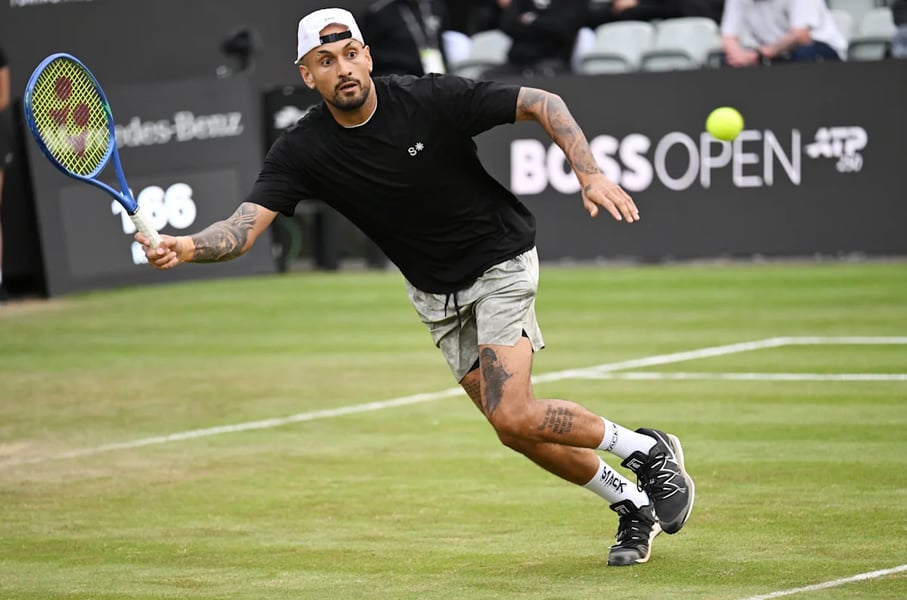

LONDON — The man who made himself the loudest voice on tennis’s doping problem has accepted a one-month suspension for cocaine use, and is eligible to return to competitive play today.
Nick Kyrgios, 31, tested positive for benzoylecgonine, a metabolite of cocaine, in a sample provided at the ATP 250 event in Mallorca, Spain, on June 22. The International Tennis Integrity Agency confirmed a World Anti-Doping Agency-accredited laboratory detected the substance on July 17. A mandatory provisional suspension began August 4. On September 3, Kyrgios accepted a one-month ban, completing a treatment program that reduced the default three-month penalty under WADA’s substances of abuse framework to a single month. His suspension, by the calendar, ends today.
He forfeited 6,570 euros in prize money and ATP ranking points from Mallorca. As of this week, he is ranked 919th in the world.
Kyrgios broke the news on Instagram in a statement that contained no ambiguity and no attempt to minimize what had happened. “I recently failed a drug test in Mallorca after testing positive for cocaine. I made a huge mistake and take full responsibility for it.” He added: “I’m sorry to my fans, my family, my sponsors and everyone close to me. Above all, I’m sorry to the kids who follow me. I know the example this sets and I’m deeply disappointed in myself.”
What he described next carried more weight than the apology. He cited injuries over two years that had reduced one of the most naturally talented players of his generation to 2 wins from 10 ATP singles matches since his 2022 Wimbledon final, ranked 919th, entering tournaments he would have once been seeded inside the top ten to win. “At times I’ve felt helpless and alone,” he wrote. The cocaine use happened on a night out before a match in Mallorca. The suspension, he said, had given him “a wake-up call.”
Twelve days before the positive sample was collected, Kyrgios had won his opening match in Stuttgart: his first tour-level singles victory in 15 months, a 6-3, 6-4 clinic against the 36th-ranked Corentin Moutet in which he served at 84 percent and faced not a single break point. That Stuttgart win had looked like the beginning of something: proof that the knee surgeries, the wrist, the accumulated injuries that had taken him from the 2022 Wimbledon final to the fringe of professional tennis might finally be behind him. Twelve days later, he tested positive for cocaine in Mallorca. He subsequently withdrew from the US Open. No firm return date exists beyond the suspension’s formal end today.
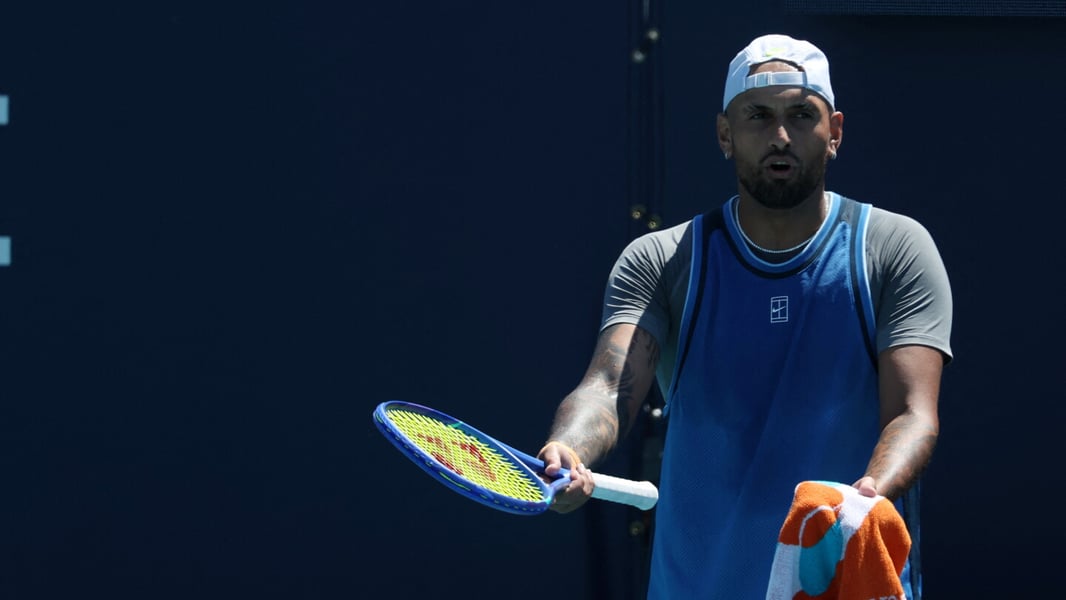
The difficulty of separating the sports story from its broader context is considerable. Kyrgios had spent the months before his positive test as perhaps the most vocal critic of doping outcomes in professional tennis. He attacked the handling of Jannik Sinner’s clostebol case publicly and repeatedly, calling the Italian’s acquittal evidence of a system built to protect its most marketable names. He raised similar questions about Iga Swiatek’s trimetazidine suspension, which lasted 31 days without significantly disrupting her playing schedule. His argument, stated bluntly on social media, was that the sport treated its biggest stars differently than anyone else.
Those statements now sit alongside his own positive test result. The drug is different: clostebol and trimetazidine, the substances Sinner and Swiatek tested positive for, are performance-related under specific interpretations of the WADA code; cocaine is a stimulant and a substance of abuse, prohibited in-competition under a separate framework. The argument about competitive advantage does not travel to recreational cocaine use the same way it travels to contaminated supplements. But the fact of the test, the timing of the statement, and the public record Kyrgios left behind create a juxtaposition the sport will not let go quietly.
His peers have not. Stefanos Tsitsipas told reporters he was not surprised, adding that he had known about the cocaine use before the announcement. Karen Khachanov was more direct: “What goes around comes around.”
The ITIA found that the cocaine use had occurred outside of competition, a finding that activated the substances of abuse provision allowing the penalty reduction to one month upon completion of a treatment program. Kyrgios chose not to appeal. The Dan Evans comparison is the nearest precedent in professional tennis: the British player received a 12-month suspension in 2017 after testing positive for cocaine at the Barcelona Open, also determined under the out-of-competition framework. Evans returned from that ban, rebuilt his ranking to a career-high of 21, and became one of the more durable players on the ATP Tour for several years. NBC Sports reported that Kyrgios chose not to contest the ruling. Yahoo Sports reported that the suspension concludes today.
Whether the pause produces anything depends on questions a one-month ban cannot answer. Kyrgios described, in his statement, a mental state that produced the night out in Mallorca: a 31-year-old athlete trying to figure out whether the career is real or over, finding the answer neither satisfying nor clear, feeling helpless in a way the sport’s injury framework offers no protocol for. A treatment program addresses the behavior. It does not address what was described underneath it.
He is eligible to compete again today. The ATP Tour schedule stretches forward. The question is not whether Kyrgios can return. The question is whether the version capable of winning at Stuttgart last June, the version that served 84 percent to a top-40 opponent and looked suddenly dangerous again, can be found inside the same person who spent a night out in Mallorca doing cocaine before a professional match. That is not a question the calendar resolves.
Related Posts