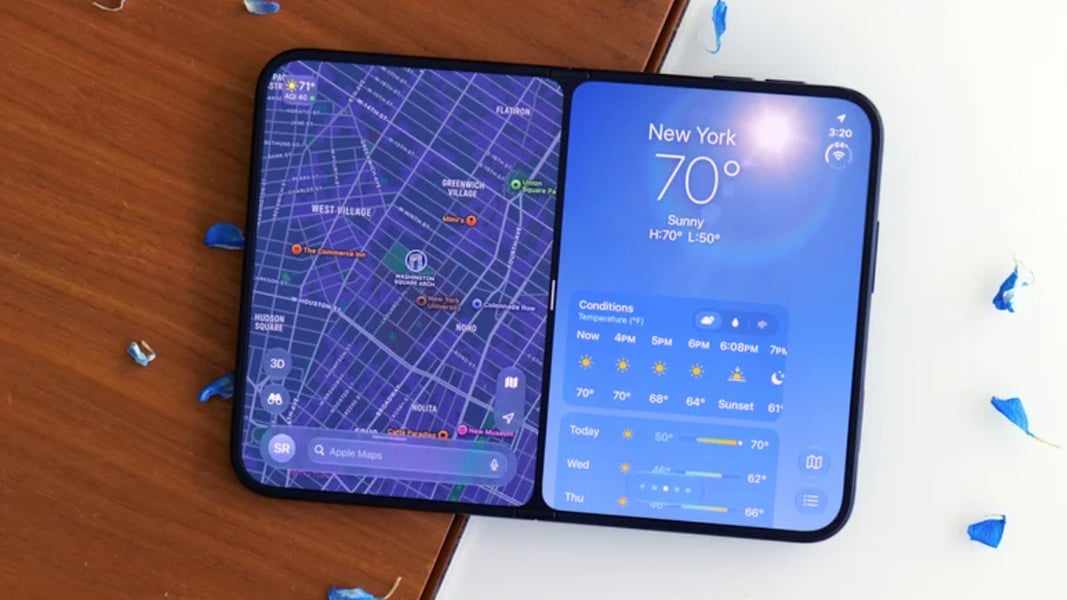

Owners of an iPhone Duo with a cracked inner screen now face a more clearly documented service process, but not a recall. Apple has sent stores and authorised service providers internal instructions on inspecting affected phones and arranging a repair or replacement, according to a memo obtained by MacRumors.
The October 30 report adds a service-network response to Apple’s earlier public acknowledgment of a display problem. The company still describes the affected population as a small number of units and has not disclosed how many phones have failed.
The instructions do not establish that every visible screen defect has the same cause or qualifies for an identical remedy. They tell technicians to inspect the device and follow standard procedures, rather than announcing a blanket replacement policy for all cracked displays.
According to MacRumors’ account of the memo, Apple shared the guidance with Apple Stores and Apple Authorized Service Providers during the week. The Eastern Herald has not independently obtained the internal document. The report describes diagnosis and handling instructions, not a change to the phone’s hardware.
Apple’s public response came earlier. In a statement supplied directly to Engadget on October 26, the company said it was aware of an issue affecting the inner display on a small number of iPhone Duo units and directed users experiencing display problems to AppleCare for a replacement.
That replacement offer was the focus of The Eastern Herald’s October 28 report. The new development is the reported distribution of instructions to the people assessing the phones. A memo can make handling more consistent without establishing that the problem has become more common.
MacRumors reports that Apple says most units are not susceptible and affected devices appear to develop defects quickly after use begins. That is not a published statistical threshold or a guarantee that a phone which survives its first few days cannot later develop a fault.
The chronology is unusually compressed. Customer deliveries began October 23, and early adopters soon reported cracks and lines on the inner display. By October 26, Apple had acknowledged the issue publicly. The memo report followed one week after launch, while the cause remained unsettled.
Some reports describe lines running down the middle and across the right side of the screen. Those patterns are important to the technical investigation, but a damaged row or column of pixels does not necessarily reveal the size or exact location of the original mechanical fault.
In its October 25 teardown, repair specialist iFixit compared reported damage locations with a hinge model built from teardown footage, patents and CT scans. It identified a possible stress concentration near the transition between the crossing-cable gap and the central hinge support.
One simulation explored what could happen if the central support bar failed to drop far enough during closing: the curved display could press onto it, producing a local stress hotspot. The teardown presents that as a possible explanation. It does not establish that this happened in every affected handset, and Apple has not confirmed the underlying cause.
The distinction between the size of a fault and its visible consequences also helps explain why dramatic screen photographs cannot provide a failure rate. iFixit notes that a local fault in tiny electrical connections can affect an entire row or column. Neither the photographs nor a model supplies the number of failed units relative to the number sold.
Repairability is a separate question. iFixit gave the Duo a provisional five out of ten, its highest score for a foldable at the time, citing accessible components and batteries that release electrically. Yet it also described inner-display and hinge work as demanding. A comparatively repairable foldable can still have an expensive and difficult screen assembly.
The teardown lists $999 for inner-display damage without coverage. That figure should not be confused with the charge for an Apple-acknowledged defect eligible for replacement. The reported memo does not provide a universal price schedule or settle every distinction between a manufacturing problem and accidental damage.
For now, Apple’s stated route for owners experiencing display issues remains AppleCare. MacRumors reports that Apple says there is no iPhone Duo recall and that no public-facing repair programme has been launched for this issue. A technician’s assessment under standard procedures remains different from a public campaign covering a defined set of devices.
The service guidance answers who should inspect an affected phone and how to route the case. It leaves the larger questions open: the failure rate, whether particular production batches are involved, and whether any component or manufacturing change will be needed. Apple has not publicly supplied those answers.