
Buying trackers for several bags or sets of keys costs less under a reported Amazon offer, but the discount is not the only condition to check. Buy Side reports Apple’s second-generation AirTag four-pack at about $70, while Apple’s own US store continues to list the bundle at $99.
That is a saving of roughly $29, or 29 percent, against Apple’s four-pack price, and an average of $17.50 per tracker. The reported offer concerns the second-generation product introduced in January, not remaining stock of the original AirTag.
The price needs a qualification before any purchase decision. The Eastern Herald could identify the second-generation four-pack listing on Amazon, but the retailer returned a shopping-verification screen rather than an accessible live price. The $70 figure is therefore a reported offer, not an independently verified checkout price, and availability may change.
In Buy Side’s deal report, senior editor Nick Guy describes the four-pack as falling below a previously observed $80 price. Its headline calls this the lowest price ever. This article does not independently verify that historical claim: a retailer discount and a complete price-history record are different kinds of evidence.
For comparison, Apple’s current US product page lists $99 for four and $29 for one. The reported Amazon price is a US-dollar offer, not an announcement of a worldwide price cut by Apple. It does not establish a corresponding discount in other national stores.
The bundle arithmetic also has limits. Four trackers at $70 average $17.50 each only if all four are useful to the buyer. Someone who needs one tracker would spend less in total on a single unit at Apple’s $29 list price, even though the bundle has the lower per-unit cost.
The more consequential restriction for some owners is compatibility. Apple requires an Apple Account and an iPhone running iOS 26 or later, or an iPad running iPadOS 26 or later. Certain functions require Find My to be enabled in iCloud settings. An older phone that cannot meet those requirements is not made compatible by the sale.
Expanded Precision Finding has a narrower hardware list than basic setup. Apple’s product-page footnote specifies iPhone Air or iPhone 15 and later, excluding iPhone 16e and iPhone 17e. Availability varies by region. Buyers should distinguish the ability to register a tracker from access to its improved nearby-finding range.
Apple Watch support also comes with conditions. Precision Finding requires Apple Watch Series 9 or later, or Apple Watch Ultra 2 or later, with watchOS 26.2.1. The watch can provide directions toward a nearby item on supported hardware; that does not mean every watch that runs Find My receives the same directional experience.
The hardware improvements were the subject of The Eastern Herald’s January launch coverage. In its official announcement, Apple says the newer Ultra Wideband chip extends Precision Finding by up to 50 percent compared with the previous generation. It also says the redesigned speaker is 50 percent louder and can be heard from up to twice as far away.
Those are Apple’s comparative claims, not independent performance measurements made for this deal report. They describe nearby retrieval, such as locating keys inside a home, rather than a guarantee that a lost bag anywhere in the world will immediately appear on a map.
At longer distances, the system depends on the Find My network. Apple describes a crowdsourced network of devices that detect an accessory over Bluetooth and relay its approximate location to the owner. That makes nearby participating devices part of the recovery process; the AirTag is not a continuously reporting cellular tracker.
For luggage, the new AirTag works with Share Item Location, which lets an owner temporarily share an item’s location with a participating airline. Apple says shared access can be ended by the owner, automatically expires after seven days and is disabled when the owner is reunited with the item. Sharing a location is assistance with recovery, not a promise that an airline will retrieve a bag.
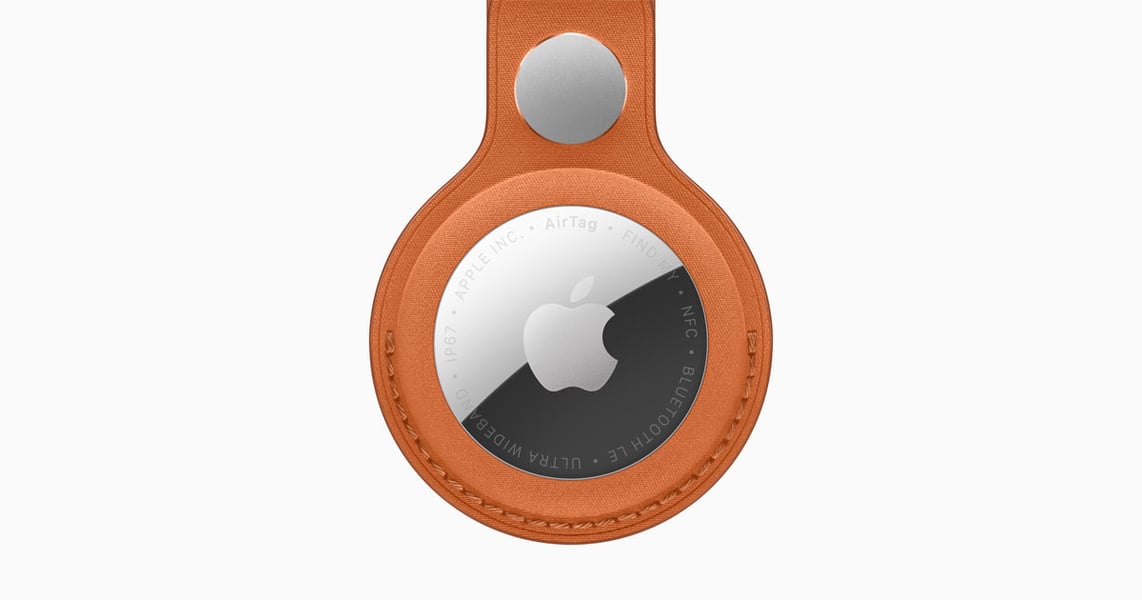
There are additional costs to distinguish from the four-pack price. Apple says accessories are sold separately, although the second-generation AirTag retains the original form factor and works with existing AirTag accessories. The box contains four trackers; a photograph showing one attached to a key ring should not be taken as confirmation that the holder is included.
Apple describes AirTag as designed for objects, not people or pets, and says it includes cross-platform unwanted-tracking alerts and frequently changing Bluetooth identifiers. The sale does not change those safeguards or turn the device into a tool intended for covert monitoring.
The open question remains the offer itself. Buy Side reports the discounted bundle, and Apple’s $99 comparison price is publicly visible, but Amazon’s live price, seller details and delivery availability were not accessible during this check. No verified end date is available for the reported discount.