
DETROIT — On October 1, Jalen Duren will have a choice neither side wanted him to face.
He can sign the $9.6 million qualifying offer the Detroit Pistons placed on the table when free agency opened, become an unrestricted free agent next summer, and spend this entire season playing for a team that could not reach his number. Or he can keep waiting, hoping Detroit closes a gap that has sat at roughly $5 million per year for nearly two months without movement from either direction.
The center is 22 years old. Last season he averaged 19.5 points and 10.5 rebounds, earned his first All-Star selection, and collected Third-team All-NBA honors. The Pistons have offered approximately $35 million annually on a five-year deal, according to CBS Sports. Duren is seeking more than $40 million per year. The Rose Rule makes him eligible for a maximum worth $287 million over five seasons. Since the standoff formed in early July, the two sides have been in near-radio silence.
The calendar is now the loudest voice in the room.
Detroit will not discuss a sign-and-trade framework, according to reporting around the negotiations. That forecloses what is typically the middle path in situations like this one: the mechanism that lets a franchise keep a player’s value from becoming someone else’s asset. The Pistons’ position appears to be that the gap either closes through a direct extension or the two sides run out of time.
The gap may not close.

The market has not generated the outside pressure that might force Detroit to move. The Los Angeles Lakers and Sacramento Kings both met with Duren when free agency opened. Neither has the cap space to submit a competitive offer sheet on a restricted free agent. No team has filed one. That leaves the qualifying offer as Duren’s primary negotiating instrument: accept $9.6 million, play 2026-27 as a technical rental, and walk to unrestricted free agency in July 2027. At that point Detroit has no matching rights and receives nothing in return.
That is the scenario the Pistons cannot afford. Duren is not one part of the rebuild. He is the foundation of it. Detroit’s front office constructed a run of consecutive playoff appearances around the assumption that he and Cunningham would develop in parallel, a pairing that gives the franchise two cornerstones at 22 and 24. A Duren who signs the qualifying offer remains on the court but exits the architecture entirely. He will play every minute of 82 games, and then he will leave. The Pistons will receive nothing for the four years they spent developing him into an All-Star center.
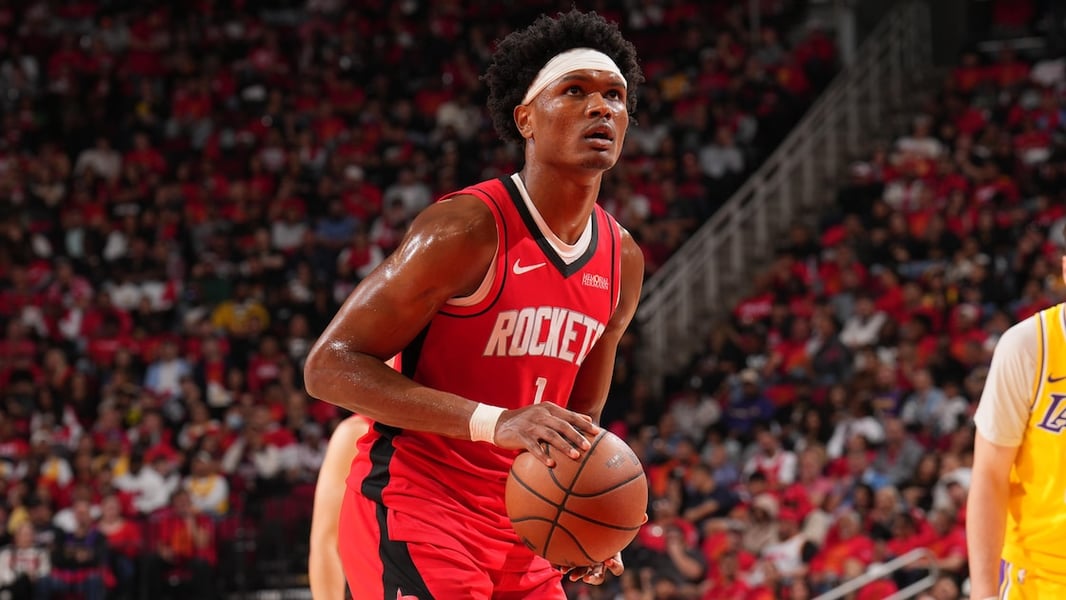
For context on what the current market looks like for restricted free agents with comparable profiles, Amen Thompson’s recent $208 million extension with the Houston Rockets illustrates both sides of the argument. Thompson was 23, averaged 18.3 points and 7.8 rebounds, and accepted $43 million below his available maximum because the Rockets made the number work within a clear championship framework. Duren is being asked to do something similar on a team that hasn’t won a playoff series yet.
As covered in the 2026-27 NBA season preview, Detroit entered the offseason as one of the quieter contenders in the Eastern Conference, a team that had outperformed projections in back-to-back seasons. That projection assumed the core stays together.
The Pistons’ front office has not said publicly what happens if October 1 arrives without a deal. Duren’s representation has not issued any statement about the qualifying offer. Both parties appear to have moved into the territory where the only remaining action is the deadline itself.
Twenty-eight days is not much runway. Detroit has a training camp to open and a roster assembled as if Duren will be in it for the long haul. Whether that assumption survives October 1 is the one question that two months of silence has not answered.