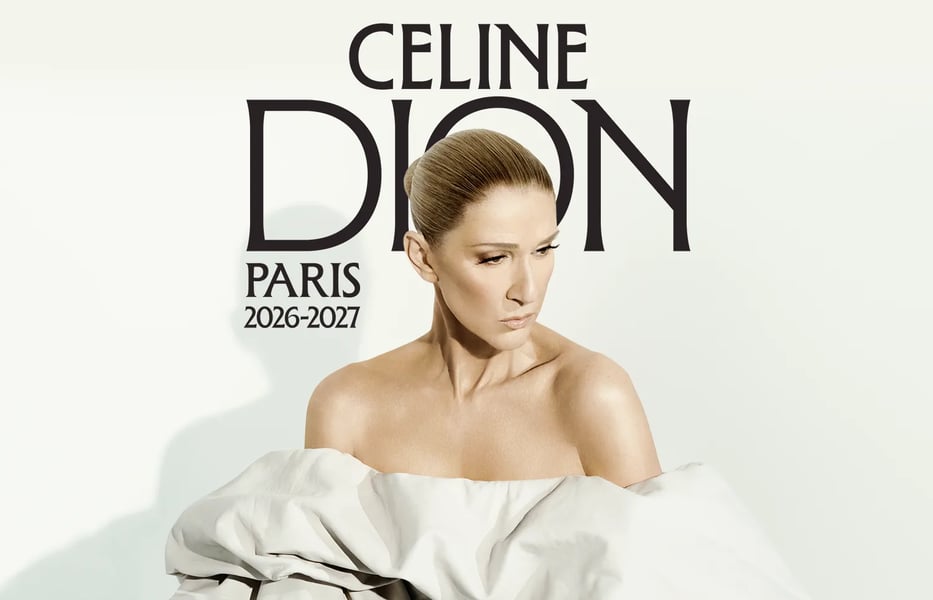

PARIS — For much of the show’s opening minutes, Céline Dion stood at center stage and wept.
She told the 30,000 people packed into the Plenitude Arena in Nanterre, on Paris’s western edge, that she might not be able to finish. She had warned them of that possibility for months. What she could not have known—and what no physician could predict—was whether her body would cooperate for the two and a half hours that followed.
It did. Mostly.
The question of whether Dion could sustain a full concert had shadowed every announcement, presale, and interview since she disclosed her diagnosis of stiff-person syndrome in December 2022. The rare autoimmune neurological disorder, for which there is no FDA-approved treatment, causes progressive muscle rigidity, debilitating spasms, and extreme sensitivity to noise and touch. At its worst, it had left her unable to walk without a walker, swallow without difficulty, or sing at all.
On Friday night in Nanterre, she opened with “On Ne Change Pas,” the Jacques Goldman-penned anthem she first released in 1999, and cried through the first verse.
The crowd did not fill the silence that followed. It held it with her.
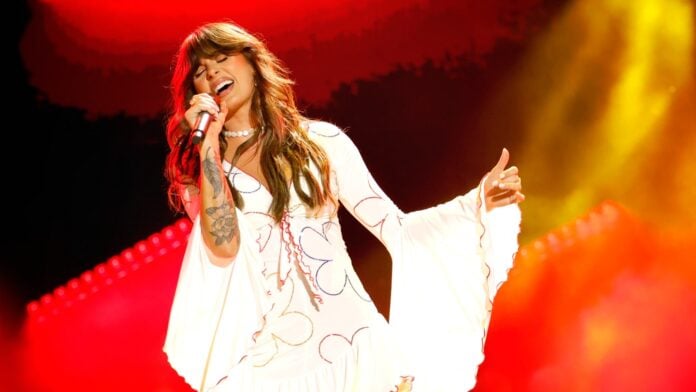
What happened over the next 167 minutes was not a concert so much as a reckoning: between an artist and an illness that had tried to take the stage from her entirely, between a woman who had spent forty years performing and a body that had spent the last four resisting. She started 47 minutes late. By the time the set closed, shortly before midnight, she had sung an opera aria under simulated snow, performed “All by Myself” a cappella without amplification, and debuted a new single, “Dansons,” the latest Goldman composition from their reunion sessions.
The last time Dion had performed publicly before Friday was at the Paris 2024 Olympics opening ceremony, when she stood on the Eiffel Tower’s first-floor platform and sang “L’hymne a l’amour.” That appearance, which she has described as her one chance to show the world she was still alive, came with an enormous physical cost: weeks of preparation, targeted immunotherapy adjustments, and a recovery interval her medical team characterized as unusually prolonged even by the unpredictable standards of her condition.
Dr. Amanda Piquet, the neurologist who leads her care at the University of Colorado Anschutz Medical Campus, has been clear in multiple settings about the limits of what medicine can promise anyone with Stiff Person Syndrome. The drugs in Dion’s regimen, including high-dose intravenous immunoglobulin, diazepam, and baclofen, were developed for other conditions and applied off-label. There is no standard protocol. There is no cure. There is, at best, a managed relationship between patient and disease that may hold or may not.
NPR’s coverage of the concert noted that attendees described the opening as unlike any they had attended, closer in atmosphere to a public reckoning than a performance.
Dion’s recovery regimen has been methodical: ninety-minute Pilates sessions three times a week, ballet twice weekly to restore proprioceptive function, and vocal therapy that began not with scales but with breathing, because Stiff Person Syndrome can compromise the diaphragm’s ability to generate the pressure singing requires. “The least I can do,” she told Harper’s Bazaar in an interview published in August, “is tell them that I’m alive.”
The concert’s staging leaned toward the intimate despite its scale. A gospel choir joined for the climax of “Because You Loved Me.” A string section came forward for “The Power of Love.” She spoke between songs in French and English, sometimes mid-sentence switching between them without breaking the thought. She joked about the late start. She thanked the medical staff who travel with the production. She cried again during “I’m Alive,” which felt less like a song choice and more like a statement of fact.
“Dansons,” the new track performed third from the end, surprised the portion of the crowd unfamiliar with the studio recording released three weeks earlier. Goldman wrote it in 2025; Dion recorded it across two sessions when her voice was strong enough, and the production team built the album version around her rather than building her voice around the production. Live, it felt lighter than much of the catalog, not a defiant return anthem but something more conversational, as if she were still working out, in public, what it means to be back.
For artists navigating a return to public life after prolonged absence, the question is almost always one of terms. At this week’s TIFF Tribute Awards, Fan Bingbing reappeared on an international stage after years of near-total withdrawal, having chosen a curated, controlled moment over a live performance. Dion chose the opposite: two and a half hours, an uncertain body, and 30,000 witnesses.
What Friday’s concert could not resolve is whether the residency will run to its scheduled conclusion in the spring. Dion’s team has said, carefully, that each date will be evaluated independently. She has said the same. The Paris Residency is not a triumph yet. It is a beginning, with all the contingency that word carries for someone whose illness does not negotiate with concert schedules.
The next show is September 14.