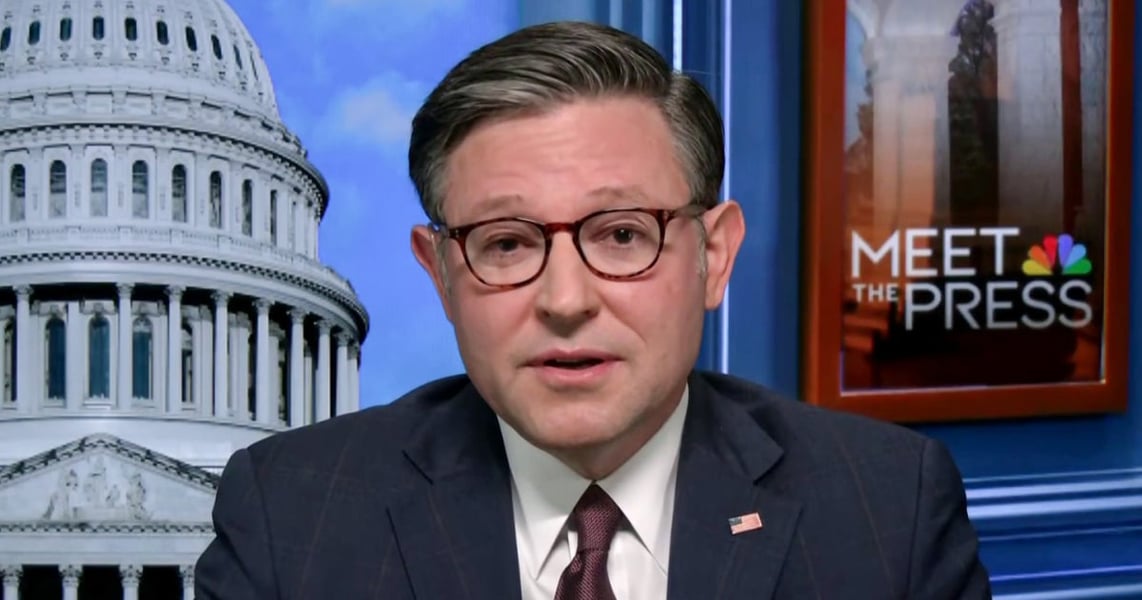

WASHINGTON — House Speaker Mike Johnson could not quite commit on Sunday.
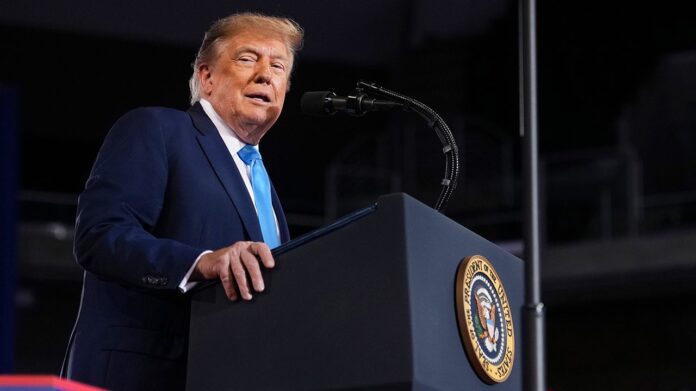
Appearing on NBC’s Meet the Press with host Kristen Welker, the Louisiana Republican became the first senior party figure to publicly address what President Trump has called the “Trump dividend” — a promise made at the Republican midterm convention in Dallas last week to send $5,000 to every American adult if Republicans hold the House and Senate in November.
Johnson told Welker that Congress would “work through it and find consensus on that,” that the checks could take “some time,” and that he would work “hand in hand” with Trump if Republicans won congressional majorities.
He did not say yes. He did not say no. He said Congress would try.
That hedge, after four days of direct contradiction between Trump and his own speaker, now defines the legislative reality behind a promise that has consumed national political attention since September 9.
Trump told CBS Texas that he did not believe the payments would require congressional approval — “We think not,” he said when asked directly. Commerce Secretary Howard Lutnick, in his own interview with NBC News, said the checks would not be taxpayer-funded, without identifying the legal authority under which the Treasury would otherwise be compelled to issue them.
Johnson, on Meet the Press, made clear Congress would need to be involved. Constitutional scholars agree. The Appropriations Clause requires that spending drawn from the Treasury be authorized by Congress — an executive announcement, however emphatic, does not substitute for legislation. The gap between Trump’s declared position and Johnson’s measured Sunday hedging is not a minor procedural disagreement. It is the Constitution.
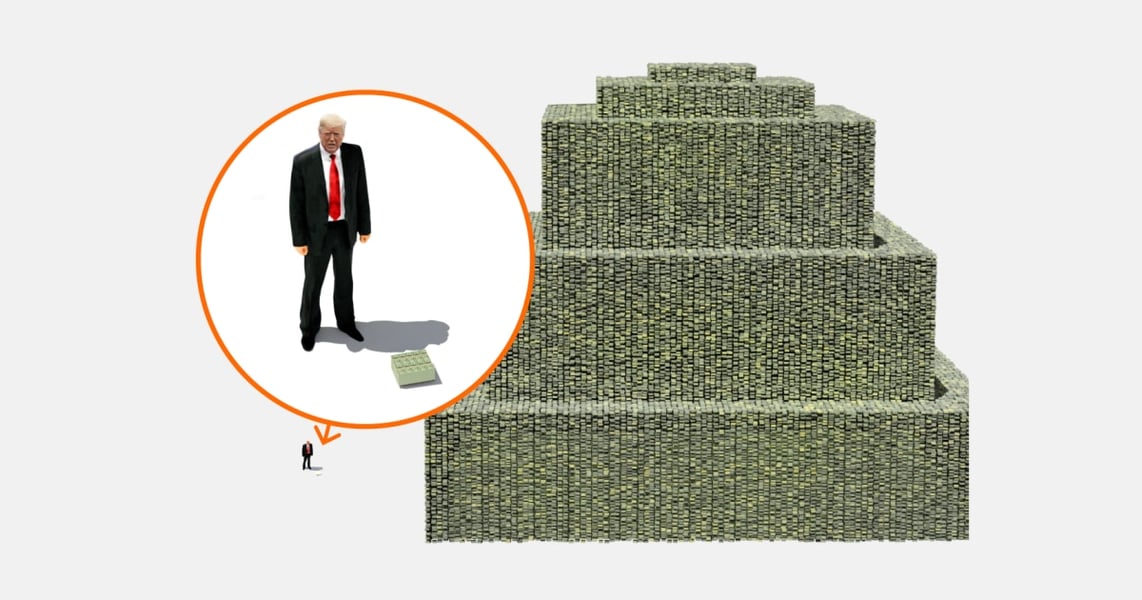
The money question is the other wall. The federal government collected an estimated $167 billion in tariff revenue through the fiscal year ending September 30, according to the Congressional Budget Office. A one-time payment of $5,000 to every American adult would cost between $1.2 trillion and $1.3 trillion. The Cato Institute has calculated that even projecting a full decade of tariff revenue forward, the total would cover only 60 to 75 percent of a single year’s payout — and that is before accounting for the Supreme Court’s ruling last year that struck down significant portions of Trump’s tariff program, reducing the very revenue stream he most frequently cites. There is no account from which $1.3 trillion can be drawn without Congress appropriating it.
Two House Republicans broke ranks before Johnson said anything. Representative Chip Roy of Texas told reporters he wanted to know how the administration planned to pay for “well over $1 trillion” in new spending. Representative Ralph Norman of South Carolina said he had “serious concerns” and would not back the proposal until he saw a credible funding mechanism. Neither framed their skepticism as disloyalty to the president; both framed it as a question about arithmetic.
The precedent is not encouraging. Early in Trump’s second term, he and Elon Musk endorsed a “DOGE dividend” to distribute savings from the Department of Government Efficiency. That promise disappeared when the projected savings did not materialize in a form that could be distributed. A $2,000 “tariff rebate” Trump promised would arrive by mid-2026 — also funded by tariff revenues — also never came. The cycle has grown familiar enough that Virginia Democratic Congressman James Walkinshaw could simply recite it on Sunday: “That would have been almost exactly $5,000 as well, and those checks haven’t gone out, because that was made up.”
NBC News, which has tracked all three unfulfilled promises in sequence, described the current $5,000 pledge as “familiar, costly and impractical” in a recent analysis — a verdict that applies, with equal force, to its predecessors.
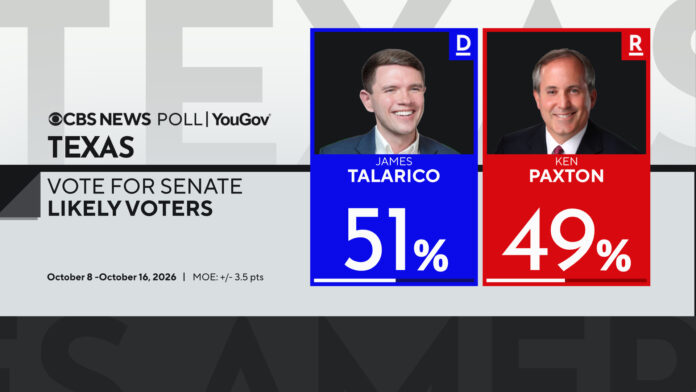
What that pattern creates in competitive Senate races is a credibility problem that no Sunday television appearance can resolve. Republican candidates in Ohio, Iowa, Texas, and Alaska are already navigating terrain where the president’s approval ratings have turned hostile and the margins are shrinking. Asking voters in those states to hold out for a $5,000 check — contingent on victory, funded by a mechanism Johnson declined to specify and Trump insists requires no legislative vote — demands a degree of trust the party’s own internal polling suggests is in short supply.
Johnson left Meet the Press without a timeline, without a bill, and without a commitment. The same, for now, is true of the $5,000 itself.