
WASHINGTON — Jon Husted did not have to campaign in a competitive state. When the Ohio Republican initiated his Senate campaign in early 2025, he was operating on terrain Donald Trump had won by more than eight points. That margin, together with a Republican majority in Washington and a national political climate that had just secured Trump a second term, rendered Ohio appear like a manageable contest at worst.
It does not appear that way now.
Civiqs’ rolling national tracking poll indicates Trump’s net approval rating has dropped to minus 24 among registered voters — 35 percent approve, 59 percent disapprove. In Ohio specifically, where Trump entered 2025 at plus 8, his net approval has declined to minus 17. That represents a 25-point shift in a state where Husted now confronts a renewed challenge from former Democratic senator Sherrod Brown, who lost his seat in 2024 and has declared his intention to recover it.
Ohio is not the sole state where the calculations have transformed. NBC News reported Saturday that there is a growing sentiment in both parties that the Senate is now genuinely contestable — a conclusion that would have been dismissed as a liberal fantasy twelve months ago. Georgia senator Jon Ossoff, defending a seat in a state Trump carried by 2.2 points in 2024, is campaigning with Trump at minus 21 in state polling. Nevada has moved from even to minus 23. North Carolina, which Trump won in 2024 with a comfortable margin, has shifted to minus 16. Florida, which entered 2025 at plus 9 for Trump, now stands at minus 10.
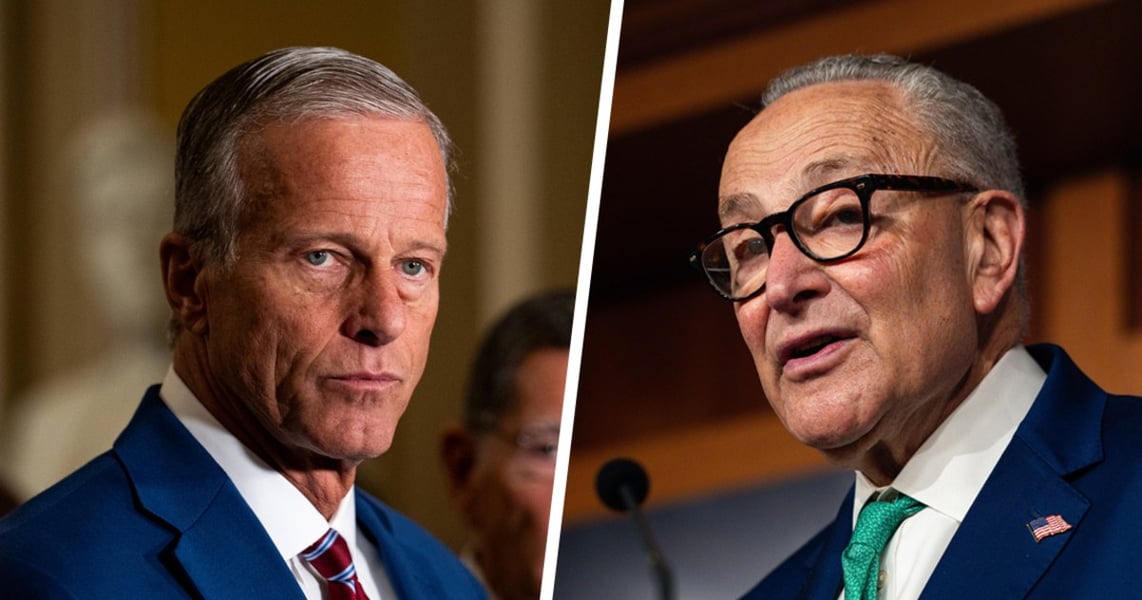
Republicans are protecting a three-seat Senate majority. Democrats require a net gain of two seats to seize control, contingent on the outcome of the vice-presidential tiebreaking vote. The map remains tilted Republican in the sense that Democrats must prevail in states Trump carried to attain that threshold. But the margin for error on the Republican side has contracted considerably from where it stood at the year’s start.
The structural issue is not a single unfavorable polling month. Civiqs monitors presidential approval on a rolling daily basis, and the trend line in battleground states has been steady and directional since March. Trump’s national figures briefly rebounded to 43 percent in April before continuing their descent. The September average across major pollsters — Gallup, Reuters/Ipsos, YouGov, Quinnipiac, Morning Consult — places his approval between 33 and 38 percent, with a composite near 37.

That range is significant because Senate incumbents traditionally need to outpace their party’s presidential approval by 5 to 10 points to endure in competitive states. In a state where Trump is at minus 17, a Republican Senate candidate must either suppress Democratic turnout or generate sufficient split-ticket support to surmount the gap. The party’s internal modeling for those scenarios presumes a relatively normal midterm environment. The environment is not normal.
The Dallas convention last week generated a headline pledge — $5,000 for every American adult dependent on Republican victory in November — that fiscal conservatives in the House labeled a “socialist vote-buying scheme,” and that the Tax Foundation says would cost $1.25 trillion, approximately six times annual tariff revenue. Trump’s own party’s competitive senators were not in the room. Maine senator Susan Collins, running against Democrat Troy Jackson with the presidency a visible liability, declined to attend. Ohio’s Husted was also absent. The convention produced a message that the conservative wing of the party has publicly contested within 96 hours, as Eastern Herald reported.
Meanwhile, Democratic candidates are outraising their Republican opponents in the majority of competitive Senate contests. The Democratic Senatorial Campaign Committee has cited polling showing the party competitive or leading in states Republicans expected to defend without significant spending. The Cook Political Report, in its most recent ratings, has rated Georgia as the top toss-up of the cycle, with Ohio and Nevada also in its battleground tier.
What the polling does not capture is candidate quality. Sherrod Brown ran Ohio twice, winning in 2006 and 2012 in environments hostile to Democrats, before losing in the 2024 wave. He is not a standard-issue challenger. Troy Jackson in Maine represents a more conventional matchup against an incumbent, Susan Collins, who has consistently outpaced presidential approval in her state by double digits. Collins’ capacity to achieve that separation, however, depended in part on a Republican president whose approval ceiling was higher than Trump’s current floor.
Republicans have contended that the fundamental dynamics of Senate elections are candidate-specific, that individual incumbents and their relationships with constituents matter more than presidential approval ratings in off-year elections, and that the map’s structural advantages will reassert themselves as Election Day approaches. Those arguments have some historical foundation. There is also historical precedent for a wave election in which the structural advantages disintegrate.
The administration concurrently managing a Supreme Court emergency on mail-ballot delivery, a lawsuit over armed ICE agents at polling places, and a convention promise that its own fiscal conservatives have publicly rejected is not an administration in a position to buoy its Senate candidates in the final 51 days. What candidates like Husted in Ohio, or the Republican incumbents in Montana and other states Trump carried narrowly, will tell their constituents about the administration’s record — and whether any of it closes the gap in states where Trump’s approval has moved 20 points in the wrong direction — is the question neither a convention speech nor an approval rating resolves.
What the map looked like in January and what it looks like today are not the same thing. Whether they look different again on November 3 is still unknown.