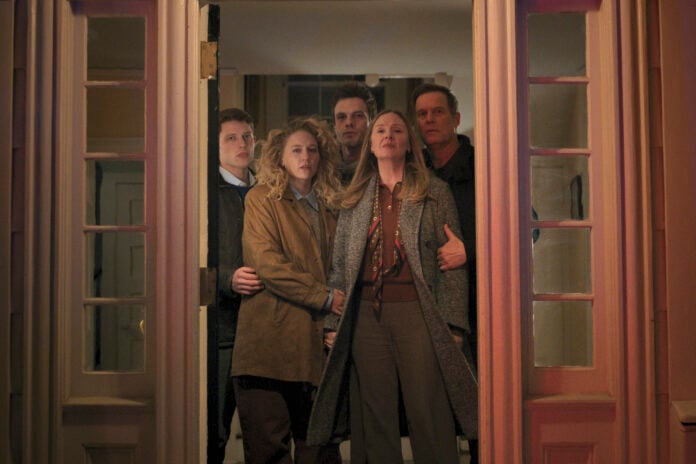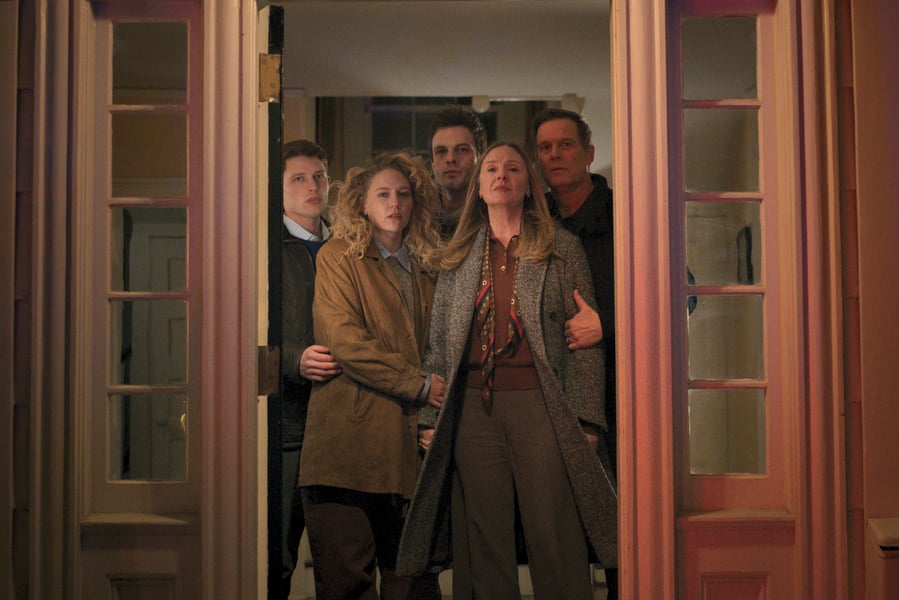

LOS ANGELES — When Jenna Bush Hager was a child, she had an unusual set of house guests: Secret Service agents who shadowed her family around the clock, men and women she came to know by name, whose professional detachment masked the kind of loyalty she would only understand years later. Decades on, that experience sits at the center of “Line of Fire,” NBC’s new family thriller, which premieres Monday night at 10 p.m. ET.
The series, created by Josh Safran and streaming the following day on Peacock, follows the Egan family, a husband and wife each pursuing separate careers in federal law enforcement, through a conspiracy that cuts across the FBI, U.S. Marshals, Secret Service, and Department of Justice. What distinguishes the premise from the standard network procedural is that the case does not stay separate from the family at its center. The conspiracy eventually turns on them.
Peter Krause plays Mike Egan, a veteran Secret Service agent making his first series regular appearance since leaving “9-1-1” in 2023. His counterpart is Hope Davis as Jane Egan, a seasoned DOJ attorney whose professional judgment has become the sharpest instrument in their marriage. Their adult children, spread across federal agencies, are drawn into the conspiracy on its own timeline, not theirs. “It’s probably 40 percent case of the week, 50 percent family drama, and 10 percent mythological,” showrunner Safran told reporters last month.

The supporting cast deepens the show’s political texture. Sam Waterston plays former President Thomas Barnes, a man with a deep bond to Mike from years on detail and a close call that both have kept quiet. Campbell Scott’s senator is pursuing something with Jane that her professional life will not easily accommodate. Chris Chalk plays President Kayana, a sitting commander in chief aware that his approval numbers are sliding and looking for a correction. None of those threads resolve cleanly in the premiere.
NBC signaled an unusual degree of confidence in “Line of Fire” before any audience had weighed in. The network ordered 13 episodes, and by mid-production, around the seventh episode, executives had already begun a conversation about extending the order. Both Safran and Krause acknowledged the discussion in an August interview with Deadline without confirming a second-season pickup. For a broadcast drama that had not yet faced a single viewer, it was an early signal of institutional faith.

Jon Hamm arrived at MGM+ earlier this week in “American Hostage,” the latest in a run of true-crime limited series that has made September dense with premium alternatives to broadcast television. The competition for viewers who have decided how to spend their Monday nights is not theoretical.
The Emmy Awards have traced the industry’s migration toward cable and streaming for the better part of 15 years, with broadcast dramas claiming fewer nominations than at any point in the format’s history. Whether that trajectory can be reversed, and whether a strong premiere for “Line of Fire” would register as even a partial correction, is the question NBC has implicitly embedded in Monday night’s schedule.

The challenge for Line of Fire is sustaining an audience across its two-part structure: a procedural format layered over a serialized family conspiracy. The pilot does not fully demonstrate whether that combination can remain compelling through both the first and ninth episodes without exhausting either storyline.
Krause and Davis have the restraint the premise demands, but their ability to work together at this scale, in this format, and on a broadcast network remains untested. That uncertainty is not necessarily a flaw—it is the question the series must begin answering.
Line of Fire premieres Monday, September 21, at 10/9c on NBC and streams the following day on Peacock.