
MADISON, Wis. – Ty Dieffenbach had thrown no passes for UCLA this season before he was asked to protect a lead at Oregon. Now the transfer quarterback is the likely opponent Wisconsin must prepare for when it visits the Rose Bowl on October 17, with Nico Iamaleava sidelined by a knee injury.
The immediate change is clearer than the injury’s long-term consequences. According to the Milwaukee Journal Sentinel’s October 13 report, coach Bob Chesney had not confirmed reports that Iamaleava would miss the rest of the season. He said further medical opinions were still being sought.
Chesney said on October 12: “There is serious concern at this moment, but at the same point in time, there is nothing that has been fully ruled at this moment.” That distinction leaves Wisconsin preparing for a replacement without treating a season-ending absence as a final diagnosis. The Badgers enter the matchup 4-1 overall and 2-0 in the Big Ten.
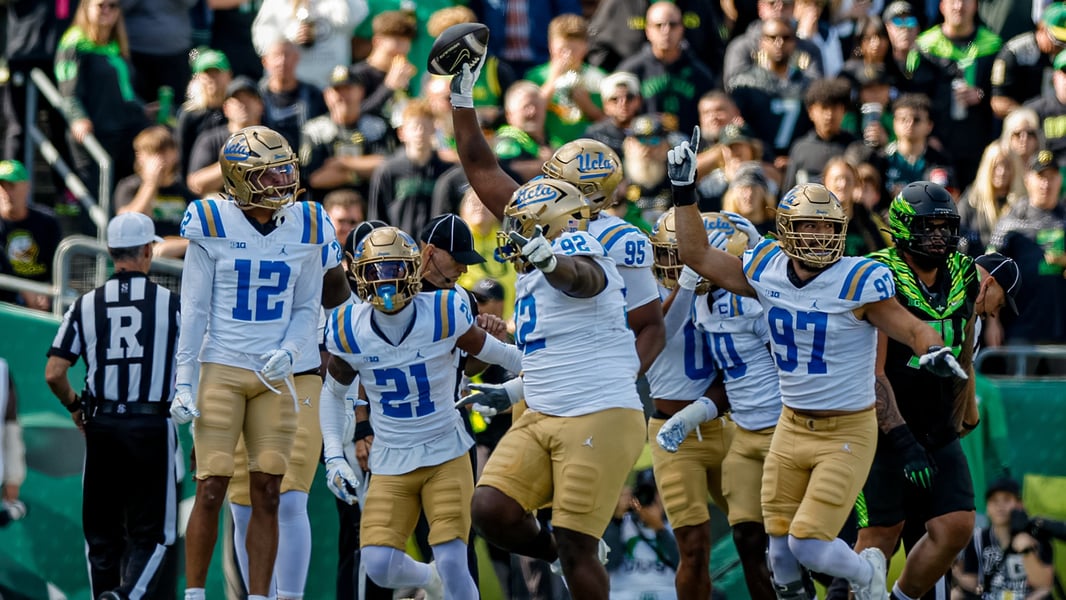
Dieffenbach’s opportunity came during UCLA’s 17-15 win at Oregon on October 10. Iamaleava did not return for the second half after his injury. Dieffenbach completed three of six passes for 43 yards and one touchdown, helping the Bruins finish a victory that lifted them to 5-0 overall and 3-0 in conference play.
The decisive scoring pass was a nine-yard throw to Wayne Knight on third and goal early in the fourth quarter. It extended UCLA’s lead to 17-6 after an interception had given the offense a short field, according to the Bruins’ official game report. Oregon closed the gap but could not complete the comeback.
UCLA’s defense forced seven turnovers and held Oregon to 272 yards, well below the Ducks’ entering average of 505.5. Those numbers matter to Wisconsin’s assessment: Dieffenbach helped finish the upset, but the Bruins did not ask him to carry the entire offense through an extended passing performance.
At 6-foot-6 and 227 pounds, Dieffenbach brings starting experience from a different level of college football. He spent 2023 and 2024 at Pittsburgh without appearing in a game, then transferred to Cal Poly. The UCLA roster biography lists nine starts in 11 appearances for the Mustangs in 2025.
He completed 92 of 162 passes for 1,305 yards, nine touchdowns and nine interceptions at Cal Poly. He also rushed for 321 yards and four touchdowns on 67 carries. His mobility gives Wisconsin another factor to account for, although his previous production does not establish how UCLA will distribute its plays against a Big Ten defense.
The backup competition has not been straightforward. Dieffenbach and Madden Iamaleava, Nico’s younger brother, had been competing for the role. Madden had received limited playing time earlier in the season, while Chesney selected Dieffenbach at Oregon based on his practice performance that week, the Journal Sentinel reported.
Chesney described both reserves as capable. He praised Dieffenbach’s accurate throws and command of the offense after the Oregon game, but the small passing sample leaves Wisconsin with relatively little film of him directing UCLA’s system.
The Bruins ran on 83% of their second-half plays against Oregon, compared with 62% across their opening four games, according to the Journal Sentinel. Those figures describe how UCLA protected that particular game; they do not guarantee the same balance against Wisconsin. Chesney said the offense must respond to the defensive matchups rather than impose a fixed run-pass ratio.
UCLA’s upset also formed part of the latest AP Top 25 shake-up. For Wisconsin, however, the immediate preparation question is narrower: how to defend an unbeaten opponent whose likely quarterback has experience, mobility and only one half of game film in his current offense.
The Badgers can study what Dieffenbach did at Oregon and what he produced at Cal Poly. They cannot assume that either sample fully describes the offense they will see at the Rose Bowl. UCLA’s next medical update and Chesney’s final quarterback decision remain the developments to watch before kickoff.