
Oct 16, 2026: The India-based biomanufacturer is scaling advanced fermentation of Bacillus clausii and Bacillus coagulans, deepening its American formulation partnerships, and extending its science into synbiotics, FOS prebiotics and postbiotics — from a culture bank built on Indian microbial innovation.
A quiet revolution, grown in steel tanks
Every morning, millions of people swallow a capsule, tear open a sachet or tip back a small vial of liquid, and never once think about what is alive inside it. Billions of bacteria, chosen because they help the body digest, defend and recover. Most of them are fragile. They do not like heat, they do not like stomach acid, and they do not like sitting on a shelf for eighteen months.
A small family of bacteria is different. The spore formers — led by Bacillus clausii, Bacillus coagulans and Bacillus subtilis — wrap themselves in a tough protective coat, go dormant through heat, acid, antibiotics and time, and wake up only where they are needed. For a probiotic maker, they are the closest thing nature offers to a survival capsule.
Anneo Biotech Private Limited, an India-based biomanufacturing company, has built its name on exactly these organisms. From its culture bank to its fermenters, from its quality laboratories to its formulation partners in the United States, Anneo has spent years turning spore science into a reliable, macro-scale industrial operation. Today it stands as one of India’s flagship producers of Bacillus clausii and Bacillus coagulans, with a portfolio that stretches across Bacillus subtilis, Lactobacillus acidophilus and a growing family of carefully selected strains.
This is the story of how a company from India made the world’s hardiest beneficial bacteria its specialty, and why clients, researchers and investors on three continents are now paying attention.
The two strains that built the house: Bacillus clausii and Bacillus coagulans
Ask anyone in a hospital pharmacy in Asia which probiotic they reach for when a patient is on antibiotics, and the answer is usually Bacillus clausii. Its spores survive the acid of the stomach and are naturally tolerant of several common antibiotics, which is why it is so often prescribed alongside them to help the gut recover. It is the probiotic of the sick child, the post-surgery patient and the traveller who ate something they should not have.
Anneo’s flagship product is its own Bacillus clausii strain, ABBC2101, produced at a potency of 100 billion colony-forming units per gram and supplied as both a dry powder and a liquid spore concentrate. The company has supplied it consistently to leading finished-dosage manufacturers, who turn Anneo’s bulk spores into the vials and sachets that end up in pharmacies and on e-commerce shelves. Batch after batch, the question Anneo’s customers care about is the same: will the count hold, and will the spores wake up. Anneo’s answer is a dedicated clausii line, strain-specific identification and stability data behind every lot.
Bacillus coagulans is the quieter sibling with a bigger passport. It is a lactic-acid-producing spore former that is recognised as safe for use in foods in the United States, and it survives the things that kill ordinary probiotics: baking, hot beverages, long shelf lives. That is why it is turning up in protein powders, cereals, gummies and functional drinks around the world. Anneo produces Bacillus coagulans on the same disciplined spore-forming platform it developed for clausii, giving food and nutraceutical brands a source that is built for scale rather than adapted to it.
Together, the two strains are the heart of Anneo’s business and the proof of its thesis: that an Indian company can own a demanding category of microbiology, not just participate in it.
A portfolio built for the whole gut, not just one problem
Spore formers are Anneo’s signature, but the company has deliberately built a wider bench. Bacillus subtilis, the third member of its spore-forming trio, is valued for the digestive enzymes it produces and serves both human nutrition and animal health, where it helps livestock and aquaculture operations reduce their dependence on antibiotics.
Alongside the Bacillus family sit the strains most people already know by name. Lactobacillus acidophilus, Lactobacillus rhamnosus, Lactobacillus plantarum, Lactobacillus reuteri, Lactobacillus salivarius and Lactobacillus delbrueckii cover the classic territory of digestive comfort, immunity and women’s health. Bifidobacterium longum addresses the large intestine, where most of the microbiome actually lives. Saccharomyces boulardii, a beneficial yeast, rounds out the set for travellers’ and antibiotic-related gut upsets.
The point of the breadth is choice. A finished-product brand can come to Anneo for a single bulk strain, or for a multi-strain blend designed so that each organism survives the others and the shelf. That is the difference between a strain supplier and a solutions partner, and it is the difference Anneo set out to make.
Strain family | Representative organisms | Where you meet them |
Spore-forming Bacillus (flagship) |
B. clausii ABBC2101, B. coagulans, B. subtilis |
Antibiotic-recovery vials and sachets, heat-stable foods and beverages, animal nutrition |
Lactobacillus (vegetative) |
L. acidophilus, L. rhamnosus, L. plantarum, L. reuteri, L. salivarius, L. delbrueckii |
Daily gut-health capsules, women’s health, immunity blends |
Bifidobacterium |
B. longum |
Large-intestine and multi-strain formulations |
Beneficial yeast |
Saccharomyces boulardii |
Travel and antibiotic-related digestive support |
Indigenous microbial innovation: strains that belong to India
For decades, the probiotic strains sold in India were licensed from Europe, Japan or the United States, grown abroad and imported in drums. Anneo was founded on a different conviction: that India’s own microbial diversity, and its own scientists, could produce strains good enough for the world.
That conviction lives in Anneo’s culture bank. The company maintains a collection of 19 characterised organisms, seven of them deposited with the Microbial Type Culture Collection (MTCC), India’s national repository. A deposit is a public, time-stamped promise that a strain is what the company says it is, and that it will remain available and unchanged. It is the kind of groundwork that global buyers quietly check before they sign anything.
Strain development at Anneo is research first, marketing second. Every production strain is screened for the traits that matter in the real world: how reliably it sporulates, how fast it germinates in the gut, how it behaves in the presence of acid, bile and common antibiotics, and how stable its count stays across months on a shelf. The company has invested in
strain-specific molecular identification, including qPCR methods, so that a customer can verify that what is in the vial is ABBC2101 and not a look-alike. Multi-strain blends are tested for
compatibility before they are offered, because two good strains do not automatically make one good product.
Anneo works with academic research institutions on this programme and is moving to formally protect its proprietary strains. The goal is simple to state and hard to do: a shelf of Indian-origin strains with documentation that stands up anywhere in the world.
Advanced fermentation at macro scale: where the spores are made
Growing a Bacillus in a flask is a student exercise. Growing it by the tonne, persuading every cell to form a spore at the right moment, then harvesting, concentrating and drying those spores without killing them, is an industrial art. Anneo has made that art its core competence.
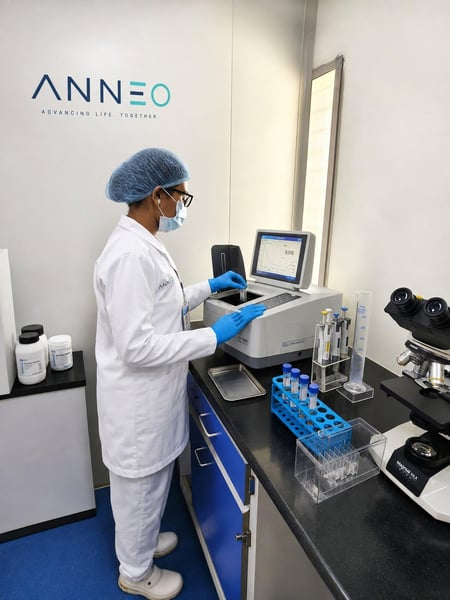
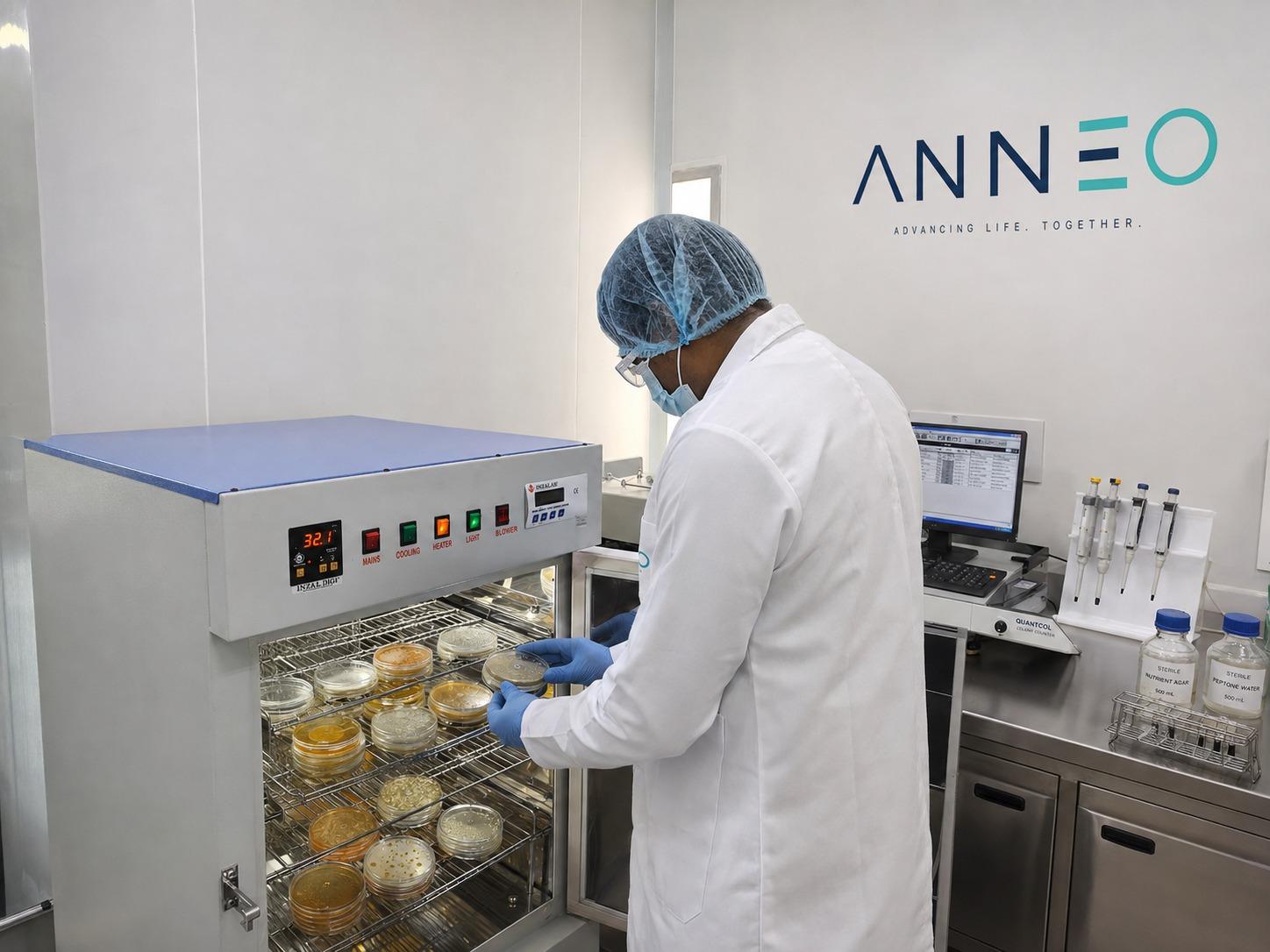
The company operates dedicated spore-forming fermentation lines in stainless-steel fermenters built to pharmaceutical standards, with sporulation managed as a controlled process rather than left to chance. Downstream, continuous centrifugation and ultrafiltration concentrate the harvest, and spray drying locks the spores into a free-flowing powder that keeps its count through transport and storage. Spore formers are kept on their own lines, separate from vegetative strains and yeasts, so there is no cross-contamination between organisms that need very different conditions.
The scale is industrial. Anneo’s clausii line runs at full utilisation, additional dedicated
spore-forming capacity is being commissioned, and the company is expanding its manufacturing footprint to a second Indian site. Its prebiotic plant produces fructooligosaccharide syrups in tonnes per day. A team of more than 70 people runs microbiology, production, quality control and regulatory affairs under a quality system certified to ISO 9001:2015 and FSSC 22000, with HACCP, Halal and Kosher certifications in place and WHO-GMP approval in progress.
What this means for a customer is unglamorous and valuable: the same potency in January and in July, documentation ready before it is asked for, and the capacity to take an order that would overwhelm a pilot-scale supplier.
Beyond probiotics: feeding the microbiome, and learning from what it leaves behind
A probiotic on its own is like sending a gardener to a plot with no soil. Anneo’s science has grown outward from the bacteria to everything that helps them do their job.
Prebiotics. Fructooligosaccharides, or FOS, are short chains of plant sugars that pass through the stomach untouched and become food for beneficial bacteria in the gut. Anneo manufactures FOS under its Fosnia range in liquid grades of 55 percent and 65 percent and in high-purity 95 percent liquid and powder grades, used by dairy, bakery, beverage and nutraceutical brands
that want fibre and gut-health credentials without compromising taste. The same science is now being carried into consumer formats, including a prebiotic fibre sweetener designed to replace sugar on the kitchen table.
Synbiotics. When a probiotic and its preferred prebiotic are formulated together, each makes the other more effective. Anneo designs such pairings from the strain upward: a Bacillus coagulans matched to the FOS grade it ferments best, or a multi-strain blend built around a fibre base. These are offered as finished premixes so a brand can go to market faster.
Postbiotics. The newest frontier is not the live bacteria but what they produce: the short-chain fatty acids, enzymes, peptides and cell-wall fragments that do much of the beneficial work.
Postbiotics are heat-stable, shelf-stable and easy to formulate, which makes them attractive for foods and cosmetics where live cultures cannot survive. Anneo has an active postbiotic research programme and an early product line, and expects this area to be one of its fastest-growing in the coming years.
Functional ingredients. The same fermentation platform produces selenium-enriched yeast and other organic trace-mineral yeasts, invert sugar syrup for the food industry, and specialty ingredients for animal nutrition. Each new product is chosen because it shares the company’s core skill: growing microorganisms well, at scale, and turning them into something useful.
Recognised far beyond India
The surest sign that a supplier has arrived is who stops at its stand. In 2026, Anneo exhibited at Fi India in Mumbai, the subcontinent’s largest food-ingredients fair, and took its team to Vitafoods Asia in Bangkok, the region’s flagship nutraceutical event. At both, the response went well beyond polite interest. Formulators from South-East Asia, East Asia and the Middle East queued for samples and certificates of analysis for the spore-forming strains in particular, and conversations that began at the stand have since matured into advanced discussions with international groups.
Anneo’s Bacillus clausii already travels. The company has long-standing export relationships in Vietnam and the Philippines, two of the most demanding markets for antibiotic-recovery probiotics, and is extending that reach across South and South-East Asia and the Gulf.
Enquiries from Korean and other East Asian buyers for high-potency multi-strain premixes and 95 percent FOS, specified against some of the strictest functional-food standards in the world, are now part of the company’s normal week.
The United States is the next horizon. Anneo’s Bacillus coagulans and FOS are positioned for the American food and supplement market, where the generally-recognised-as-safe framework rewards suppliers with deep documentation and manufacturing discipline. Halal and Kosher certifications open doors in the Middle East, Indonesia, Malaysia and the global kosher-certified trade.
For an industry that once looked outside India for every strain it used, an Indian company being sought out by buyers from Seoul to Manila to Dubai is a quiet milestone. Anneo intends it to be the first of many.
Made in India, formulated with America
A strain is only as good as the product it ends up in. That is why Anneo has built working relationships with formulation scientists and research collaborators in the United States, the market that sets the pace for the global supplement and functional-food industry.
The model is deliberately two-sided. Anneo’s Indian facilities grow, harvest and stabilise the organisms at scale. Its American partners bring formulation expertise honed in the world’s most competitive consumer market: how to keep a multi-strain blend stable in a gummy, how to dose Bacillus coagulans into a protein bar that will be baked, how to design a synbiotic that tastes like something a family would actually buy twice. Finished formats are developed to meet US regulatory expectations from the start, so that a product designed for Houston can be manufactured for Hyderabad or Ho Chi Minh City without starting over.
The collaboration runs into research as well. Anneo is working with American researchers on strain characterisation, stability science and the emerging postbiotic field, bringing international rigour to Indian-origin strains and giving its customers a documentation package that reads the same in every regulatory language.
For Anneo this is not outsourcing and it is not import substitution. It is the company’s view of what an Indian biotech should look like in the 2020s: deeply rooted manufacturing at home, and a seat at the table where global products are designed.
In their words
“We chose the hardest organisms in the probiotic world on purpose,” said Vasant B, Managing Director of Anneo Biotech. “Anyone can grow a Lactobacillus. Getting a Bacillus clausii to sporulate on schedule, hold a hundred billion CFU per gram, and wake up in a child’s gut six months later is a discipline. We built the company around that discipline, and it is why buyers from markets far more mature than ours now come to India for their spores.”
“People ask why we partner with American formulators when we can manufacture everything here,” he added. “The answer is that we want Anneo ingredients inside the best products in the world, not just the biggest ones. India gives us scale and science. Our partners in the United States give us the view from the shelf. Together, that is what a global brand from India looks like.”
Marimuthu Selvam, founding team member and company spokesperson, said the company’s culture bank is its most important asset. “Every strain we deposited with the national culture collection is a public commitment. It says: this is ours, it is characterised, and it will be the same
organism in ten years. That is the foundation you need before anyone will let you into their formulation, and we built it before we built the sales team.”
Why it matters now
The world is changing its mind about the gut. What was once a niche shelf in the pharmacy is now a mainstream conversation about immunity, mood, metabolism and healthy ageing, and the market for the ingredients behind it is growing on every continent. The supply base for those ingredients, however, is still concentrated in a handful of Western and East Asian companies.
There is room, and need, for a serious producer from India.
For existing customers, Anneo’s expansion means more of what they already rely on: dedicated capacity, consistent potency and documentation that keeps pace with the strictest export markets. For prospective clients, it offers a shortcut: a single partner for strains, prebiotics, synbiotic premixes and the formulation support to turn them into products. For investors, Anneo represents a platform company at the meeting point of two long-term trends, the rise of Indian biomanufacturing and the global demand for microbiome-based health, with proprietary strains, certified infrastructure and international partnerships already in place.
And for the millions of people who will never read a certificate of analysis, it means something simpler. The next time a doctor hands them a vial of spores to help their gut recover, there is a good chance those spores were grown, counted and cared for in India, by a company that decided the hardest bacteria were worth mastering.
About Anneo Biotech
Anneo Biotech Private Limited is an India-based microbiome and biomanufacturing company that develops, ferments and supplies probiotic, prebiotic, synbiotic and postbiotic ingredients to the pharmaceutical, nutraceutical, food and animal-health industries worldwide. The company is a flagship Indian producer of spore-forming Bacillus probiotics, led by its proprietary Bacillus clausii strain ABBC2101 and Bacillus coagulans, and maintains a characterised culture bank of 19 organisms with deposits at India’s national Microbial Type Culture Collection. Its macro-scale fermentation facilities operate under ISO 9001:2015 and FSSC 22000 certified quality systems with HACCP, Halal and Kosher certifications. Anneo collaborates with formulation and research partners in the United States and academic institutions in India, and its ingredients are supplied across South and South-East Asia with expanding reach into East Asia, the Middle East and North America. Anneo’s philosophy: from strain to finished solution. Its promise: Advancing Life. Together.
Tags: Anneo Biotech, Bacillus CLausii, Bacillus Coagulans, Probiotics, Synbiotics, PostBiotics
This Press Release has not been vetted by The Eastern Herald and is sourced by VMPL