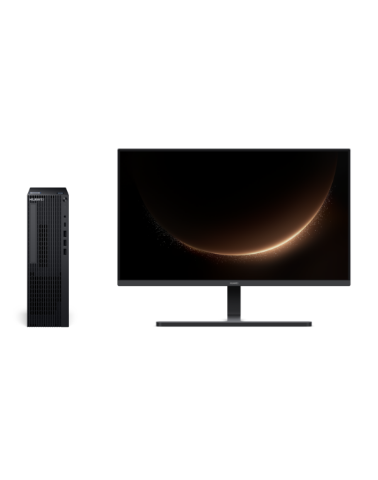

Huawei says its Qingyun HM650 desktop uses entirely Chinese-made components, adding a new enterprise computer to its push for a more domestically sourced technology stack. The claim concerns where parts are manufactured; it does not establish that every component uses a Chinese design.
The desktop pairs Huawei’s Kirin X90 processor with an enterprise version of HarmonyOS. Its official specifications confirm LPDDR5 memory and one solid-state storage device, with an additional mechanical hard drive supported on some models.
That combination gives buyers a concrete hardware and operating-system configuration to evaluate. The wider assertion of complete domestic sourcing needs a different kind of evidence: a component-by-component account of manufacturers and design origins, rather than a processor name or product specification alone.
In a November 9 report, The Register’s Simon Sharwood said Huawei launched the machine the previous week and reported its claim that local companies manufactured all of its components. He noted that it remained unclear whether all those parts also used Chinese designs.
Manufacturing location and design provenance are not interchangeable. A part made in China can incorporate technology developed elsewhere. Conversely, the presence of an unresolved design question does not disprove a claim about local manufacturing. The report does not provide an independent teardown or a full bill of materials establishing either conclusion.
Huawei’s official HM650 specifications identify the operating system as HarmonyOS V1.0, Enterprise Edition for computers. They name the Kirin X90 but do not list its core count or clock speed. The Register reports ten cores, 20 threads and a 2.3GHz clock; those figures are reporting from the outlet, not independently measured performance results.
The published configuration is a compact desktop measuring 293mm high, 93mm wide and 315.5mm deep. Huawei gives an approximate weight of 3.6kg for versions without an optical drive or mechanical hard disk and lists an optional DVD-RW drive. It cautions that dimensions and weight vary by configuration.
Its front panel provides one USB-C port, three USB-A 3.2 Gen 1 ports and a combined headphone-and-microphone connection. Rear connections include four more USB-A ports, gigabit Ethernet, HDMI, DisplayPort and separate audio connections. The listed package includes a wired keyboard, wired mouse and power cable.
The specifications do not establish application compatibility, independent benchmark performance or a universal retail price. For enterprise buyers, those questions remain separate from the sourcing claim: a locally manufactured computer still needs to run the required software, connect to existing equipment and meet the organisation’s support requirements.
The HM650 therefore offers evidence of Huawei combining its own processor brand and enterprise operating system in a desktop. Whether its complete supply chain is domestically manufactured as claimed, and how much of the underlying design is also domestic, remain distinct questions that the available disclosures do not fully resolve.