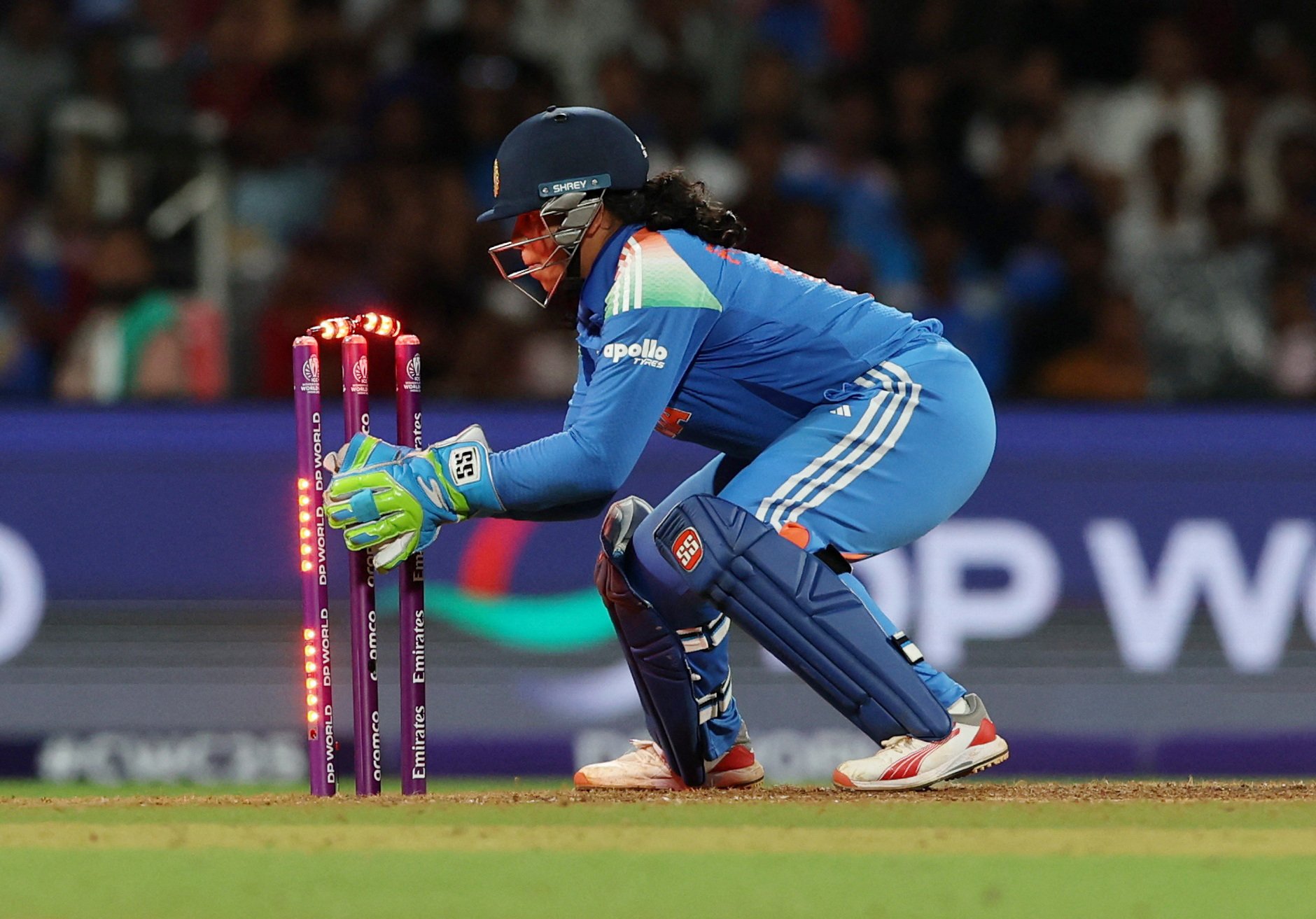
Indian cricket’s newest sensation Richa Ghosh has her eyes firmly set on adding another jewel to her already glittering crown, the Women’s T20 World Cup trophy. Fresh off a historic maiden ODI World Cup triumph where she battled through pain and smashed records, the 22-year-old wicketkeeper-batter from Siliguri is already plotting her next conquest as the cricketing world prepares for the 2026 T20 World Cup in England.
In an era where women’s cricket is experiencing unprecedented growth and global attention, Ghosh stands as a testament to resilience, power, and ambition. Her journey from the lanes of West Bengal to becoming a World Cup champion while nursing a hairline fracture has captivated millions and redefined what it means to play through adversity at the highest level of international sport.
The road to England begins in January 2026 with the Women’s Premier League, where Ghosh will once again don the Royal Challengers Bengaluru jersey alongside stalwarts like Smriti Mandhana and Ellyse Perry. For the young dynamite, the domestic T20 competition represents far more than franchise glory, it’s the proving ground where she intends to hone her explosive game for the ultimate prize.
“The T20 World Cup is going to be very important for me,” Ghosh stated in a recent interview, her determination palpable even through the video call. “We have ticked the one-day World Cup off our list but we have to tick the T20 World Cup as well. But before the World Cup, we have the WPL. So my main focus and mindset is on helping my team win, regardless of the tournament or format.”
Royal Challengers Bengaluru has retained Ghosh alongside their core group for the upcoming WPL season, a clear indication of the franchise’s faith in the explosive batter. Having secured the WPL title in 2024, the franchise is hungry for back-to-back championships, and Ghosh is central to those ambitions. While remaining tight-lipped about specific strategies, she hinted at meticulous planning already underway.
“I can’t disclose all the things as of now but our main focus is to bring the second trophy home,” she revealed, the competitive fire evident in her words.
The young cricketer’s recent World Cup heroics have elevated her from promising talent to established match-winner. During India’s triumphant campaign that culminated in a 52-run victory over South Africa in the final at Navi Mumbai’s Dr. DY Patil Stadium, Ghosh etched her name into the record books by equalling West Indies legend Deandra Dottin’s mark of 12 sixes in a single Women’s World Cup edition, a record previously also matched by South Africa’s Lizelle Lee in 2017.
What made Ghosh’s achievement even more remarkable was the revelation that came after India’s coronation: she had played through the knockout stages with a hairline fracture on the middle finger of her left hand. The injury, sustained before the semi-final against Australia, would have sidelined most players. Not Richa Ghosh.
“The middle finger of her left hand had a hairline fracture ahead of the semi-final, yet she batted through it,” disclosed her childhood coach Shib Shankar Paul in an interview with Sportstar. “She endured that pain, and that tells us about her immense mental strength.”
Endure she did. Against Australia in the semi-final, a match that will be remembered as one of the greatest in women’s cricket history, Ghosh walked out with India chasing a mammoth 339, the kind of target that breaks teams. While Jemimah Rodrigues played a magnificent unbeaten 127 to guide India home, it was Ghosh’s blistering 26 off just 16 balls that provided crucial momentum during the record chase. Her ability to strike boundaries at will turned what seemed impossible into achievable.
In the final, with India batting first and looking to post a defendable total against a dangerous South African outfit, Ghosh once again delivered when it mattered most. Her 34 runs off 24 deliveries, laced with three fours and two towering sixes, propelled India past the psychological 300-run barrier to 298 for seven. That late surge proved decisive as India eventually restricted South Africa to 246 despite Laura Wolvaardt’s valiant century.
The statistics paint a vivid picture of Ghosh’s impact throughout the tournament. She accumulated 235 runs from eight innings at an average of 39.16 with a strike rate exceeding 133. More tellingly, in the death overs, the phase from overs 41 to 50 where matches are often decided, she scored 185 runs at a blistering strike rate of 165.17, the highest among all batters in the tournament. Her role as a finisher, meticulously crafted under head coach Amol Muzumdar’s guidance, proved instrumental in India’s historic triumph.
Yet for Ghosh, the World Cup victory represents not an endpoint but a launching pad. Her trophy cabinet, already impressive for someone who made her international debut in 2020, includes the 2023 Under-19 World Cup, the 2022 Asian Games gold medal, and the 2022 Commonwealth Games silver. Each achievement has been a stepping stone, building the experience and temperament required for the biggest stages.
The T20 format presents unique challenges and opportunities for a player of Ghosh’s attacking instincts. While ODI cricket allowed her to pace innings and explode in the death overs, T20 cricket demands instant impact. Every ball can be decisive. The margin for error shrinks dramatically. Yet these are precisely the conditions where power-hitters like Ghosh can dominate.
The 2026 T20 World Cup in England will bring its own set of challenges. English conditions, with their green pitches and swing-friendly atmospheres, traditionally favor bowlers. The grounds vary significantly in size and character. Weather can be unpredictable, with matches often interrupted. Yet India has been building a squad specifically designed to succeed in all conditions, and Ghosh is a crucial component of that blueprint.
Her approach to managing the inevitable ups and downs that accompany any cricketer’s journey speaks volumes about her mental fortitude. “Each and every player faces ups and downs but how you tackle those lows is the real test of a player,” Ghosh reflected. “I was playing for the country and nothing else mattered to me. Apart from my mindset, the physios also helped me a lot and backed me. Their trust helped me to get over my injury.”
That mindset, putting country above personal comfort, trusting support staff, and maintaining focus on the larger goal, separates good players from champions. It’s the quality that allowed Ghosh to receive painkiller injections before batting in knockout matches, to grip the bat despite a fractured finger, and to swing freely when her team needed it most.
Beyond the white-ball formats that have made her famous, Ghosh harbors ambitions in Test cricket as well, cricket’s longest and arguably most challenging format. India’s women have played limited Test cricket in recent years, but the format is experiencing a renaissance with more bilateral series being scheduled. For a wicketkeeper-batter, Test cricket offers unique opportunities to influence matches across multiple days, to construct long innings, and to showcase technical skills alongside aggression.
“There is a different feeling while playing test cricket because as a batter you get many balls to bat,” Ghosh explained. “So, I want to score more and do much better in the red-ball format.”
This desire to excel across formats demonstrates the completeness of Ghosh’s cricketing ambitions. In modern cricket, specialists increasingly dominate rosters, with players focusing on specific formats. Yet the truly great players, the Ellyse Perrys, the Smriti Mandanas, excel everywhere. Ghosh clearly aspires to join that elite company.
The Women’s Premier League, scheduled to commence in early January 2026, will provide the perfect stage for Ghosh to fine-tune her T20 game. The tournament has rapidly established itself as one of the premier domestic T20 competitions globally, attracting top international talent and providing Indian players with invaluable experience against diverse bowling attacks. The quality of pitches, the pressure of packed stadiums, and the intensity of franchise cricket create an environment that closely mimics international tournaments.
For Royal Challengers Bengaluru, retaining Ghosh alongside Mandhana and Perry signals clear intent. The franchise won the WPL title in 2024 and understands the value of continuity. Building chemistry within a core group allows for better tactical execution and creates leadership depth. Ghosh, despite her youth, brings World Cup-winning experience and the kind of fearless approach that can define T20 matches.
The broader context of Indian women’s cricket adds significance to Ghosh’s ambitions. India’s World Cup victory ended decades of near-misses and heartbreak. The team had reached finals before, most notably in 2017 when they lost to England in a thriller, but had always fallen short of the ultimate prize. The ODI World Cup triumph has unleashed unprecedented enthusiasm for women’s cricket across India, with packed stadiums, increased media coverage, and greater commercial opportunities following.
This momentum must now be harnessed and channeled toward the T20 World Cup. India enters that tournament as one of the favorites, armed with a balanced squad, home conditions advantage in the lead-up, and the confidence that comes from being world champions. For players like Ghosh, the opportunity to cement India’s dominance across formats is tantalizing.
Her journey resonates particularly in Siliguri and across West Bengal, where she has become an inspiration for young girls who dream of playing cricket at the highest level. Growing up watching her father Manabendra Ghosh, a local club cricketer, young Richa would climb trees just to watch matches. That raw passion, nurtured through junior cricket and refined at the international level, now inspires the next generation.
West Bengal Chief Minister Mamata Banerjee has already announced plans for a new cricket stadium in Siliguri to honor Ghosh’s achievements, while the state government awarded her the prestigious Banga Bhushan award along with a Deputy Superintendent of Police post and significant financial rewards. These honors reflect not just individual achievement but the broader impact of sporting success on communities and regions.
As the cricketing calendar unfolds toward the T20 World Cup in England, all eyes will be on how India’s key players evolve and adapt. For Richa Ghosh, the path is clear: dominate in the WPL, carry that form into bilateral series, and arrive in England as a player opposition teams fear. Her power-hitting, her ability to accelerate run rates even against quality bowling, and her composure under pressure make her indispensable to India’s T20 ambitions.
The hairline fracture that she played through during the ODI World Cup has healed. The memories of those knockout matches, of striking sixes despite the pain, of holding the World Cup trophy aloft in Mumbai, will endure. But for a competitor like Ghosh, past glories are merely foundation stones for future conquests.
The T20 World Cup awaits. And if Richa Ghosh’s recent trajectory is any indication, England 2026 might just witness another chapter in her remarkable story, this time, with a different trophy but the same indomitable spirit that has defined her journey from Siliguri to the summit of world cricket.
Her message to aspiring cricketers is embedded in her actions: talent opens doors, but mental strength, dedication to the team cause, and the willingness to push through pain separate champions from participants. As India builds toward the T20 World Cup, they do so knowing that in crunch moments, when matches hang in the balance, they have a finisher who has already proven she can deliver under the most intense pressure while carrying physical limitations that would sideline most athletes.
The countdown to England has begun. The Women’s Premier League will light the fuse. And when the T20 World Cup arrives, expect Richa Ghosh to be ready, bat in hand, fire in her belly, and another record in her sights.