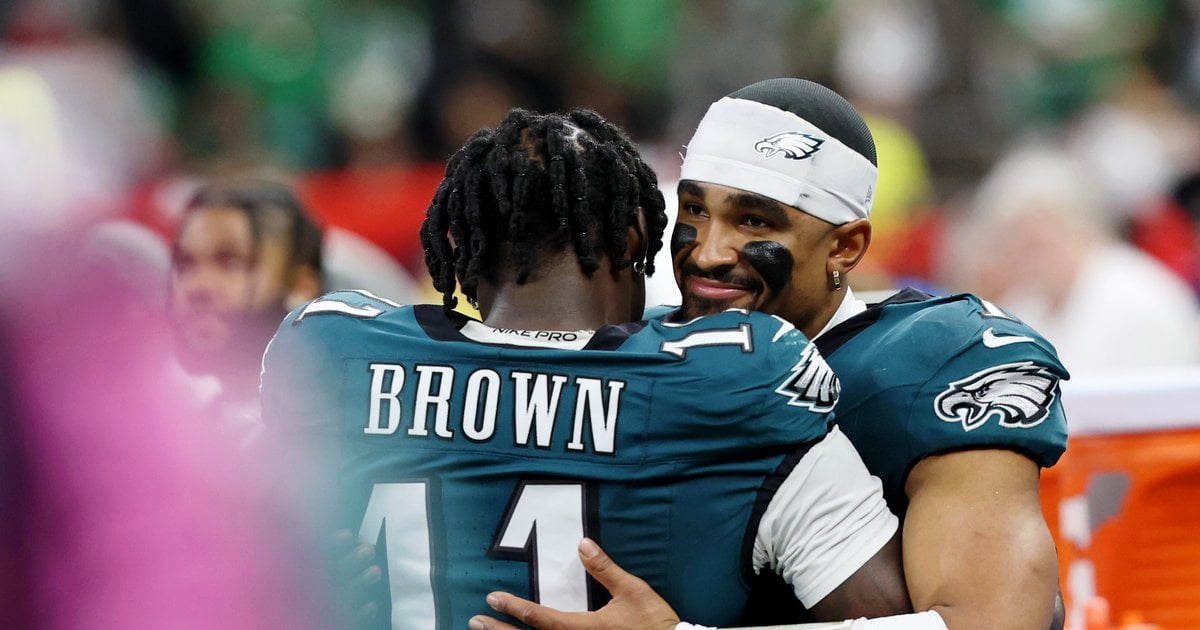
In the glare of Monday Night Football, where legacies are forged and frailties exposed, Philadelphia Eagles quarterback Jalen Hurts authored a moment that will echo through NFL annals, a single play that birthed two turnovers, an unprecedented double calamity in the league’s meticulously tracked history. The bizarre sequence unfolded in the second quarter against the Los Angeles Chargers at SoFi Stadium, turning a routine pass attempt into a slapstick tragedy that encapsulated Hurts’ nightmare evening. Intercepted first by Chargers defensive lineman Da’Sawn Hand, who rumbled seven yards before fumbling it back to Hurts, the ball slipped from the quarterback’s grasp almost immediately, this time snared definitively by defensive back Troy Dye. What statisticians have framed as the first such feat since comprehensive play-by-play records began in 1978 now stands as a historic stain on an otherwise ascending career.
The double-turnover play was remarkable not simply for its absurdity but for what it foretold about the rest of Hurts’ evening. On a night when the Eagles needed composure to steady a wobbling season, their franchise quarterback instead unraveled, finishing with five total turnovers in a 22-19 overtime defeat that further deepened Philadelphia’s late-season spiral. His final interception in overtime, a tipped-ball giveaway that set up the Chargers’ winning field goal, cemented a performance that will be replayed endlessly across highlight shows and dissected in meeting rooms from South Philadelphia to the NovaCare Complex.
Context only sharpens the edges of the embarrassment. The Eagles entered the primetime showcase clinging to NFC supremacy, their season already riddled with narrow escapes, red-zone inefficiency, and growing concern over Hurts’ decision-making. This was supposed to be the corrective, a chance to impose order on a middling Chargers team and reaffirm Philadelphia’s status as a conference powerhouse. Instead, the night became a case study in how quickly an elite offense can fracture when its quarterback hemorrhages possessions. Hurts completed fewer than two-thirds of his passes, labored to push the ball downfield, and repeatedly forced throws into coverage that Chargers defenders eagerly converted into opportunities.
The anatomy of the double-turnover play reads like farce on paper and looked even more chaotic in real time. Under pressure off the right edge, Hurts fired high and inside toward DeVonta Smith; Hand snatched the pass and churned upfield, only to have the ball punched loose as Hurts tracked him down near midfield. For a fleeting instant, it appeared the quarterback had authored a momentum-swapping redemption, diving onto the loose ball and igniting the Eagles’ sideline. Then, almost instantly, he lost it again, jolted by contact as he tried to gather his feet, letting the ball spill free for Dye to pounce on amid a scrum of bodies. Within seconds, Hurts had thrown an interception and committed a fumble, both logged to his name on the official play sheet.
For a player whose public brand has been built on poise, discipline, and incremental improvement, the image of Hurts lying on the turf while Chargers defenders celebrated above him felt jarringly out of character. This is the same quarterback who steadied the Eagles through last season’s defensive regression, who built an MVP-caliber résumé on his ability to erase mistakes with the next possession. Yet in Los Angeles, every miscue seemed to snowball. After the double-turnover, Hurts forced a late throw over the middle that was intercepted by a lurking safety, then misread a coverage rotation and sailed another ball into waiting hands. Some interceptions were products of pressure and miscommunication; others were errors of pure judgment. All of them shredded the margin for error of a team whose defense kept delivering chances that the offense squandered.
Advanced metrics add a harsher gloss to the night. Hurts’ total expected points added plunged into deeply negative territory, reflecting how costly his giveaways were relative to field position and game state. His per-play efficiency cratered in high-leverage moments, especially on third down, where he struggled to recognize late blitzes and hot reads that have been staples of his growth over the past two seasons. For a quarterback whose legs often paper over schematic cracks, even the ground game offered little reprieve: scrambles were bottled up, designed keepers sniffed out, and the Chargers’ front consistently set edges that forced him back inside to waiting tacklers.
Across the line of scrimmage, the Chargers were ruthless in punishing every slip. Justin Herbert, operating behind a reshuffled line and under the bright scrutiny that always accompanies his immense talent, turned each extra possession into a small referendum on Hurts’ struggles. While his stat line was efficient rather than explosive, Herbert’s command of the moment contrasted sharply with his counterpart’s hesitancy. He repeatedly found soft spots in Philadelphia’s zones, manipulated safeties with his eyes, and leaned on quick-game concepts that neutralized the Eagles’ pass rush. On the decisive overtime march, he strung together completions against tight coverage, trusting his receivers to win at the catch point just enough to set up the final kick.
Philadelphia’s defense had every right to feel aggrieved. For three quarters, they bent without breaking, generating pressure up front, contesting throws on the perimeter, and forcing field goals that kept the game within reach. It was a continuation of the evolution that produced their early-season statement win in a grinding, low-scoring clash, a theme familiar to anyone who followed the narrow triumph in which the Eagles Eagles Edge Packers in another Monday night defensive showcase. In those games, the formula was clear: disruptive front seven, opportunistic secondary, and just enough offensive competence to escape. In Los Angeles, the front did its job again. The offense, and Hurts in particular, did not.
That disconnect echoes earlier chapters of this campaign. Against Washington in a divisional showdown, the Commanders vs Eagles meeting saw Philadelphia stare down a feisty opponent and ultimately lean on superior talent to pull away, though not without leaving points on the field. In a subsequent matchup, the Los Angeles Rams vs Philadelphia Eagles contest exposed defensive breakdowns that threatened to undo strong stretches of complementary football before late adjustments sealed the outcome. Those games showcased a team able to win in multiple ways, but also one walking a knife’s edge, repeatedly asking its stars to rescue uneven performances. Monday’s loss to the Chargers felt like the bill coming due for that pattern, except this time, the star quarterback was the one dragging his teammates down.
That reality heightens the scrutiny on Hurts’ broader body of work this season. On paper, his cumulative numbers remain impressive: passing yardage in the upper tier of starting quarterbacks, rushing totals that would headline many running backs’ résumés, a touchdown rate that still reflects red-zone effectiveness. Yet the turnover column has been creeping upward, especially in crunch-time situations. When stacked against Jalen Hurts career stats, this season’s spike in giveaways stands out as an aberration and a warning. The margin between dynamic playmaking and reckless overreach is razor-thin, and in Los Angeles, Hurts spent too much time on the wrong side of that line.
Coaches and teammates were careful in their public comments not to throw their quarterback under the bus, but they did little to sugarcoat the stakes. Hurts himself, usually measured and sparse in front of microphones, acknowledged that he “didn’t play well enough” and that his job is to protect the football above all else. The staff, meanwhile, hinted at the need to recalibrate the offense, striking a better balance between designed runs, quick-game timing routes, and the aggressive downfield shots that so often define this attack when it’s humming. There is a recognition that the current mix is putting too much on Hurts’ shoulders, asking him to be both the system’s engine and its safety valve.
Inside the building, the tape will tell a complicated story. There will be valid critiques of route depth, protection calls, and situational play selection. There will also be snaps where Hurts simply misread leverage, stared down his target, or tried to create something out of nothing when a throwaway would have sufficed. For a player who has built his reputation on incremental growth, year to year, month to month, sometimes drive to drive, this is the sort of performance that demands an equally incremental, detail-oriented response. The fix is unlikely to come from grand schematic overhauls so much as from tightened mechanics, sharper pre-snap identification, and a renewed commitment to risk management.
Outside, the conversation inevitably drifts toward legacy. Quarterbacks are judged less on their worst nights than on how they respond to them, and Philadelphia has seen this cycle before. In an era now bookmarked by both euphoric highs and wrenching collapses, the franchise has lived through star passers who could own a city one season and polarize it the next. Hurts enters the coming stretch with that history hanging over him, praised for his toughness, leadership, and resilience, but now also carrying the weight of a statistical oddity that will cling to his name long after this season ends.
League-wide, the play has already taken on a life of its own. Clips of the double-turnover ricocheted across social media, spliced with incredulous commentary and labels that veered from clever to cruel. It will join the canon of memorable NFL bloopers, replayed alongside wrong-way runs and improbable lateral disasters. Yet buried beneath the viral humor is a more sobering point for the Eagles: this wasn’t an isolated gag in a meaningless game. It was a critical moment in a tight contest that Philadelphia, with its talent and ambitions, should have controlled.
For the Chargers, the win represents something more constructive. Coming off an uneven stretch of their own, they found in this game a template for how to navigate high-pressure environments against elite competition. The defense, long maligned as a mismatch with its offensive counterpart, rose to the moment with disciplined coverage and timely pressure. The offense, guided by Herbert’s calm and occasional brilliance, capitalized just enough on the extra possessions Hurts gifted them. In a crowded AFC playoff picture, nights like this help define whether a team is merely entertaining or legitimately dangerous.
Philadelphia’s path forward is no less clear for being uncomfortable. The schedule offers little respite, with divisional games looming and opponents studying every misstep from the Chargers tape. The Eagles have been here before, teetering between contention and disappointment, rescued by sudden surges in form or by their ability to dominate the line of scrimmage. This time, their fortunes hinge even more heavily on whether Hurts can turn a historic low into a turning point, recalibrating his risk tolerance, reasserting his command of the offense, and reestablishing the trust that has defined his relationship with a demanding fan base.
In the end, the box score will list the double-turnover sequence as just one play among many and the loss as just one defeat in a long season. But some moments in the NFL transcend their statistical footprint, becoming shorthand for an era, a team, or a player’s evolution. For now, Jalen Hurts is the first quarterback in league history to commit two turnovers on one play, a distinction that reads like parody and feels like a gut punch. How quickly, and how convincingly, he writes the next chapter will determine whether this night is remembered as a cruel punchline or the beginning of a redemption story worthy of the stage on which it unfolded.