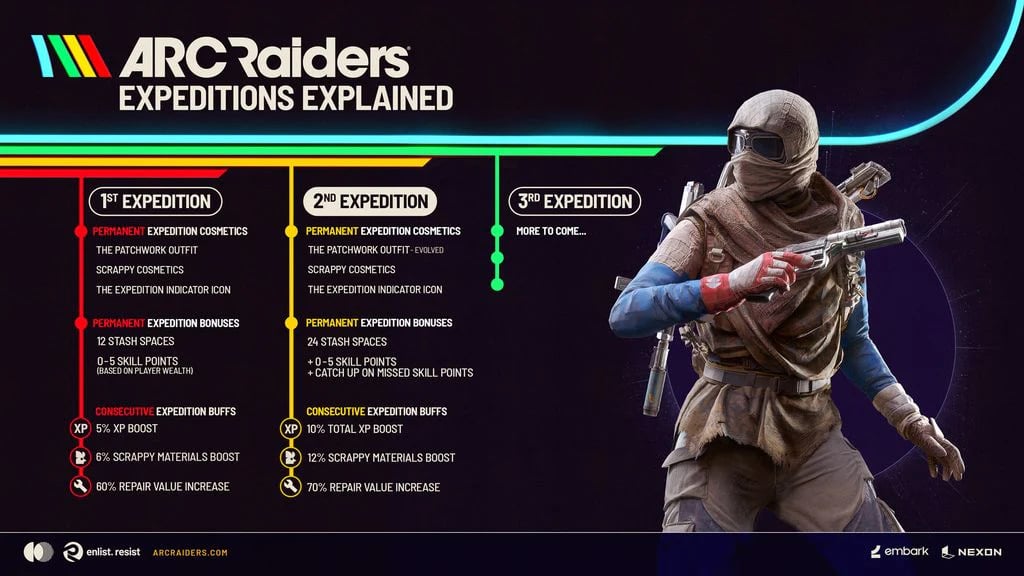
In a sweeping redesign that signals a major philosophical shift, Arc Raiders is evolving as Embark Studios abandons one of its most controversial progression systems in favor of a more action-oriented model. The upcoming Expedition update replaces stash-value grinding with a damage-based reward system—an overhaul intended to make the game more engaging, but one that has already ignited backlash across the community.
For months, Expeditions in Arc Raiders rewarded players based on how much in-game currency or loot—known as stash value—they accumulated over a season. The system encouraged careful hoarding, often discouraging players from using their best gear. But in an official developer update, Embark acknowledged what many players had long argued: the system had become tedious.
“We know that grinding for monetary value isn’t the most exciting experience,” the studio said, adding that the new approach is designed to encourage the use of loot rather than hoarding it.
Under the revised system, players will now earn up to five permanent skill points by dealing damage during a limited Expedition window. The challenge can be completed using any weapon or gadget against any enemy, shifting the focus squarely onto combat performance rather than accumulation. Reporting from Eurogamer confirms that this marks a decisive shift toward combat-driven progression.
The change aligns with a broader effort to make Arc Raiders more dynamic. Instead of stockpiling resources, players are incentivized to actively engage in firefights, use high-tier equipment, and experiment with different playstyles.
Yet, while the intent may be clear, the execution has proven divisive.
Many players had spent weeks preparing for the previous system—hoarding millions in stash value in anticipation of converting it into skill points. With the sudden shift, much of that effort is now effectively obsolete. Coverage from Insider Gaming highlights growing frustration across the community.
Criticism has centered not only on wasted effort but also on the structure of the new system itself. The limited-time nature of the Expedition has been described as restrictive, particularly for players with limited availability. Some fear that the change introduces a fear-of-missing-out dynamic, forcing participation within a narrow timeframe or risking permanent progression loss.
Further analysis from Vice suggests the redesign may alienate players who preferred long-term progression over time-limited performance challenges.
Embark has attempted to soften the impact with a partial catch-up mechanic. Players who have missed skill points in previous Expeditions can still earn them using stash value—but only after completing the new damage-based challenge. This hybrid system preserves a limited link to the old model while reinforcing the new progression philosophy.
Despite the controversy, some players have welcomed the change. The previous system discouraged risk-taking and undermined the game’s identity as a high-stakes extraction shooter. By tying rewards to damage dealt, the new model encourages players to embrace combat rather than avoid it.
The upcoming Expedition will serve as a crucial test for Embark Studios. If successful, the damage-based system could redefine progression in Arc Raiders. If not, the backlash may force further revisions in future updates.
For now, the message is clear: in Arc Raiders, survival is no longer about what you save—it’s about how much damage you deal.