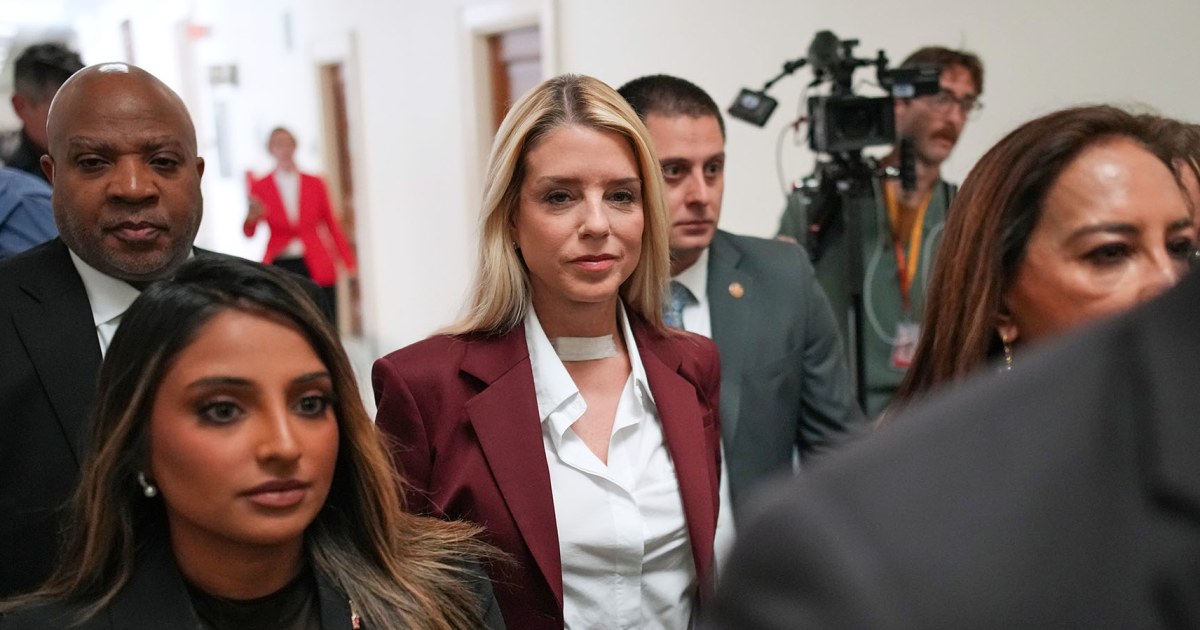
WASHINGTON — Outside the hearing room on the third floor of the Rayburn House Office Building on Friday morning, Epstein survivor Liz Stein stood with a small group of women and waited. She had been told Pam Bondi would answer questions inside. She wanted to hear what Bondi said.
She is still waiting.
The former attorney general arrived shortly after 8:30 a.m., walked past reporters without a word, and spent the next several hours in a closed-door transcribed interview with the House Oversight and Government Reform Committee. When it was over, the picture that emerged was not of what Bondi revealed about Jeffrey Epstein — but of what she would not say about Donald Trump.
Rep. Robert Garcia, the committee’s top Democrat, told reporters afterward that he personally put five separate questions to Bondi about the president’s involvement in the handling of the files. Five times, Garcia said, she refused to answer. A Justice Department attorney sat at Bondi’s side throughout and, according to Garcia, stepped in to block those questions directly.
“She said that she would not speak or respond to any questions that had anything to do with President Trump,” Garcia told reporters after the session concluded. “In fact, she said she would not speak to or respond to any question having anything to do with President Trump.”
The interview was conducted neither under oath nor on camera — decisions made by Republican committee chairman James Comer of Kentucky. Comer said permitting a transcribed interview rather than a formal deposition was an incentive for Bondi to cooperate voluntarily. A transcript will eventually be released to the public. Democrats noted that the depositions of former President Bill Clinton and former Secretary of State Hillary Clinton earlier this year were both filmed and subsequently published.
Bondi arrived at the Rayburn Building wearing a bandage on her neck, days after disclosing that she had undergone surgery for thyroid cancer. She made no statement to reporters as she entered.
In her prepared opening statement, she defended the Justice Department’s record under her tenure, acknowledged that there had been “redaction errors,” and credited her leadership for releasing more than three million Epstein-related documents — roughly half of the total the department holds. For the errors in that release, she placed responsibility on acting Attorney General Todd Blanche, who took over after Trump dismissed her in April.
As CBS News reported, Bondi said in her prepared statement: “I delegated oversight over this process to Deputy Attorney General Todd Blanche.” She described Blanche as having been “managing the entire investigation.”
The presence of serving DOJ officials at Bondi’s side drew sharp criticism from Democrats. Harmeet Dhillon, the assistant attorney general for the Civil Rights Division, attended as what the Justice Department described in a pre-hearing letter as “agency counsel” — there to assist the committee’s understanding of departmental processes, not to act as Bondi’s personal lawyer. Garcia said Dhillon went considerably further than that description.
“Sitting next to her is DOJ counsel, somebody who currently works for the Department of Justice, who on multiple occasions stepped in and told the former attorney general that she was not going to answer those questions,” Garcia said. “The DOJ is in there right now, stopping questions about President Trump.”
The Epstein files became a recurring source of political friction throughout Bondi’s brief tenure at the Justice Department. In one of her earliest television appearances as attorney general, she told Fox News that a client list was “sitting on my desk right now to review.” The department later concluded no such list existed. When Congress passed the Epstein Files Transparency Act in November 2025, requiring release of the full archive within 30 days, the department missed the deadline. Documents eventually released in January 2026 contained more than a thousand mentions of Trump; subsequent reporting indicated that materials specifically involving the president had been withheld.
Reuters reported that the Justice Department has acknowledged roughly 2.5 million pages of investigative Epstein files remain unreleased — withheld, the department says, to protect survivor identities and avoid jeopardizing active federal investigations.
The bipartisan subpoena that brought Bondi to Capitol Hill on Friday passed the Oversight Committee in March by a vote of 24 to 19, with five Republicans joining all committee Democrats. Bondi had originally been scheduled to appear in April, but the Justice Department argued the subpoena no longer applied after Trump fired her — a position Democrats rejected. She ultimately agreed to appear voluntarily under the terms Comer set.
Stein, the survivor who waited outside the hearing room Friday morning, called afterward for Bondi’s testimony to be placed on video and made public. Garcia echoed that demand.
“Former Attorney General Pam Bondi should testify under oath on video,” Stein said, “with a full transcript and recording released publicly, because the American people deserve transparency.”
Whether that will happen depends on answers the hearing did not produce — and that Bondi, for now, has shown no inclination to give.