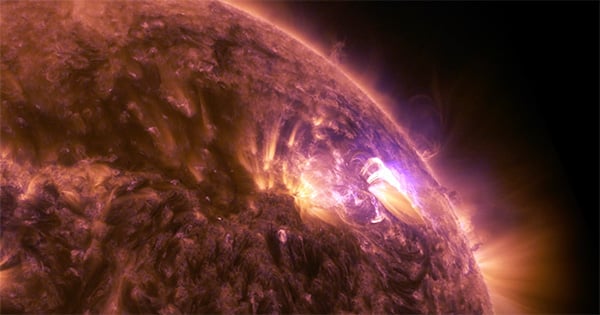
BOSTON — When a solar storm knocked out GPS systems used to guide tractors across American farms in May 2024, the disruption lasted days and cost an estimated $500 million in lost productivity. Nobody scrambled a defense. Nobody could. The storm came, and the world sat and took it.
That assumption – that space weather is something civilizations must endure, never to be deflected is exactly what Brian Walsh wants to break. The Boston University mechanical engineering professor has published a study in the journal Space Weather proposing the first peer-reviewed system designed not to forecast solar storms but to physically redirect them. He calls it StormWall.
The idea is more grounded than it sounds. Working with colleagues at the University of Michigan, Walsh ran simulations of a six-spacecraft constellation parked in geosynchronous orbit, each carrying canisters of alkaline chemical elements – barium or lithium are the leading candidates – that would be released on command into the upper atmosphere. Once exposed to sunlight, those elements would photoionize, generating a plasma cloud at the outer edge of Earth’s magnetosphere. In the simulations, that plasma was enough to disrupt the energy transfer between an incoming solar storm and the magnetosphere, deflecting the worst of the storm around the planet. The modeled reduction in storm intensity: roughly 50 percent for a major geomagnetic event.
“Since humans have been in space, we’ve been trying to predict what’s going to happen in the space environment,” Walsh told Boston University’s research publication. “But we came up with a model that could flip the paradigm. It’s like people in a village who see a river flooding – maybe they can predict when that will happen, but probably what’s even better is if they could build a storm wall. That’s what we’re proposing here.”
The stakes Walsh is designing around are not abstract. According to NOAA’s National Environmental Satellite Service, geomagnetically induced currents from solar storms can flow into power line infrastructure and destroy high-voltage transformers, a failure mode that played out in widespread outages during past storms. Satellite drag increases as Earth’s upper atmosphere expands under solar heating, pulling low-Earth orbit satellites off course. Radio blackouts hit aviation, military communications, and polar flight routes simultaneously. The last once-in-a-century geomagnetic event – the Carrington Event of 1859 – would cost over $2.4 trillion in power grid damage alone if it struck today’s infrastructure, Walsh and his co-authors estimated in their paper.
What makes StormWall a harder sell is also what makes it plausible: it would be a one-time deployment. The six spacecraft would carry enough mass-loading material – roughly equivalent to a dozen oil tankers’ worth – for a single firing event. Once the canisters are emptied, the system is inert and cannot be replenished. The plasma itself, Walsh noted, dissipates naturally, flushed out of the magnetosphere within about six hours, alleviating concerns about orbital contamination. But any replacement capacity would require a fresh launch campaign.
That cost structure, Walsh acknowledged, is the central obstacle. Six spacecraft plus payload is a significant investment, and the system would be consumed in a single use. What changes the math, he argued, is the private space economy. With commercial companies now investing billions in orbital infrastructure – and proposals already circulating for data centers in Earth orbit – the cost-benefit calculation for defending that infrastructure may look very different inside a decade than it does today.
The research team’s next phase is focused on trimming the mass requirement, possibly through a pulsed release sequence that extends the system’s effective operational life, and on identifying more efficient orbital configurations. The chemistry question is still open: the specific element choice affects ionization efficiency and the behavior of the resulting plasma, and the team has not yet settled on barium over lithium or determined whether some mixture might perform better in a real-event scenario rather than a simulation.
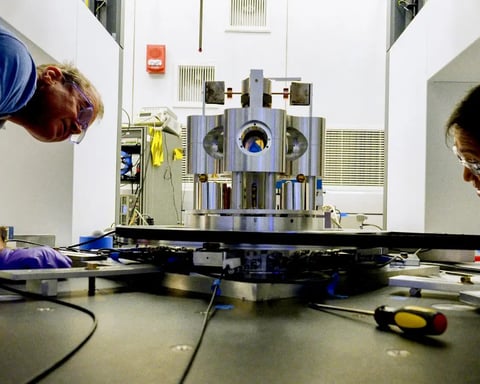
Walsh’s wider research orbit adds context to why StormWall emerged from his lab. His Boston University Space Physics & Technology Lab sent a telescope to the moon in 2025 that imaged Earth’s magnetosphere in X-ray frequencies for the first time, capturing the boundary where solar wind presses against the planet’s magnetic shield. That mission, LEXI, produced data on how the magnetosphere opens and closes under solar pressure – precisely the dynamic StormWall is designed to interrupt. The StormWall proposal emerged partly from watching that boundary respond to solar events and asking whether it could be artificially stiffened.
There is a geopolitical dimension to the proposal that Walsh himself noted. Unlike most space infrastructure, which benefits operators in proportion to their investment, a functional StormWall system would protect all satellites regardless of nationality, all power grids regardless of continent, and all GPS-dependent industries regardless of who funded the launch. The system, as designed, could not be weaponized or made selective. Walsh described that universality as a feature. Whether governments and private investors see it as a reason to fund or a reason to free-ride is a question the paper does not answer.
The proposal sits at an unusual intersection of space physics and geoengineering Walsh acknowledged he is not aware of any other research group proposing to actively engineer the near-Earth space environment in this way. Most space weather research, including work by NASA and NOAA programs that track solar flare impacts on aviation and power systems, remains focused on prediction and hardening of vulnerable ground-based systems. StormWall proposes to address the source of the disruption rather than improve tolerance to it.
What the simulations cannot yet tell us is how the system would perform against the specific geometry of a real geomagnetic storm, which varies in its approach angle, plasma density, and magnetic field orientation in ways that no model fully captures. The May 2024 storm – a G5 event and the most powerful to hit Earth in over 20 years – was described by NASA scientists as the best-documented geomagnetic storm in history, and it still produced unexpected effects that are being studied into 2026. Walsh’s team has the physics working in simulation. The gap between a validated model and a deployable defense system remains, for now, an honest and open one.
“People have always thought, ‘space is huge, the sun is massive, we just have to sit here and take whatever it gives us,’” Walsh said. “But what we found is that we can impact it.”