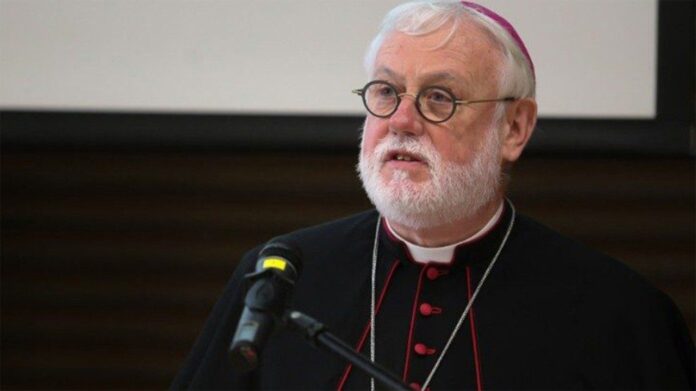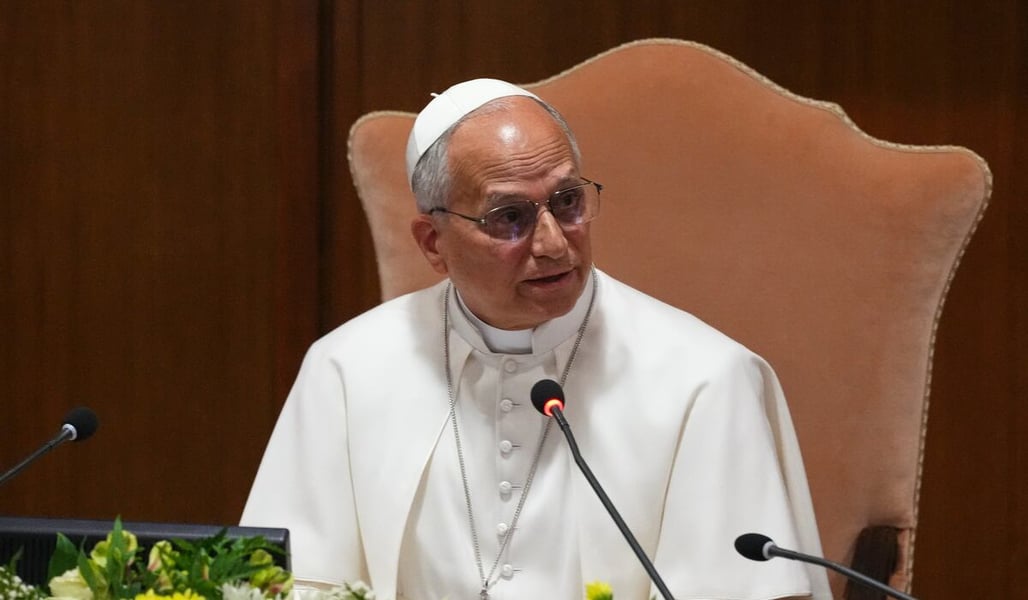

VATICAN CITY — The request Christopher Olah made before he sat down said more than his speech did. Standing before cardinals and theologians in the Vatican’s Synod Hall on May 25, the 33-year-old co-founder of Anthropic asked the world’s religious institutions to become its critics. Not supportive voices. Not ceremonial endorsers. Critics — the kind, he said, that the incentive structures of the AI industry are structurally unable to produce from within.
It was an unusual thing for a tech founder to say at the launch of a papal document. It was also, as the document itself made clear, precisely the kind of conversation Pope Leo XIV had in mind when he wrote it.
The encyclical, titled Magnifica Humanitas — Latin for “Magnificent Humanity” — is Pope Leo XIV’s first major teaching document. At roughly 40,000 words across 245 paragraphs and five chapters, it is not a policy brief. It is a theological reckoning with what the pope described as a transformation of similar magnitude to the industrial revolution, one that is already touching “decisions that shape human coexistence” and “dramatically changing how war is waged.”
Leo signed the encyclical on May 15, the 135th anniversary of Rerum Novarum — the foundational social encyclical of his papal namesake, Leo XIII, which addressed the rights of workers during the first industrial revolution. The parallel was deliberate and structural, not merely symbolic. Where Leo XIII confronted the factory floor, Leo XIV is confronting the data center. The document positions the Catholic Church not as a reluctant commentator on AI but as an institution with centuries of accumulated thought on human dignity, labor, and the common good that the technology sector has so far failed to produce on its own.
Olah was the most unexpected figure on the panel that presented the encyclical. He is Canadian, 33, and by his own description an atheist. He co-founded Anthropic — the developer of the Claude AI system, financially backed by Amazon — and leads its interpretability research. In that role, he studies what is actually happening inside AI models at a structural level. What he said he finds there is part of what brought him to Rome.
“We keep finding things that are mysterious, even unsettling,” Olah told the hall. “We find structures that mirror results from human neuroscience. We find evidence of introspection. We find internal states that functionally mirror joy, satisfaction, fear, grief, and unease.” He did not interpret these findings. He said, flatly, that they warrant “ongoing discernment” — and that such discernment is not a task for computer scientists alone.

The encyclical’s central demand — the word Leo uses repeatedly is “disarm” — is not a call to halt AI development. It is a call to strip the technology of what the pope frames as its most dangerous attachments: military and economic interests that have outrun any meaningful democratic or ethical constraint. Leo XIV invoked the biblical prophet Nehemiah as the document’s guiding image, describing AI as a “construction site of history” that can serve human life but only if it is built on solid foundations. “Let’s not fear artificial intelligence,” he said during the presentation, “but constantly keep the question of the human in play.”
Three specific dangers are named in the document with particular force. The first is autonomous weapons — systems, Leo wrote, that are “practically beyond any human reach to govern them effectively.” The second is algorithmic decision-making in healthcare, employment, and access to public services, where data “tainted by prejudice and injustice” is producing new forms of exclusion. The third, and perhaps the most structurally significant, is the concentration of AI development in a handful of wealthy nations, which the encyclical treats as a justice problem of historic proportions. “We do not have a mechanism for this,” Olah said of global benefit-sharing during his own remarks. “It is an unsolved problem.”
The encyclical arrives against a specific political backdrop that gave the Olah invitation its sharpest edges. The Trump administration has been pulling in the opposite direction from almost everything in Magnifica Humanitas. Anthropic itself was labeled a Pentagon supply chain risk earlier this year — the first time such a designation was applied to a U.S. technology company — after it refused to loosen safeguards that would have allowed its models to be used for lethal autonomous warfare or mass surveillance without human oversight. OpenAI moved quickly to fill the gap, signing a Defense Department contract in Anthropic’s absence. David Sacks, the White House AI adviser, has publicly accused Anthropic of running what he called a “regulatory capture strategy based on fear-mongering.”
None of that was mentioned by name in the Synod Hall. It did not need to be. Leo’s relationship with the Trump White House has been publicly strained for weeks, and the presence of an AI company whose refusal to cooperate with military applications is what got it into political trouble — standing beside the pope who used his first encyclical to argue that autonomous weapons must be “disarmed” — was a statement the Vatican did not have to make explicit.
The encyclical’s immediate audience is the world’s Catholic bishops, but its ambitions are secular as well as theological. Leo frames the document in the tradition of Catholic social teaching — a body of thought that runs from Rerum Novarum through the Second Vatican Council and Pope Francis’s environmental encyclical Laudato Si’ — and that tradition has historically addressed not only the faithful but governments and economic actors. Cardinal Víctor Manuel Fernández, the Dicastery for the Doctrine of the Faith’s prefect, stated at the presentation that the document insists “every human being possesses infinite dignity and never loses that sublime capacity for love which God bestowed upon humanity.” Artificial intelligence, he said, “cannot replicate humanity’s capacity to suffer, grow and love.”
Whether the document produces any of the regulatory outcomes it calls for is an open question. Encyclicals bind Catholics morally but carry no legal force with governments, and the AI regulation debate in the United States, Europe, and China is moving on timelines and in institutional channels that a papal letter cannot directly command. What Magnifica Humanitas can do, and what Leo XIV’s decision to present it personally alongside a Silicon Valley researcher suggests is the intention, is to shift the terms of the conversation — to insist, loudly and in the language of centuries of moral philosophy, that what is technically possible and what is permissible are not the same question, and that the people best equipped to answer the second question are not the same people building the first.
Olah, for his part, seemed to find that useful. Every frontier AI lab, including his own, he told the audience, “operates inside a set of incentives and constraints that can sometimes conflict with doing the right thing.” Those incentives include the pressure to stay commercially viable, to stay at the research frontier, and — the plainest pressure of all — pride and ambition. They cannot, by definition, produce the moral voice that can resist them. According to the National Catholic Reporter, Olah told the hall: “It is through dialogue and mutual effort, through the push and pull, that humanity will achieve great things.”
The Vatican announced last week the formation of a new study group on AI, operating across multiple dicasteries, to exchange information on projects related to artificial intelligence, including policies on its use within the Holy See. Leo XIV did not describe that as an ending. “Today is just the beginning,” Olah said in his closing remarks, as reported by the U.S. Conference of Catholic Bishops. What it is a beginning of remains, deliberately and honestly, unanswered.