TAIPEI – The confrontation that landed on Taiwan’s eastern doorstep on Sunday had its origins not in Taipei or Beijing, but in a joint announcement by Tokyo and Manila about maritime boundary talks that neither China nor Taiwan were invited to attend.
China’s transport ministry organized maritime police from the coastal provinces of Fujian and Guangdong to conduct what state media called a “special maritime traffic law enforcement operation in waters east of Taiwan Island.” The operation, announced Saturday by the state news agency Xinhua, was described explicitly as a response to Japan and the Philippines’ plans to formalize negotiations over the delimitation of their exclusive economic zone and continental shelf — waters Beijing claims as its own on the grounds that Taiwan is Chinese territory.
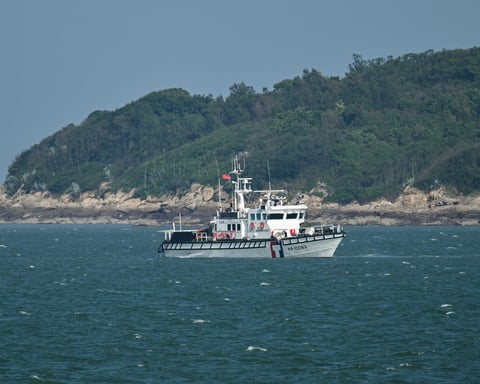
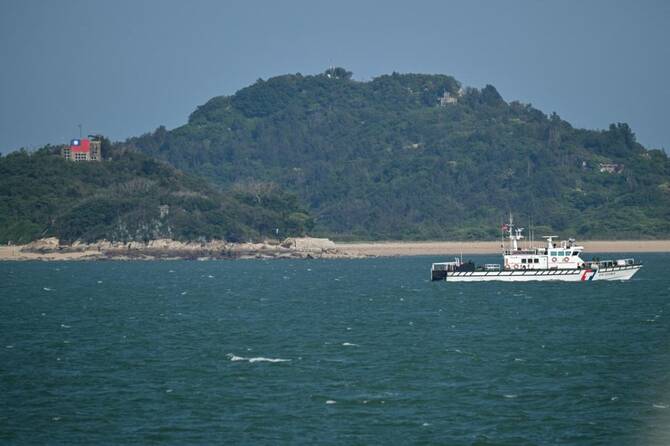
Taiwan’s coast guard did not wait to find out what that law enforcement looked like up close. By Sunday morning, it had dispatched more than five vessels to shadow four Chinese government ships that had departed Xiamen port and were tracked sailing outside Taiwanese restricted waters southwest of the island. The Chinese flotilla was expected to reach the eastern waters later in the day.
“China does not enjoy any sovereign rights in the waters east of Taiwan,” Taiwan’s coast guard said in its statement. “The sovereignty of the Republic of China must not be infringed upon.”
What distinguishes this episode from the near-daily pattern of Chinese military aircraft and naval vessels operating around Taiwan is the stated justification. Beijing has previously framed its coast guard operations as responses to arms sales, political visits, or Taiwanese independence rhetoric. This is the first publicly documented instance of China explicitly invoking a third-country bilateral negotiation — one it was excluded from — as the legal basis for asserting jurisdiction over waters east of Taiwan.
The Japan-Philippines talks, announced last month, concern the delimitation of the maritime boundary of an economic zone and continental shelf “in accordance with international law,” Tokyo and Manila said. They did not specify precise geographic coordinates. Beijing’s foreign ministry filled in the blank for them: the talks, it said, covered waters east of Taiwan, which China considers part of its territory. Those talks are, in Beijing’s framing, therefore “completely illegal, null and void.”
China’s coast guard confirmed the operation through its spokesperson Jiang Lue, who said it was “a necessary action taken in response to Japan and the Philippines’ unilateral announcement” of the boundary talks, which he said “seriously infringes upon China’s territorial sovereignty and maritime rights and interests.” The formation was led by the vessel Daishan. Jiang urged Tokyo and Manila to “immediately cease all illegal actions.”
Taiwan’s foreign ministry rejected the premise entirely, saying China had no authority to interfere in Taiwan’s territorial sovereignty or maritime rights. Taiwan had also said Wednesday that it should have been consulted on the Japan-Philippines talks — a position that puts Taipei in the unusual posture of objecting, on different grounds, alongside Beijing to a negotiation between two democracies.
The operation came one day after Taiwan’s coast guard reported what it described as a more alarming development: a Chinese survey vessel had joined a coast guard ship in waters around the Pratas Islands in the northern South China Sea, Reuters reported. Taiwan controls Pratas but Beijing claims it, along with most of the South China Sea. Taiwan called Saturday’s pairing “the first observed instance of Chinese coast guard and survey vessels acting in coordination to provoke Taiwan” — a detail that defense analysts are likely to examine closely, since survey vessels are used to map sea floors for submarine navigation and potential amphibious routes.
The broader pattern is one of geographic expansion. China has for years normalized coast guard pressure in the Taiwan Strait, around Kinmen, and in the South China Sea near the Philippines. The eastern waters — between Taiwan proper and the Philippine Sea — represent a newer and strategically significant vector. The Diplomat noted last month that Beijing appeared to be making greater use of the China Coast Guard as a first-line force to pressure Taiwan east of the island, potentially accompanied by what analysts described as cognitive warfare designed to test Taiwan’s psychological resilience.
Taiwan’s defense ministry has recorded Chinese military aircraft operating around the island 186 times in May alone, with naval vessels tracked 174 times over the same period. That rate of activity, sustained now for years, has normalized what would once have been considered crisis-level pressure. The coast guard dimension adds a legal ambiguity that military operations do not carry: law enforcement vessels invoke civilian jurisdiction frameworks, complicating the calculus for Taiwan and its partners when deciding how to respond.
Manila and Tokyo have drawn closer in recent years partly because of shared exposure to Chinese maritime pressure — Japan through disputes over the Senkaku Islands in the East China Sea, and the Philippines through years of confrontations at the Second Thomas Shoal. That convergence, formalized now in a joint boundary delimitation process, has apparently produced exactly the kind of alignment that Beijing most wants to deter. Whether Sunday’s deployment succeeds in that goal, or accelerates the trilateral coordination it was meant to discourage, is a question the operation itself cannot answer.
Eastern Herald previously reported on China’s deployment of 100 vessels in the Western Pacific last month, a buildup that defense analysts at the time assessed as a service-level naval exercise rather than a Taiwan-specific escalation. Sunday’s coast guard operation, smaller in scale but more precisely targeted in its stated rationale, carries a different kind of weight: it is a legal and jurisdictional claim, dressed in the language of law enforcement, over waters that Taiwan, Japan, and the Philippines each have distinct reasons to contest.
What Beijing has not said publicly is what it intends to enforce — or against whom. The Xinhua report gave no details on the operation’s duration, whether ships actually reached the eastern waters, or what authority the maritime police would exercise there. That silence is, by itself, part of the message.