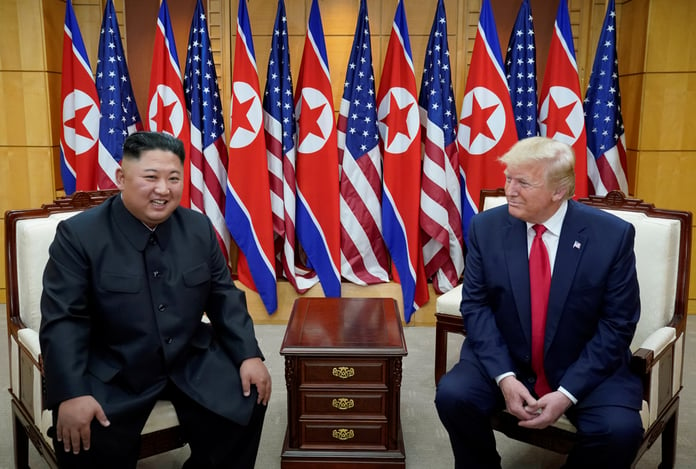

WASHINGTON — He called it a “completion.” Not a deal, not a ceasefire, not a withdrawal. Three months into the most sustained American military engagement in the Middle East since Iraq, President Donald Trump told NBC News on Sunday that US forces would remain in the region until something undefined — but final — had been achieved.
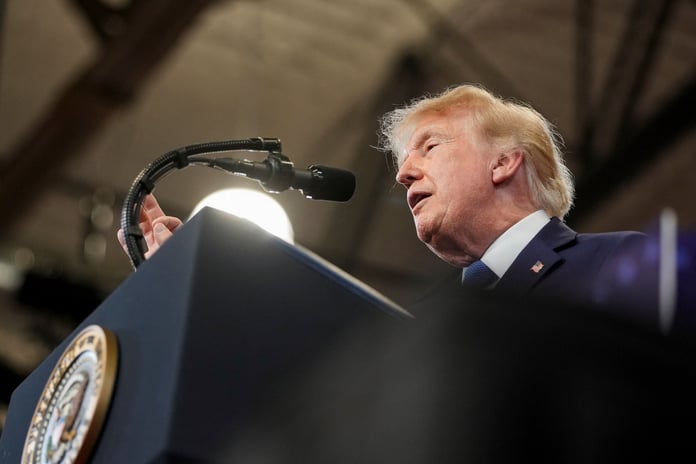
“Maybe we may use them. It’s unlikely, but I think we’ll keep them there until such time as we have a completion,” Trump said in a prerecorded interview with NBC’s Meet the Press that aired Sunday morning. The interview was taped Friday at Custer Farms in Chippewa Falls, Wisconsin, and conducted by moderator Kristen Welker.
The word was chosen carefully, or perhaps not carefully enough. “Completion” implies an end state — but Trump’s administration has not publicly defined what that end state looks like. A signed nuclear accord? Iranian compliance with a US-drafted IAEA resolution, reported Sunday by Reuters, demanding precise accounting of Tehran’s bombed enrichment sites and remaining uranium stocks? Or simply the exhaustion of Iran’s military capacity to cause trouble?
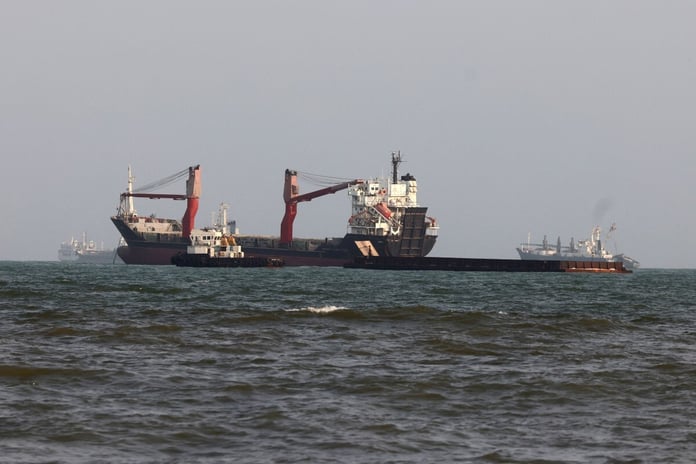
The president insisted the deployment carried little cost. “It costs us very little to keep them there,” he said. He added that he did not believe US personnel in the region faced significant danger — a claim at some tension with the operational tempo of recent days. On Friday, US Central Command shot down four Iranian drones launched toward the Strait of Hormuz and struck coastal surveillance radar sites on Iranian territory. CENTCOM has now conducted three separate intercept operations in the Gulf in the past week alone.
The NBC interview aired as the conflict between Washington and Tehran entered what both governments appear to regard as a frozen phase. The US and Israel began striking targets on Iranian territory on February 28. By April 8, Washington and Tehran had announced a two-week ceasefire. That ceasefire expired without a formal resumption of major hostilities, but the United States imposed a naval blockade on Iranian ports — a pressure measure Trump himself, speaking to NBC last week, called “a piece of steel.”
Talks have stalled. Iran’s Foreign Ministry spokesperson told CNN on Sunday that Washington’s “changing and contradictory” positions were Tehran’s primary obstacle to an agreement. The Trump administration, meanwhile, has been pressing a UN nuclear watchdog resolution and dispatching envoys and regional mediators to consult at a national laboratory in Tennessee on nuclear verification procedures.
Trump’s most striking claim in the interview was not about the troop presence but about what American firepower had already accomplished. “Their navy is gone. Their air force is gone. Their anti-aircraft is gone,” he said. Later in the same interview, he elaborated: “In three months, I’ve demolished the navy, the air force, anti-aircraft. They have no radar. They have nothing.”
NBC’s own fact-check, published hours after the interview aired, directly challenged those claims. The network’s reporting found that roughly half of Iran’s unconventional navy remains intact — the small fast boats operated by the Islamic Revolutionary Guard Corps that are the most consequential instruments of Iranian pressure on commercial shipping through the Strait of Hormuz. Because those vessels are dispersed, mobile, and difficult to distinguish from civilian craft, targeting them has proven harder than eliminating fixed naval infrastructure. They are also precisely the force most relevant to whether the Strait stays open.
That gap matters strategically. If Iran’s capacity to threaten the Strait remains materially intact, Trump’s “completion” framing — and his assurance that US forces face little danger — rests on a more fragile foundation than the interview suggested. The blockade was imposed, in part, because active military operations had not resolved the Strait’s status. Three months in, it still has not been resolved.
The president did not close the door on a diplomatic resolution. He described the new Iranian supreme leader — Mojtaba Khamenei succeeded his father Ali Khamenei earlier this year — as “more rational” than his predecessor. Trump has characterized the new leadership as a potential opening in prior remarks, but on Sunday he paired that assessment with an unambiguous threat. “If we don’t make a deal, then we’re going to take them out militarily very harshly,” he said.
He also described a scenario in which a deal could allow joint US-Iranian cooperation on Iran’s remaining nuclear material. “If we make a deal that now we’re friendly, we’ll all go together. It’ll be our equipment. We’ll take it out and destroy it, whether it’s on-site or whether we take it off-site,” Trump said. Absent a deal, he said, he would degrade Iran’s defenses to the point where American forces could enter and collect the stockpile unilaterally.
What Trump did not say — and what NBC did not extract from him — is how close he believes the two sides actually are. Iran’s foreign ministry has characterized American demands as internally contradictory. The US-drafted IAEA resolution circulating Sunday adds a new verification layer on top of whatever political framework is being negotiated. The Pentagon’s war bill has already topped $29 billion, as Eastern Herald reported last week. Whether “completion” arrives through diplomacy or the next round of military action — Trump left that question, deliberately or not, unanswered.
Asked why Iran had not yet agreed to a deal despite the military pressure, Trump offered what amounted to a compliment. “It’s a very hard thing for them,” he told Welker. “They’ve had great independence, they’ve dealt with very weak and ineffective leadership on behalf of the United States and other countries, frankly. They’re strong, they’re proud.”
The war, by Trump’s own accounting, is now in its third month. He compared the timeline to Vietnam — noting that conflict lasted nineteen years — and said he was “moving very fast.” The comparison was intended to project patience. It also, perhaps unintentionally, acknowledged that the end is not yet visible from where the president is standing.
Related Posts