
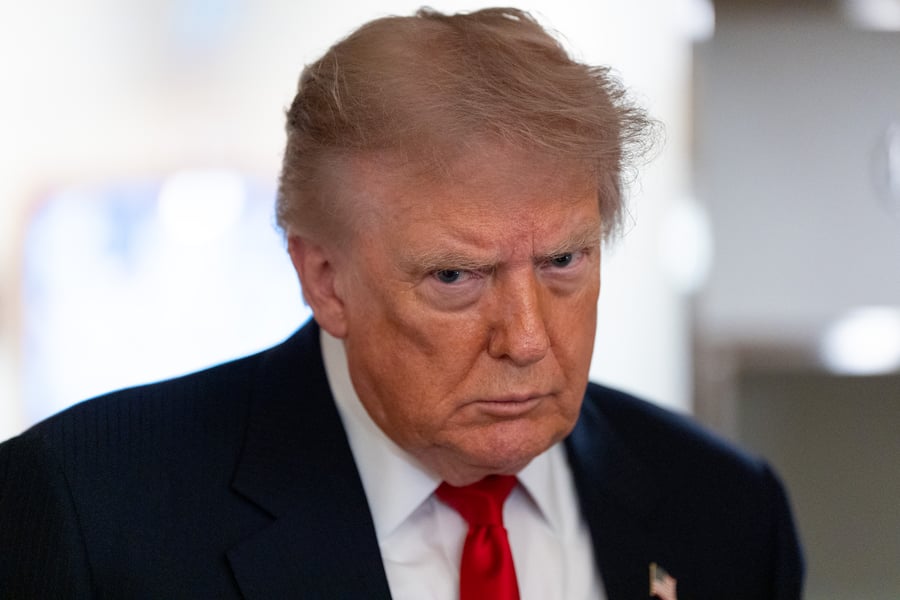
WASHINGTON — At some point between Saturday’s post on social media and Monday’s remarks in the Oval Office, Donald Trump said Kim Jong Un sent a response.
Trump confirmed Monday that the North Korean leader had replied to his outreach, a request the president had indicated over the weekend that accompanied his order to reduce joint military exercises with South Korea. When a reporter asked whether Kim had responded, Trump deflected with a question of his own: “How do you know he hasn’t responded?” Asked to be more direct, he was: “Yeah, he has.” He described the exchange as “very positive” and said nothing more about its content, its channel, or its timing.
That phrase, “Yeah, he has,” is the entirety of what the United States government has publicly confirmed about the state of contact between Washington and Pyongyang as of Monday evening. North Korea has not acknowledged the exchange. South Korea’s government, whose military exercises continue despite Trump’s reduction order, has expressed hope that the president’s personal rapport with Kim will translate into “meaningful North Korea-United States talks,” as Seoul’s presidential office put it. What “meaningful” means, what Kim actually said, and whether the two sides’ interpretations of the exchange align are not things the Oval Office disclosure addressed.
The context is specific enough to read carefully. Trump cited his relationship with Kim as the reason for reducing the Ulchi Freedom Shield military exercises that began in South Korea last week. He posted on Saturday that he was “not happy” with the joint drills, called them “totally inappropriate and hostile,” and said the Pentagon would substantially reduce the exercises. Two days later, he said Kim had responded positively. The sequencing, drill reduction announced followed by Kim’s positive response disclosed, suggests the two events are connected in Trump’s diplomatic framing, even if no formal exchange between the two governments has been confirmed by either side.
South Korea’s government is in the position of managing several moving pieces simultaneously. Its military has maintained that the exercises are proceeding as planned, declining to confirm which specific elements were reduced or whether any reduction has occurred in practice. President Lee Jae Myung’s office has been careful to frame the potential Trump-Kim diplomatic track as complementary to South Korea’s security posture rather than a challenge to it. In a situation where the United States and North Korea are exchanging signals in ways that Seoul cannot verify, that framing is doing a great deal of diplomatic work.
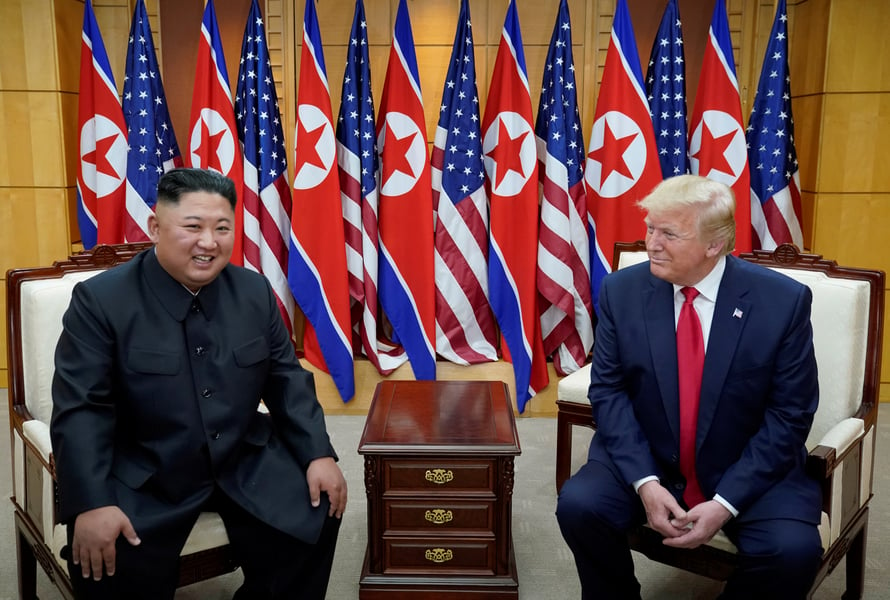
The last time Trump and Kim Jong Un held a formal meeting was at Hanoi in February 2019, which ended without an agreement after the two sides could not bridge a gap between North Korean demands for sanctions relief and American demands for denuclearization steps. The relationship went quiet through the remainder of Trump’s first term, through the Biden years, and into Trump’s return to office. What appears to be resuming now is being conducted through a different channel: informal, unconfirmed, and routed through the president’s social media posts rather than through any interagency diplomatic process.
How Kim’s positive response was transmitted, by whom, and through what mechanism is something neither Washington nor Pyongyang has explained. North Korea operates with extreme sensitivity about direct communications with the United States, historically routing sensitive exchanges through neutral intermediaries. Whether the channel that produced a “very positive” response is the same channel that would be used to arrange any formal meeting is not known.
What South Korea also does not know: whether its ongoing military exercises, which Trump’s Pentagon order is supposed to have reduced, are now part of the negotiating environment or simply operating in parallel with it. North Korea has consistently demanded that US-South Korea exercises cease as a precondition for serious talks. Trump’s reduction of those exercises, timed to Kim’s positive response, could be read by Pyongyang as a concession, by Seoul as a miscalculation, and by the Trump administration as a diplomatic opening. Al Jazeera, which reported Trump’s Oval Office remarks, noted that the Korean peninsula carries the most concentrated military standoff in the world, with American forces interleaved through South Korean defense plans that require extensive rehearsal to function.
Trump made one other remark on Monday worth reading closely. He described talking to Kim as making South Korea “safer,” a claim with no mechanism publicly explained. A conversation between the US and North Korean leaderships would, if it led somewhere, reduce the risk of miscalculation. Miscalculation is the most dangerous risk in a relationship between two nuclear-armed sides. But it requires a North Korean interlocutor willing to engage on terms that Washington and Seoul can both accept, and on that point, Monday’s Oval Office remarks offered nothing except a president’s confidence that the other side has engaged at all.
The exchange, if it is what Trump says it is, represents the first confirmed diplomatic contact between Trump and Kim since Trump’s return to office in January 2025. North Korea has not confirmed it, and without confirmation from Pyongyang, what has or has not been communicated remains, for now, the president’s word.