
SEOUL — The 11-day Ulchi Freedom Shield exercises were already underway on Monday when Donald Trump announced he had told the Pentagon to cut them.
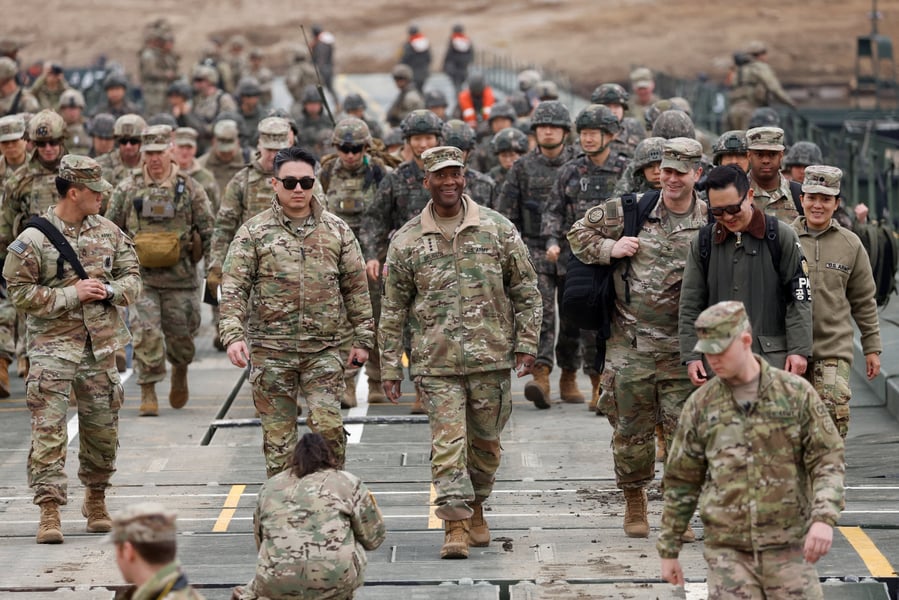
Eighteen thousand South Korean soldiers had reported for the annual war games as scheduled, beginning what the alliance has described as a cornerstone of Indo-Pacific deterrence for more than seven decades. Trump’s post on his social media platform reached Defense Secretary Pete Hegseth before it reached most of Seoul: the exercises were to be “substantially reduced,” effective immediately, because of the president’s relationship with North Korea’s Kim Jong Un.
South Korea’s Ministry of Defence responded with a sentence that, read carefully, does not say what Trump said. The exercises, it announced, would “proceed as previously notified and scheduled.” Whether that means all 18,000 soldiers running the full simulated command sequence, or a reduced exercise restructured to comply with a directive no one has publicly defined, remains the question Seoul is not answering.
Trump’s stated rationale was his relationship with Kim. “Based on my very good relationship with Kim Jong Un, of North Korea,” he posted, “I am not happy with the fact that the United States has, long ago, agreed to participate in Joint Military Exercises with South Korea.” He called the exercises “totally inappropriate and hostile,” language that has never appeared in any formal American characterization of the drills. He also cited Seoul’s refusal to join American-led military operations during the Iran war as a contributing factor, making the exercise cut partly a penalty for South Korea’s independent foreign policy.
Seoul’s presidential office offered a calibrated response, saying it expected Trump’s relationship with Kim to lead to “meaningful North Korea-US talks.” President Lee Jae Myung, who built his early presidency around declining to join American military campaigns abroad, did not personally address Trump’s announcement. The presidential office reframed what Washington presented as a cut into what Seoul preferred to call an opening.
The drills being reduced are not symbolic. The Ulchi Freedom Shield is one of two annual exercises that form the spine of US-South Korea alliance readiness. They involve live-fire simulations, joint command-post exercises, and scenario rehearsals designed to ensure commanders on both sides can operate together under real-time pressure. The State Department has described the US-South Korea partnership as a “linchpin for security and stability in the Indo-Pacific,” according to Al Jazeera. Without regular exercises, that phrase describes a relationship rather than a rehearsed capability.

The timing produces a compounding problem. Thousands of North Korean troops are currently deployed in Russia, fighting alongside Russian forces and acquiring real combat experience in exchange for manpower and materiel. The US interceptor shortage from the Iran war has already left allied militaries in the region with diminished American air defence cover, a vulnerability that compounds the exercise reduction rather than offsetting it. North Korea’s Foreign Ministry, issuing its own statement before Trump’s announcement changed the picture, warned that “the US-Japan-South Korea military cooperation is turning into a nuclear alliance, and Pyongyang will respond to a new level of threat with a new level of deterrent.”
Republican Senator Thom Tillis offered a critique that runs against Trump’s reasoning: the exercise cut effectively frees North Korean troops to continue supporting Russia’s military campaign, because the historical counterpressure of exercises potentially triggering mobilization back to the peninsula is now weakened. That North Korean soldiers fighting abroad and Trump’s relationship with Kim are now interacting effects of a single American foreign policy decision is a tension the administration has not addressed.
The Democratic response was direct. Jack Reed of Rhode Island, the Senate Armed Services Committee’s ranking member, said the decision showed that “America’s commitments are negotiable,” Anadolu Agency reported. Senator Andy Kim of New Jersey criticized the announcement as a unilateral social-media post made without prior consultation with Seoul. Representative Pramila Jayapal described the move as “dangerous” for regional stability.
Seoul refused Trump’s request to join the US-led campaign against Iran, reportedly telling Washington “No thanks” when the approach was made formally. That refusal is now cited by Trump as a reason to reduce joint exercises designed to protect South Korea from a North Korean attack. The logic links two separate theaters in a way Seoul had no basis to anticipate when it made its Iran decision.
The 1953 Mutual Defence Treaty between the United States and South Korea remains in force. Trump did not say he was reviewing it. He said he didn’t like the exercises and told his defense secretary to reduce them. What “substantially” means in operational terms has not been disclosed. Which simulations are cut, how many American troops will participate, which scenarios are removed from the schedule; none of this has been confirmed by either government. Eighteen thousand South Korean soldiers began their exercises Monday inside that ambiguity, rehearsing for a contingency whose American dimension is, this week, genuinely unclear.