
WASHINGTON — The bill for Operation Epic Fury is climbing faster than the Pentagon can pay it. Adm. Daryl Caudle, the Navy’s chief of naval operations, told House Armed Services Committee lawmakers in May that the fiscal year 2026 budget simply did not account for a war in Iran — and that without a supplemental spending package, he will be forced to freeze personnel moves and cancel training by July.
“The [fiscal 2026] budget didn’t bake in [Operation] Epic Fury,” Caudle told the committee. “You see a large Navy force in the Middle East. So we’re burning bright … but it does come at cost, and it comes at operational costs.”
The Navy is not alone in its squeeze. The Pentagon’s acting comptroller, Jules Hurst III, told Congress in late April that the Defense Department had spent roughly $25 billion on the conflict as of that date, with the majority consumed by munitions. By late May, that estimate had risen to nearly $29 billion — and those figures, Hurst acknowledged, do not include the cost of rebuilding damaged bases or replacing aircraft. Sources briefed on internal assessments told CNN the full accounting, once construction and attrition are factored in, runs closer to $40 billion to $50 billion.
The mismatch between official tallies and independent analysis is not incidental. It reflects how the Pentagon has structured its disclosures: each testimony to Congress has produced a new, higher figure, and each has come with a new set of caveats about what was left out. A May 13 Congressional Research Service report counted 42 U.S. aircraft lost or damaged during the campaign — a number the Defense Department has not matched with its own public assessment.
The broader picture of unbudgeted strain extends well beyond the Navy. Operation Epic Fury was one of three unplanned operations draining Pentagon accounts this year, alongside southern border missions and National Guard deployments. Rising fuel prices have compounded the pressure. The Pentagon had been authorized roughly $856 billion for fiscal year 2026 as part of a $891 billion national defense budget passed in December — none of it anticipating a sustained air campaign and naval blockade in the Persian Gulf.
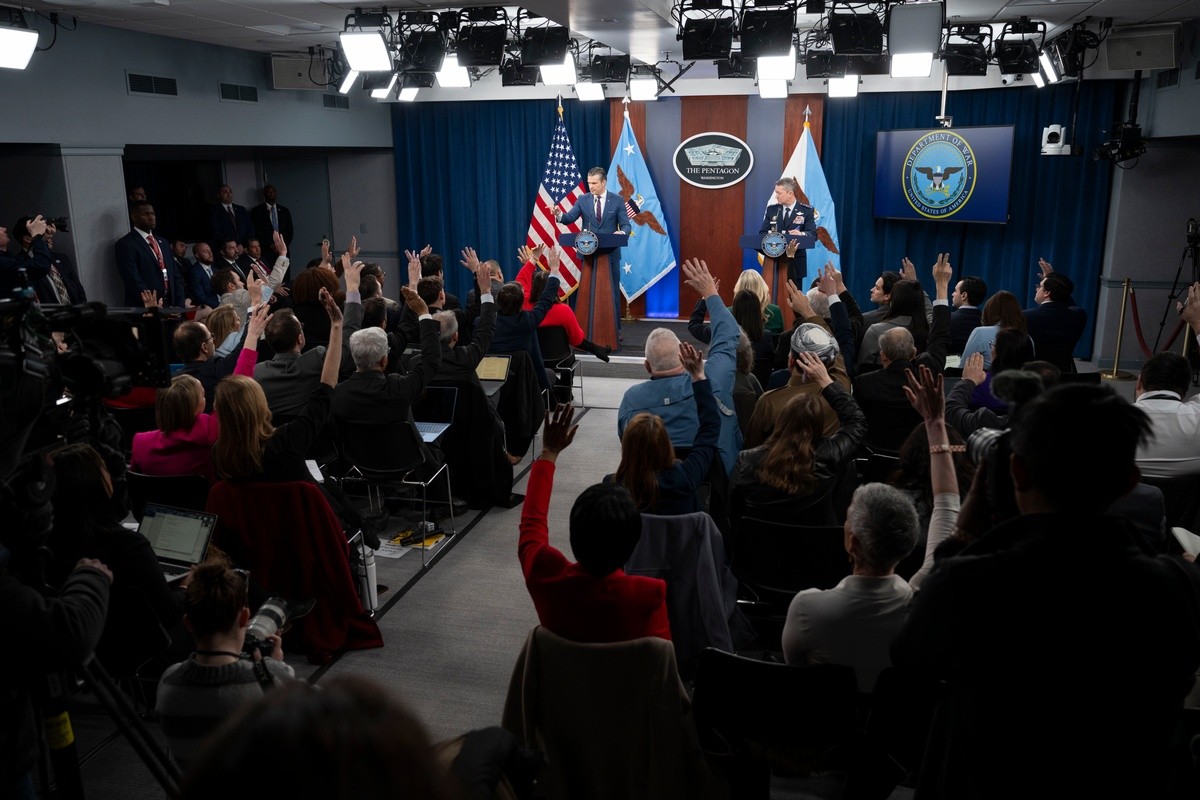
Defense Secretary Pete Hegseth moved early to signal that a supplemental would be necessary. In March, speaking at a Pentagon briefing, he confirmed that the administration was seeking more than $200 billion from Congress — a figure that included replenishing depleted munitions stockpiles and covering operational costs. “It takes money to kill bad guys,” Hegseth told reporters. A senior House Republican source told Fox News at the time that the price tag “will be whatever it will be.”
That supplemental has not arrived. Democratic opposition is firm: lawmakers on that side of the aisle have consistently argued the conflict lacked proper congressional authorization. Republican support is fragmented — some members remain wary of another reconciliation vehicle after the passage of the One Big Beautiful Bill Act, which included approximately $150 billion in Pentagon funding primarily aimed at restocking munitions. The Hill reported that a senior congressional source privately assessed the supplemental as being “in big trouble.”
The practical consequences are beginning to accumulate. Caudle warned lawmakers that he would have to freeze between 12,000 and 15,000 permanent change-of-station moves — effectively blocking new sailors from transferring after boot camp — and halt enlistment and reenlistment bonuses if additional funds did not materialize. “My record recruiting is going to be thwarted without additional funding,” he said. The USS Gerald R. Ford, which returned to Naval Station Norfolk in May after what became the longest carrier deployment since the Vietnam War era, is now in maintenance — a cost that also falls outside the original budget projections.
Defense analysts have largely agreed that stopgap measures can hold through the summer, in part because of the $150 billion munitions fund in the One Big Beautiful Bill. But Jerry McGinn, director of the Center for the Industrial Base at CSIS, noted that the operational tempo of naval and air forces had been significant across multiple theaters — Venezuela operations in January, the Iran campaign from February, ongoing Hormuz patrols — and that this cumulative strain was receiving less scrutiny than the munitions bill.
The Navy has also begun reconsidering force generation models in response. Master Chief Petty Officer of the Navy John Perryman, speaking at a forum this month, described the difficulty of adapting older deployment cycles to an era of overlapping unplanned operations. Caudle has separately proposed extending amphibious ship deployment cycles from 36 months to 50 or 52 months, running two deployments through the same maintenance phase to reduce overhead. The logic is sound under financial pressure; what it means for sailor welfare and equipment reliability over time remains an open question.
The ceasefire brokered by Pakistan on April 8 has held in the formal sense — there has been no renewed air campaign — but the United States has maintained a naval blockade of Iranian ports since early April. Sporadic exchanges of strikes continue. Negotiations on a framework memorandum of understanding between Washington and Tehran have not produced a signed agreement, and Tehran has gone silent on the latest draft peace text, according to reporting from earlier this week. The Strait of Hormuz remains effectively closed to normal commercial traffic, with Baker Hughes executives telling CNBC that normal shipping flows will not resume before the second half of 2026 at the earliest.
That prolonged naval presence — carrier strike groups, destroyers, logistical ships — costs money that no fiscal year 2026 budget anticipated. The Pentagon’s earlier warnings about the readiness costs of extended Middle East deployments have now become operational reality. Whether Congress provides relief before Caudle’s July deadline is the question the Defense Department cannot yet answer — and one that the administration has not yet formally asked Congress to resolve with a spending request on the Hill.
For context on how the United States has historically absorbed the cost of extended military commitments, Congress has approved $195 billion for Ukraine since 2022 — a figure that itself drew criticism for its scale, and which now sits alongside a potential Iran supplemental request that could dwarf it.
—Inputs from RIA Novosti, Sputnik.
Related Posts