
WASHINGTON – When Guren “Bobby” Zhou introduced himself to the financial world in June, he did so only briefly, identifying himself as “Mr. Bobby” from a company called Aqua 1 during a short audio stream on X. What followed was a $100 million purchase of cryptocurrency tokens from World Liberty Financial, the Trump family’s flagship digital-asset venture and the single largest publicly known investment in that enterprise at the time.
By the time Zhou’s identity became known, the portrait that emerged bore little resemblance to the professional cryptocurrency investor he had implied himself to be. He was a failed hardwood flooring retailer from Britain who had been arrested in March 2021 on suspicion of money laundering by England’s National Crime Agency. The case remained open and had since ensnared two of his longtime employees, including a woman who had handled paying his companies’ bills for more than a decade. Zhou had also burned through $7.6 million in a previous crypto venture that became worthless, made false claims about celebrity endorsements, and left Britain carrying roughly $5 million in debt owed to his own father’s company.
Under the terms that govern World Liberty Financial, the Trump family entity receives 75 percent of all revenues from token sales after operating expenses. Under that structure, as much as $75 million of Zhou’s $100 million purchase was distributed to a company controlled by the president and his three sons. Capital from a man with an active British criminal investigation had flowed into a presidential business.
World Liberty Financial was co-founded by Eric, Donald Jr., and Barron Trump, with the president designated co-founder emeritus. Zach Witkoff, son of Trump’s Middle East envoy Steve Witkoff, serves as a founding partner. Both families benefited financially from the Aqua 1 transaction.
The investment vehicle Zhou used, Aqua 1 Foundation, emerged suddenly. Its website was created in May 2025, one month before the investment was announced in late June. The company claimed affiliation with regulated financial entities in Abu Dhabi. Regulators there told reporters it was not registered, licensed, or affiliated with them in any capacity. Aqua 1’s original account on X was subsequently suspended. Its website offered little beyond financial-technology buzzwords.
The red flags surrounding Zhou reached people well beyond financial regulators. When Zhou’s representatives approached Wesley Clark, the retired four-star general who commanded NATO forces during the Kosovo campaign, about a potential business relationship, Clark’s team investigated Zhou’s background and withdrew. “We’re not going to speak with you,” Clark told Zhou’s representatives, upon learning of the money laundering investigation in England.
World Liberty Financial said it maintains “a compliance program that meets or exceeds industry standards” and declined to confirm whether it had been aware of the sources of funds behind the Aqua 1 purchase. The White House said Trump’s assets are held in a trust managed by his children and that there are no conflicts of interest.
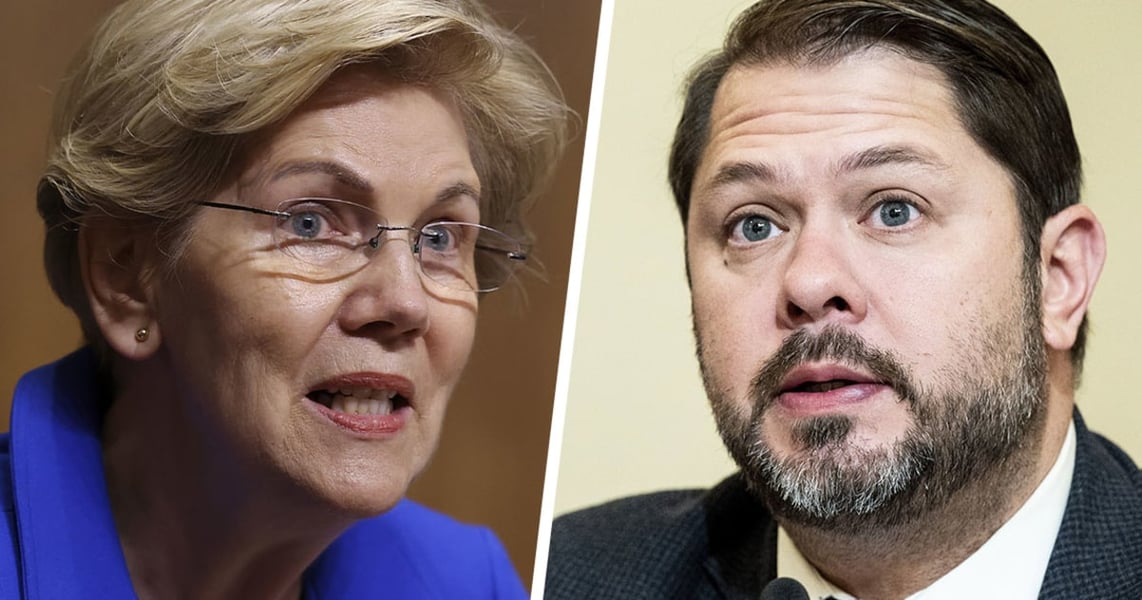
Those assurances have not quieted Democratic senators who have spent months building a political case around what World Liberty’s investor roster reveals. Five senators, Elizabeth Warren of Massachusetts, Ron Wyden of Oregon, Richard Blumenthal of Connecticut, Gary Peters of Michigan, and Dick Durbin of Illinois, formally demanded hearings into the Trump family’s cryptocurrency holdings and the identities of their foreign investors. Senate Democrats have made the hearings a condition for moving on any crypto legislation, a position that has found no support from Republican committee chairs who control the calendar.
The Zhou disclosure landed against a fraught legislative backdrop. The CLARITY Act, which would establish the first comprehensive regulatory framework for digital assets in the United States, stalled in the Senate before the August recess as Democrats conditioned their support on Trump divesting from crypto. The Senate set a September 15 vote, a deadline that will arrive with new questions about who has been buying into the president’s business.
Reuters reported in July that Aqua 1’s publicly documented investments consist almost entirely of its transfers to World Liberty, totaling $92 million across three transactions between March and June. The apparent source of the funds was OKX, a major cryptocurrency exchange. No prior investment track record existed. No explanation of the capital’s origins was offered.
Zhou is not the only World Liberty investor whose background has drawn concern. Justin Sun, the billionaire founder of the Tron blockchain, pledged $75 million and was at one point the company’s largest publicly known backer before his holdings were frozen by World Liberty. Sun accused the company of having created “a trap door marketed as an open door.” Separately, a UAE-linked group tied to Sheikh Tahnoon bin Zayed Al Nahyan, Abu Dhabi’s national security advisor, committed a $500 million stake, an arrangement that coincided with the Trump administration easing export controls on advanced technology sales to the Emirates.
Trump’s 2025 cryptocurrency earnings disclosure, a 927-page document released in June, showed more than $1.4 billion in crypto-related income for his first year back in the White House, the largest share from World Liberty token sales and meme coin royalties. Ethics lawyers called it an unprecedented concentration of financial interest inside a presidency simultaneously writing the rules governing that industry.
Trump’s crypto stakes and Senate legislation tensions had already fractured bipartisan support for the CLARITY Act before the Zhou investigation surfaced. The new reporting adds a different dimension to that dispute: not a conflict of interest, but a question of due diligence, whether a compliance program performed any meaningful check on the origin of $100 million it accepted before routing most of it to the president.
What remains unresolved is where Zhou’s capital originated. His 2021 arrest for suspected money laundering has not yet led to a personal charge. The two employees charged in the London case have not publicly named him as a subject. Aqua 1’s legal structure, its ultimate beneficial owners, and the provenance of the funds it deployed into the president’s business are open questions in a venture that has collected more than half a billion dollars from investors, many of whom have declined to be publicly identified.