
NEW YORK — Kevin Warsh’s signal at Jackson Hole was supposed to cool the crypto trade. It did, briefly. Leveraged positions across digital assets were flushed in a single violent session that liquidated $488 million in exposure and sent ether briefly below $2,100. Then institutional money came in at the strongest weekly pace in ten months.
Spot Ethereum exchange-traded funds in the United States recorded $824 million in net inflows for the week ending August 28, according to data compiled by SoSoValue. That figure — which arrived alongside a parallel $924 million flowing into spot Bitcoin ETFs in the same period — represents a quiet refutation of the theory that tighter monetary policy and the risk-off mood Warsh produced would translate into reduced institutional appetite for digital assets. For allocators in London, Toronto, and Mumbai watching whether U.S. rate signals would spill into crypto markets, the week’s numbers offered an answer: they did, and then demand accelerated.
BlackRock’s iShares Ethereum Trust ETF, ticker ETHA, captured $567 million of that weekly total, about 69 cents of every institutional dollar flowing into Ethereum that week. The fund logged $225.8 million on August 27 alone — its largest single-day inflow since October 28, 2025 — and extended its streak to 11 consecutive sessions of positive flows as of August 31, a run that accumulated $1.02 billion. Total net asset value across the U.S. spot Ethereum ETF complex now stands at $15.23 billion, representing 5.20% of Ethereum’s total market capitalization. Cumulative net inflows since the complex launched have reached $12.97 billion.
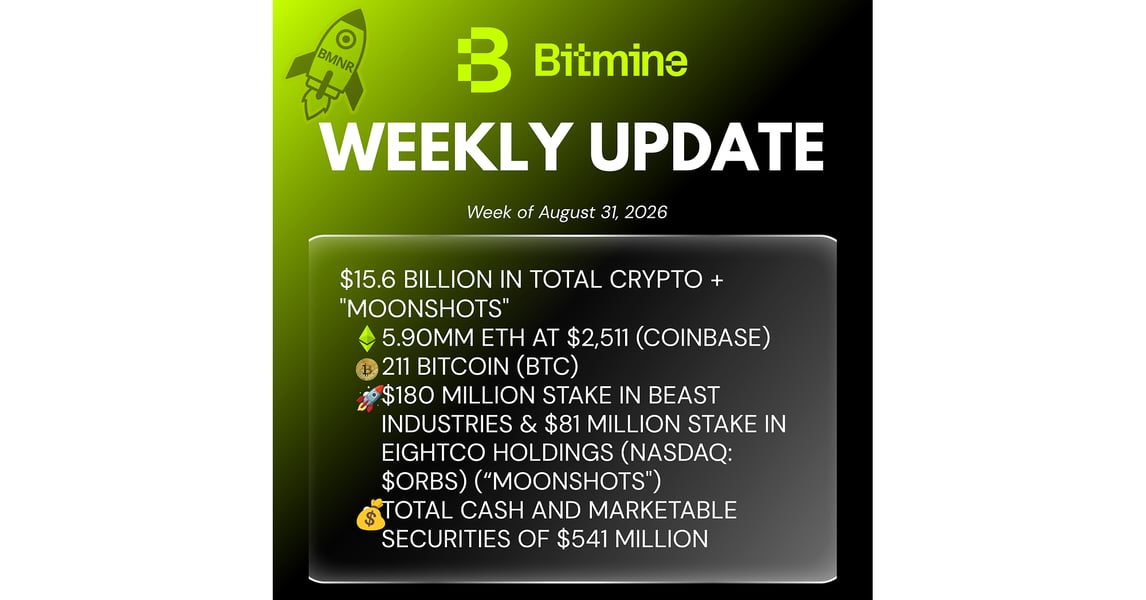
The week’s demand came alongside a separate accumulation story that has been building for 65 consecutive weeks. BitMine Immersion Technologies added 53,501 ether to its treasury in the week ending August 31, its largest single-week purchase since June, bringing total holdings to 5,901,112 ETH. The position is valued at approximately $14.8 billion and represents roughly 4.9% of all ether in circulation — 133,900 tokens short of the 5% target the company has publicly declared. CEO Jonathan Bates, in a press release dated August 31, called the purchase evidence of “continued conviction,” without specifying whether buying at this pace would continue once the target is reached.
Conviction is a word worth examining. BitMine has staked approximately 86% of its holdings — roughly 5.07 million tokens — through the MAVAN protocol, generating approximately $335 million in annualized staking rewards at current rates. Tom Lee, who spearheaded the treasury strategy when the company pivoted in June 2025, has argued consistently that this yield changes what it means to hold Ethereum long-term. The asset generates a real return while you hold it. That makes it a structurally different proposition than Bitcoin, which carries no native yield.
That asymmetry became more legible after Jackson Hole. Warsh’s rate signal clarified the Fed’s direction. Once the direction was priced, the question facing allocators was not whether higher rates would hurt crypto broadly — they would — but which digital asset held up best in a higher-for-longer environment. Ethereum’s staking yield of approximately 3.5% annualized offers portfolio managers something Bitcoin cannot: a carry return. For funds in Edinburgh, Toronto, or Singapore that must justify digital asset exposure in a rate environment rewarding cash and short-duration fixed income, that yield matters in the performance attribution conversation in ways it did not two years ago. CoinDesk reported that Warsh’s signal mattered differently to funds making multi-year allocation decisions than it did to traders running levered positions overnight.

There is a supply dimension running beneath both stories. With 86% of BitMine’s tokens staked and approximately 33% of total ETH supply already locked across the network’s validators, the liquid float available to ETF managers absorbing fresh demand is considerably narrower than headline supply figures suggest. Whether that compression contributed to August’s price resilience — ETH closed the month near $2,511, up from below $2,100 at its worst — or whether it becomes a more visible price driver in a future demand cycle is something neither BitMine nor its counterparts have modeled publicly.
The $824 million also registered against a broader context. Combined Bitcoin and Ethereum ETF inflows of approximately $1.75 billion for the week represent the strongest coordinated institutional week for spot crypto ETFs in 2026. For investors in India, where SEBI consultations on domestic crypto ETF frameworks have been running for months, and for Canadian investors whose domestic Bitcoin ETFs preceded the U.S. market by three years, the U.S. institutional trend carries weight as a reference point for regulatory and allocation decisions. Bitcoin ETFs recorded $924 million in net inflows the same week, led by BlackRock’s IBIT with $938 million, narrowing the inflow gap between the two assets to roughly $100 million — closer than it has been at any comparable point this year.
BitMine also holds 211 bitcoin and $541 million in cash and securities, giving it total assets of $15.6 billion. The company disclosed those figures alongside the treasury update without offering forward guidance on whether the buying pace would continue at this rate once the 5% threshold is crossed. That silence matters as much as the numbers. At 4.9% of circulating supply, with 86% of those tokens staked, BitMine has locked up a meaningful share of Ethereum’s tradeable float and has said nothing about what happens next.
What August did not deliver was clarity on price trajectory. ETH’s price action through the month was constructive, not explosive. The data describes a structural shift in how Ethereum is held — more of it in regulated vehicles, a growing share on a single corporate balance sheet, less of it available to move — without confirming what that shift will do to the price next quarter. That remains the central question in Ethereum’s investment thesis. The answer was not visible in August’s closing price.