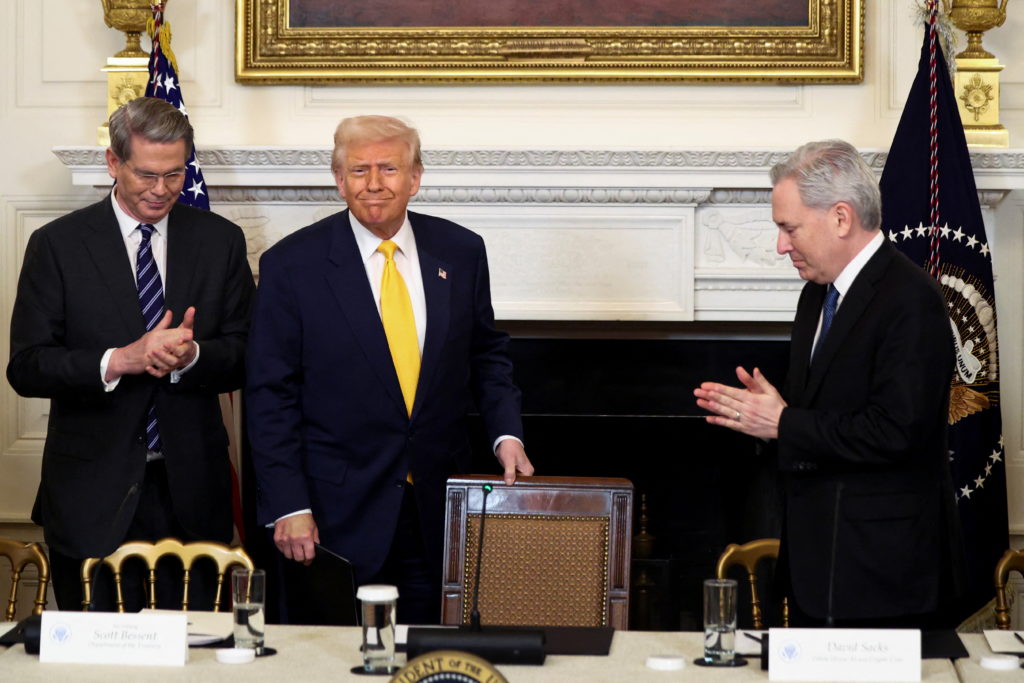

WASHINGTON — President Donald Trump earned more than $1.4 billion from cryptocurrency ventures during 2025, his first year back in the White House, according to a sweeping financial disclosure released Tuesday by the U.S. Office of Government Ethics — a figure that has renewed a fierce debate over whether a sitting president can simultaneously set the rules for an industry in which he has a profound financial stake.
The disclosure, stretching to 927 pages — compared with eight pages for Barack Obama’s final filing and eleven for Joe Biden’s — offered the most detailed public accounting yet of how Trump’s personal fortune has ballooned since he returned to power. Forbes had estimated his net worth at $6 billion before the filing; analysts at Bloomberg put it closer to $7.6 billion. The document does not resolve the precise figure, because many individual income items are reported in ranges rather than exact sums.
The largest single line item was $635 million in royalties attributed to CIC Digital LLC, the entity behind the $TRUMP meme coin that Trump launched three days before his second inauguration in January 2025. The coin briefly soared past $74 within a day of its debut, making early buyers wealthy on paper. By Tuesday evening it was trading at $1.67, according to Coinbase — a collapse of more than 97 percent from its peak. The disclosure linked those royalties to a group called “Celebration Coins,” though no public digital footprint for the entity could immediately be found; the Trump Organization did not respond to a request for comment.
On top of the meme coin income, Trump reported more than $500 million from token sales by World Liberty Financial, the cryptocurrency company he co-founded with his sons Eric and Donald Jr. and two associates with ties to the family of Steve Witkoff, the U.S. special envoy. The firm issues WLFI governance tokens and USD1, a stablecoin pegged at one dollar. An additional $196 million in equity sales from Stablecoin Holdco LLC, the parent holding company that controls World Liberty Financial, was also listed.
World Liberty Financial has attracted controversy since its launch. An Abu Dhabi government-backed sovereign wealth fund used its USD1 stablecoin last year to facilitate a multibillion-dollar investment in the cryptocurrency exchange Binance, whose co-founder, Changpeng Zhao, had received a presidential pardon from Trump for financial crimes. Trump denied any connection between the pardon and the transaction. The company drew additional scrutiny when a Chinese-born crypto billionaire, Justin Sun, spent $75 million on governance tokens and $200 million on both the $TRUMP and $MELANIA meme coins. A U.S. fraud case against Sun was paused shortly after those purchases and ultimately settled last month for a $10 million fine. Sun has denied any link between his spending and the resolution of his legal case; World Liberty has dismissed the notion of a conflict of interest.
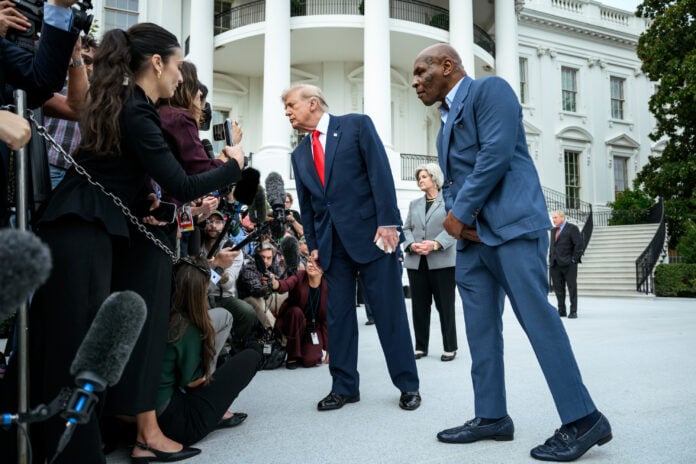
The White House reacted to Tuesday’s filing with a prepared statement. “Neither the President nor his family has ever engaged — or will ever engage — in conflicts of interest,” Principal Deputy Press Secretary Anna Kelly told reporters, adding that Trump “proudly made the United States the crypto capital of the world through executive actions, supporting legislation like the GENIUS Act.” When pressed directly, Trump himself told reporters: “If you ever have a 401k, how’s your 401k doing? It’s been up 85 percent. Thank you, President Trump. So, we’re all profiting.”
Ethics lawyers and historians were less sanguine. Richard Painter, who served as the chief ethics attorney for President George W. Bush, said the arrangement represents an unprecedented conflict between a president’s official duties and personal financial interests. “This is the first president that we’ve seen with substantial conflict of interest with his official duties since the Civil War,” Painter said, pointing to a loophole in federal law that exempts the president and vice president from the primary conflict-of-interest statutes that govern the broader executive branch. He argued there is little legislative appetite to close that gap because many members of Congress benefit from similar exemptions on their own investment portfolios.
Douglas Brinkley, a presidential historian at Rice University, put the disclosure in a longer frame. “What strikes me as remarkable is how many pies Trump has his fingers in,” he said. “There is no precedent to compare it with.” The Trump administration, for its part, has argued that the assets are managed at arm’s length by third-party financial institutions using automated trading technology and that Trump does not discuss investment decisions with the managers. “What they do is, we gave it — I think it’s called a blind account,” Trump told CNBC on Wednesday. “Basically, they take it, and I purposely, I never speak to any of the people that run the money.” Critics note that the arrangement does not meet the standard definition of a blind trust, because the underlying assets and their identities remain known to the president.
The cryptocurrency windfall vastly overshadowed Trump’s traditional income streams. His Mar-a-Lago club in Palm Beach brought in more than $77 million; his Doral golf resort in Florida generated $122 million; and properties in Jupiter, Bedminster, and Turnberry, Scotland, each produced upwards of $30 million. Branded merchandise added millions more — $4.7 million from Trump-branded watches alone, plus income from sneakers, fragrances, guitars and various books, including roughly $1.9 million from “Save America.” More than $80 million was listed from legal settlements with ABC News and anchor George Stephanopoulos, CBS, Meta, YouTube and Sundar Pichai, the chief executive of Alphabet; those proceeds were directed to the Donald J. Trump Presidential Library Foundation, according to the filing.
The filing also revealed that Trump’s investment accounts bought and sold shares in GEO Group, a private prison company that is one of the largest federal contractors with U.S. Immigration and Customs Enforcement. The first purchase was made just ten days after Trump’s inauguration. As the number of immigrant detainees held by ICE grew from roughly 35,000 to nearly 70,000 over the course of the year, the disclosure shows the purchases increased, ranging in value from $143,000 to $445,000. The White House has maintained there is no connection between the investments and immigration enforcement policy.
The disclosure is required annually under a 1978 statute. Trump received a 45-day extension to file and paid late fees for transactions not previously reported on earlier forms, according to an ethics official’s notation attached to the document. His filing runs to nearly 1,000 pages partly because it encompasses tens of thousands of individual line items across a sprawling web of domestic and international holdings.
For investors who bought in early, the picture is considerably less rosy. The $TRUMP meme coin — a digital asset designed primarily as a commemorative token rather than a functioning currency — has fallen more than 97 percent from its January 2025 high. World Liberty Financial’s governance tokens have lost roughly 80 percent of their value since trading opened last September. The disclosure reports revenue, not profit; it does not indicate what portion of the gross figures flows directly to Trump after costs, licensing fees and revenue-sharing arrangements. What is clear is that the president and his family collected upfront royalties and fees while many retail buyers absorbed substantial losses.
The Trump administration has simultaneously pushed to reshape the regulatory environment governing digital assets, ending numerous enforcement actions opened under the Biden administration and pressing Congress to pass the Digital Asset Market Clarity Act, which would set new ground rules for how financial regulators oversee the industry. Critics say the combination of policymaking authority and direct financial interest in the sector’s success is precisely the kind of entanglement that conflict-of-interest law is meant to prevent. The White House says the two tracks are entirely separate.