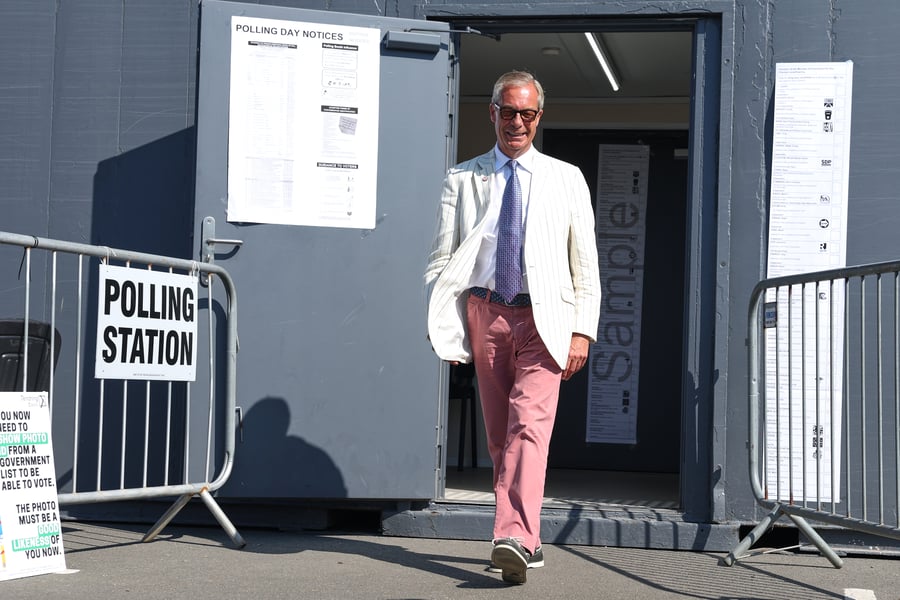

LONDON – The ballot paper in Clacton measured ninety centimetres from top to bottom. It listed 34 candidates, a new record for a British parliamentary by-election. When the returning officer announced the result in the early hours of Friday, the winner was the same man who had resigned the seat five weeks earlier: Nigel Farage, whose calculation that voters would vindicate him where parliamentary investigators and the mainstream press would not produced a majority of 12,784.
Farage received 22,239 votes, 63.34 percent of the ballots cast, on a turnout of 44.37 percent. In second place, with 9,455 votes and 26.93 percent of the total, was Count Binface, the satirical candidate whose real name is Jon Harvey and whose campaign, built around a metallic helmet and a platform of cheerful absurdism, attracted more media coverage than most of the 32 others on the ballot. The Rejoin EU candidate, John Stevens, finished third with 492 votes. The remaining 31 candidates shared 1,925 votes between them.
The outcome was the mandate Farage said he was seeking when he resigned his seat on July 7. He framed that resignation not as an admission of fault but as a confrontation: “I called this by-election because I wanted the people of Clacton to be my judge, not the mainstream media,” he said after the declaration. He did not attend in person, citing credible security threats, an absence that gave his moment of victory an unusual quality, won without being present for it.
The by-election was triggered by the disclosure scandal that preceded his resignation. Farage failed to declare a £5 million donation from Christopher Harborne, a British cryptocurrency investor based in Thailand, within the required parliamentary reporting window. A parallel inquiry examined undeclared gifts connected to George Cottrell, a financier convicted in the United States on charges of wire fraud, money laundering, and extortion, who had previously worked for Farage. Farage described the scrutiny as a witch-hunt and called the by-election a deliberate escalation against what he termed the “entire establishment.” In Clacton, the voters who had given him 46.2 percent at the 2024 general election gave him 63.34 percent in a contest without Labour, Conservative, Liberal Democrat, or Green candidates on the ballot.
The four main parties declined to stand, calling the by-election a stunt designed to turn accountability into a campaign opportunity. What their absence produced was a result in which Count Binface, running on a deliberately satirical platform, became the de facto leader of the opposition in Clacton. He drew more than one vote in four. “There’s more than one way to win,” he told Al Jazeera after the declaration, referencing his long record of challenging sitting prime ministers without defeating any of them.

The contest reflected something about the by-election’s particular logic. With no serious alternative on the ballot, protest votes and genuine Reform support compressed the result into a shape that looked like a landslide but measured something narrower: what happens when the main parties step back from a fight. Farage’s 46.2 percent in 2024, against the full range of opposition, had been a tighter contest. His 63.34 percent in 2026, against a field that included a man in a space-themed costume and twenty independents, is a different kind of number.
The turnout of 44.37 percent was 13.6 percentage points below the 2024 general election figure for the constituency. It tracks the typical pattern for British by-elections, which draw lower participation than general contests regardless of circumstances. Of the roughly 35,000 voters who showed up on Thursday, more than 9,000 chose a satirical candidate over the man who engineered the election. That is a protest vote of some consequence, even if it was delivered by someone who describes himself as an intergalactic space lord.
What the result does not settle is the parliamentary investigation that preceded it. Farage’s return to the House of Commons as the duly re-elected member for Clacton does not suspend the inquiry already examining his financial disclosures. The parliamentary standards watchdog continues its work independently of the ballot result. A finding against Farage could carry consequences ranging from a formal reprimand to a suspension that triggers a further by-election in the same constituency he has now won twice. Clacton’s record-breaking field dissolved on polling day; the institutional scrutiny did not.
The Metropolitan Police criminal investigation into Reform UK donations also remains active. That inquiry concerns the party’s donor verification processes, not solely Farage’s individual declarations, but both threads point toward the same question: whether the financial practices Reform UK employed in its rapid rise from fringe movement to major parliamentary force complied with the laws governing British political money. Those questions do not answer themselves in a by-election, however decisive the margin.
Reform UK’s deputy leader Richard Tice faces a separate parliamentary standards investigation, adding to the party’s institutional pressures at the same moment its poll numbers remain strong. Reform holds 98 seats in the Commons following the 2024 result and leads in national opinion surveys. The by-election Farage engineered in Clacton adds one seat to that total. Whether the ongoing investigations cost him the seat again is the open question his victory leaves in place.
Farage told his supporters that Clacton voters had “stuck two fingers up to the entire political establishment.” The establishment he was addressing, parliamentary standards committees, the Metropolitan Police, disclosure rules built over decades, will not have received the message in quite the way he intended. It continues its work. So does he, from the seat he resigned and won back in five weeks.