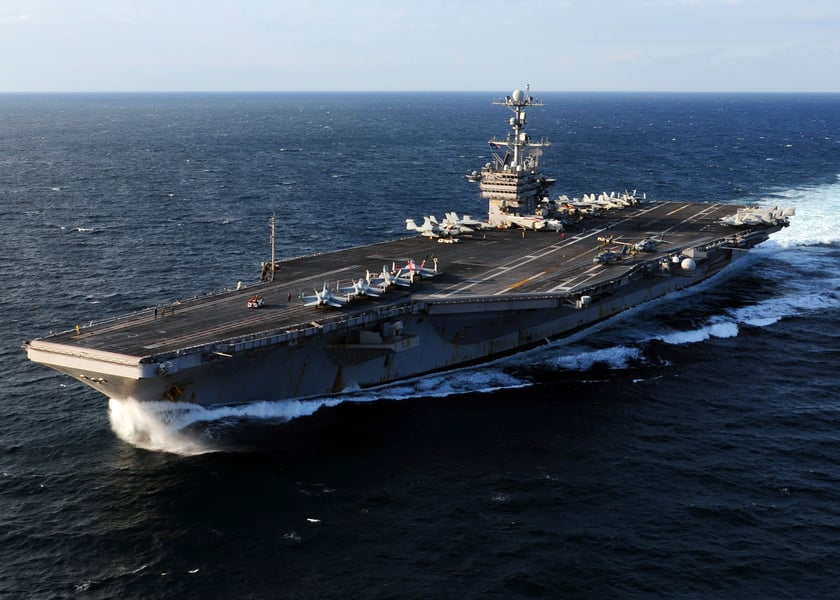

WASHINGTON – The mother of a sailor aboard USS Abraham Lincoln told a Navy town hall this week that life on the ship after 260 days of continuous deployment had come to resemble “a scene out of the ‘American Horror Story,’ where everybody’s dead, but they don’t know it yet.” The Pentagon’s response was to send another carrier.
The USS George Washington, a Pacific-based carrier strike group named for the first president, departed Da Nang, Vietnam, last week and was spotted crossing the Singapore Strait and transiting the Strait of Malacca, the sea route that precedes an Indian Ocean crossing toward the Middle East. The Navy has not confirmed the Washington’s destination or arrival timeline, but the transit path left little ambiguity: the Lincoln, which has been operating in waters near Iran since January and was supposed to return home in May, is finally getting a replacement. The Pacific, in the meantime, will be left without American carrier coverage for an indeterminate period.
The Lincoln’s numbers tell a specific kind of story. More than 260 days at sea. Roughly 10,000 aircraft sorties flown. One and a half million pounds of ordnance expended. A deployment that began November 21, 2025, from San Diego and was supposed to end in spring, extended month after month as the Iran war, which launched February 28 when joint American and Israeli airstrikes struck Tehran, created the operational demand that kept the Lincoln in place. Senate Democrats formally demanded Pentagon accountability Thursday after reports surfaced that sailors had attempted to jump overboard and that the ship was experiencing food shortages, water contamination, and a mental health crisis that the Navy had euphemistically described as “dark thoughts.”
What life actually looked like aboard was supplied by the families who spoke at the town hall. Sailors were running short not only on food but on hygiene items and mail, the connection to home that military psychologists have long identified as critical to morale on extended deployments. A sailor went overboard in early August; the Navy said he was quickly recovered and did not confirm his condition. U.S. Central Command, in a social media post that seemed calibrated more for optics than for candor, described Lincoln’s sailors as “resilient and resolved.” A sailor’s mother described something else entirely.
Defense Secretary Pete Hegseth, when asked about conditions aboard the Lincoln, offered an assurance notable for what it did not acknowledge: “We make sure that every ship, every crew, every captain has everything we can provide them at every single moment.” The Navy’s own statement added a qualifier that undermined the same claim: leadership had “prioritized mission-critical supplies: first food, then hygiene items, then mail.” The implication that some categories of supplies had not arrived was embedded in the priority structure itself.
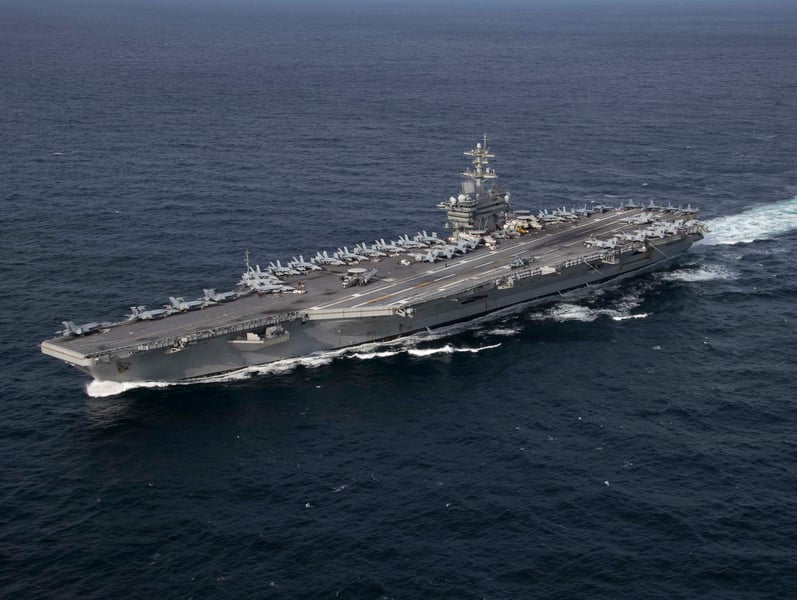
The George Washington’s Pacific departure to relieve the Lincoln is itself a strategic calculation with costs. The Washington’s movement from Southeast Asian waters toward the Indian Ocean leaves the Pacific, where China’s naval expansion has driven years of American strategic concern, without a US carrier strike group for an unknown stretch of time. The Navy is simultaneously being ordered to redesign future carriers to use steam catapults instead of the electromagnetic systems currently in production, a parallel disruption to the industrial base that makes the service’s capacity constraints more acute, not less. The combination of an overstretched fleet, a redesigned procurement program, and a war that has now consumed eight months of one carrier’s operational life points toward a naval posture under strain in multiple directions at once.
The strategic gap in the Pacific is not a new concern. Washington sent two amphibious ready groups to the Gulf in July while dispatching negotiators to Doha, a posture that concentrated combat power in one theater while leaving others relatively uncovered. The George Washington’s transit extends that logic: the Middle East theater continues to consume carrier capacity that the Navy cannot fully replace without drawing from its Pacific presence. Whether Beijing reads the absence as an opportunity or simply as a data point in its longer-term assessment of American staying power in the region is a question that Pentagon planners are, by necessity, already asking.
For the Lincoln’s crew, the strategic calculus is abstract. The concrete reality is 260 days at sea, overdue by months, in a war zone where Iran has previously targeted the carrier directly. The sailor who went overboard in early August was recovered. The mental health crisis that the Navy acknowledged through carefully chosen bureaucratic language, “dark thoughts,” has not been quantified. The town hall that produced the American Horror Story comparison was meant to give families a venue for concerns; it produced instead a public record of conditions that the service’s senior leadership has not adequately explained.
What changes when the George Washington arrives is the Lincoln’s ability to leave. What does not change immediately is the toll already accumulated: the months at sea, the shortages, the sorties, the weight of the deployment on sailors who signed up for a service that overextended them in a war they did not begin. Whether the Navy addresses the institutional failures that allowed the conditions aboard the Lincoln to develop, or whether the Washington’s arrival simply absorbs the operational pressure and repeats the pattern in a newer hull, depends on answers from Hegseth and Acting Navy Secretary Hung Cao that have not yet been given.