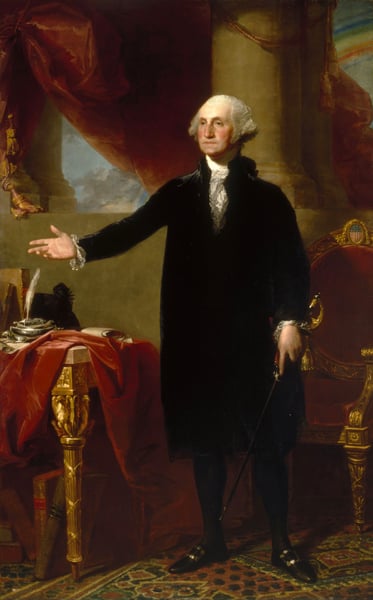

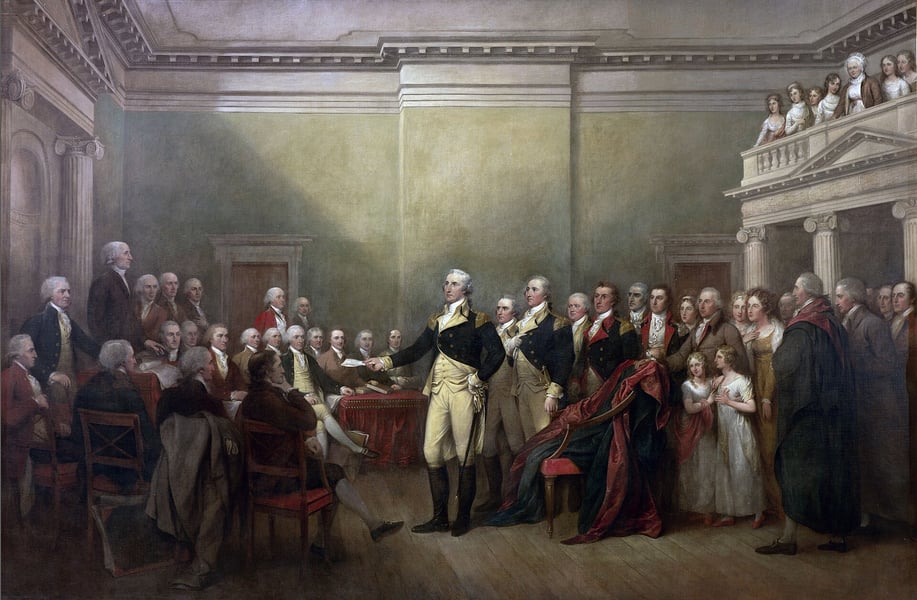
On 23 December 1783, in the Maryland State House at Annapolis, a general who had just won a war against the most powerful empire on earth walked into a room of civilian politicians and handed back his commission. The Continental Congress had no army left to speak of and no money to pay one. Nothing except his own decision obliged him to do it.
That moment is the reason George Washington occupies the place he does. He is not remembered as the greatest battlefield commander of the Revolution, because he was not one. He lost more engagements than he won. He is remembered because twice, holding power that almost nobody could have taken from him, he put it down and went home.
The second time was March 1797, when he declined a third term as president and set a two-term limit that held for a century and a half without ever being written into law. The sharpest test of that reading of his life is the one place he did not let go: the 317 men, women and children enslaved on his own farms.
| Field | Detail |
|---|---|
| Full name | George Washington |
| Born | 22 February 1732, Popes Creek, Westmoreland County, Virginia (11 February 1731 Old Style) |
| Died | 14 December 1799, Mount Vernon, Virginia, aged 67 |
| Spouse | Martha Dandridge Custis, married 6 January 1759 |
| Children | None biological; raised two stepchildren and two step-grandchildren |
| Height | About 6 feet 2 inches |
| Commander-in-Chief | Continental Army, 15 June 1775 to 23 December 1783 |
| President of the Constitutional Convention | May to September 1787, Philadelphia |
| President of the United States | 1st, 30 April 1789 to 4 March 1797 |
| Vice President | John Adams, both terms |
| Party | None. The only US president never affiliated with a political party |
| Enslaved at Mount Vernon, 1799 | 317 people; 123 owned by Washington, 153 Custis dower, the rest rented |
| Dates before 1752 are given in both the Julian calendar used at the time and the Gregorian calendar adopted afterwards. | |
Early life: a second son on the Virginia frontier
He was born on 22 February 1732 at Popes Creek in Westmoreland County, Virginia, the eldest son of Augustine Washington’s second marriage. Under the Julian calendar still in use in the British colonies, the date was recorded at the time as 11 February 1731. Britain and its colonies adopted the Gregorian calendar in 1752 and the birthday moved with it.
His father died when he was eleven. That single fact shaped everything after it. Augustine’s estate went principally to the sons of his first marriage, and George, as a younger son of the second, inherited neither the land nor the English education his half-brother Lawrence had received. There was no Oxford, no Inns of Court, no grand tour. He was schooled locally, learned surveying, and at seventeen was appointed surveyor of the newly created Frederick County.
Surveying is an unglamorous entry in a founder’s biography and it mattered more than any of the rest. It taught him the western land in physical detail at exactly the moment that land was becoming the central asset of colonial Virginia, and it made him, over decades of acquisition, one of the largest landowners in the colonies.
The French and Indian War and a reputation built on defeats
In 1753 the twenty-one-year-old Washington carried a message from the governor of Virginia to French commanders in the Ohio Country demanding they withdraw. They declined. He returned the following year with troops, was surrounded at a hastily built stockade he named Fort Necessity, and surrendered on 3 July 1754 after a day of rain and casualties. The surrender document, in French, contained an admission of assassination that he later said he had not understood when he signed it.
A year later he was aide to General Edward Braddock on the march to Fort Duquesne. The column was ambushed near the Monongahela on 9 July 1755 and destroyed. Braddock was killed. Washington, by his own account, had two horses shot from under him and four bullets through his coat, and he organised what was left of the retreat.
Neither episode was a victory. Both made him famous in Virginia, which is a lesson about reputation that recurs through the rest of his career.
Mount Vernon, Martha and the making of a Virginia gentleman
He leased Mount Vernon from his half-brother’s widow in 1754 and inherited it outright in 1761. On 6 January 1759 he married Martha Dandridge Custis, a widow whose late husband’s estate was among the largest in Virginia. The marriage brought him wealth, social position, two stepchildren, and the legal entanglement that would define the last decade of his life: the Custis dower slaves, whom he controlled but did not own.
The couple had no children together. Washington raised Martha’s son and daughter, and later two of her grandchildren, and the absence of a biological heir is not a small detail. A man with no dynasty to found has less to lose by walking away from power, and contemporaries noticed.
Commander-in-Chief, 1775 to 1783
Congress appointed him commander of the Continental Army on 15 June 1775. He refused a salary and asked only that his expenses be covered, a gesture that was both genuine and, as the expense account eventually showed, not inexpensive.
| Date | Event | Outcome |
|---|---|---|
| 15 June 1775 | Appointed Commander-in-Chief by the Continental Congress | Refused a salary |
| March 1776 | Siege of Boston ends | British evacuate |
| August to November 1776 | New York campaign: Long Island, Kip’s Bay, White Plains, Fort Washington | Defeat; army driven across New Jersey |
| 26 December 1776 | Trenton | Victory over a Hessian garrison of about 1,500 |
| 3 January 1777 | Princeton | Victory |
| September to October 1777 | Brandywine and Germantown | Defeats; Philadelphia falls |
| Winter 1777 to 1778 | Valley Forge encampment | Roughly 2,000 deaths from disease and exposure |
| 28 June 1778 | Monmouth | Inconclusive; the army holds the field |
| 19 October 1781 | Yorktown, with French land and naval forces | Cornwallis surrenders about 8,000 troops |
| March 1783 | Newburgh Conspiracy | Defused in a single meeting |
| 23 December 1783 | Resigns his commission at Annapolis | Returns to private life |
| Washington lost more battles than he won. The strategic objective was to keep the Continental Army in existence rather than to win decisive engagements. | ||
The war he fought was not the war of the paintings. For most of eight years he commanded an army that was underfed, unpaid, short of powder and perpetually about to dissolve as enlistments expired. His strategic achievement was negative and it was decisive: he kept the army in existence. Britain could not win without destroying it, and he declined to offer it up in the kind of pitched general engagement where it would have been destroyed.
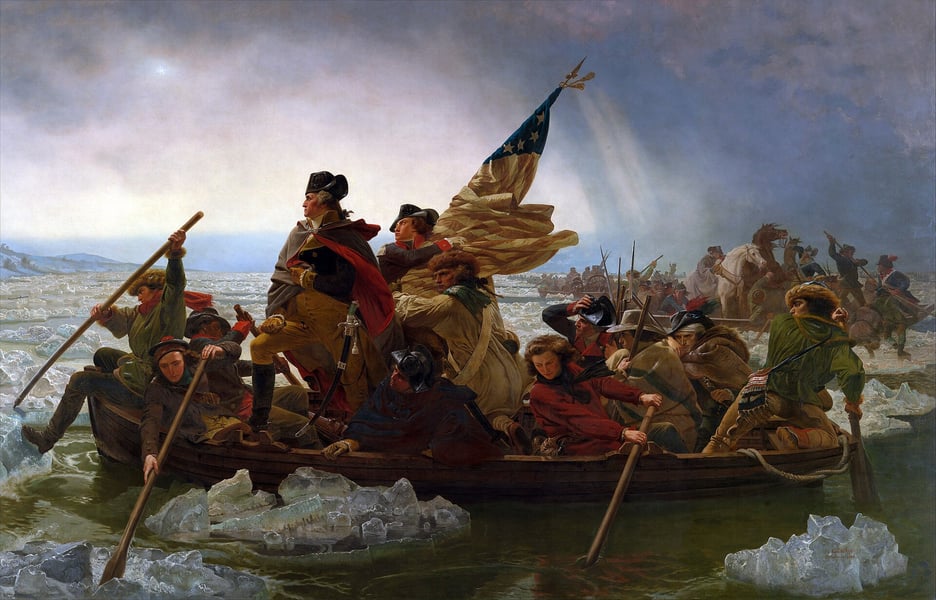
Trenton, on the morning after Christmas 1776, is the exception that shows the pattern. It was a raid on a garrison of roughly 1,500 Hessians, executed at the point when the cause was closest to collapse, and its value was less military than political. Enlistments were expiring in days. The victory bought him an army for another year.
The most dangerous moment of his command came with no British troops present at all. In March 1783, with the fighting effectively over and Congress unable to pay the officers, a circular went round the Newburgh cantonment urging the army to act against the civil government. Washington appeared unannounced at the meeting, began to read a letter, stopped, and put on spectacles almost none of them had seen him wear, saying he had grown grey and now found himself going blind in the service of his country. The officers wept. The conspiracy ended in the room.
Annapolis, and the precedent that outlived him
He could have kept the army. Congress was broke, the officers were owed years of pay, and the only force in North America capable of dictating terms to the civil government was the one he commanded. On 23 December 1783 he rode to Annapolis instead, stood before Congress, and read a short statement returning the commission it had given him eight and a half years earlier.
The act had no precedent that anyone in the room could point to. Reports reached London that he intended to go home to his farm, and the story that George III said this would make him the greatest man in the world comes to us third hand, through the painter Benjamin West, which is exactly the level of confidence it deserves. What is documented is what happened next: he went back to Mount Vernon and stayed there for five years.
He repeated it in 1797. Nothing in the Constitution limited a president to two terms, and he had been elected twice without a dissenting elector. He left anyway, and the custom he created held for a hundred and forty-three years before Franklin Roosevelt broke it, and became binding law with the Twenty-Second Amendment in 1951. That amendment is under argument again in Washington today.
The presidency, 1789 to 1797
He presided over the Constitutional Convention at Philadelphia in 1787 and said almost nothing during it. He did not need to. Delegates were designing an executive branch in the knowledge of who would occupy it first, and that knowledge made a strong presidency politically survivable.
The electoral college chose him unanimously twice, sixty-nine votes in 1789 and one hundred and thirty-two in 1792. No other president has been elected without a single dissenting elector, and none will be.
| Measure | Figure |
|---|---|
| Electoral votes, 1789 | 69 of 69, unanimous |
| Electoral votes, 1792 | 132 of 132, unanimous |
| Annual salary | $25,000, voted by Congress on 24 September 1789, about 2 per cent of the federal budget |
| States in the Union at inauguration | 11; North Carolina and Rhode Island had not yet ratified |
| States at the end of his presidency | 16 |
| Vetoes | 2 in eight years |
| Supreme Court justices appointed | 11, including the first two Chief Justices |
| Militia raised for the Whiskey Rebellion, 1794 | About 13,000 |
| Cabinet departments created | State, Treasury, War, plus the Attorney General |
| Terms served | 2, declining a third |
| The two-term limit remained an unwritten custom until Franklin Roosevelt broke it in 1940, and became law with the Twenty-Second Amendment in 1951. | |
Almost everything he did in office was a precedent because there was nothing else for it to be. He created a cabinet, though the Constitution does not describe one. He assembled it from men who despised each other, kept Alexander Hamilton at Treasury and Thomas Jefferson at State in the same room for three years, and adopted Hamilton’s programme over Jefferson’s objections while insisting the disagreement was not a party system. It was becoming one anyway.
In 1794, when western Pennsylvania farmers refused an excise on whiskey, he raised roughly 13,000 militia and rode out at their head, the only sitting president to take the field with troops. The rebellion evaporated before contact. The point was never the fighting.
His Proclamation of Neutrality in 1793 kept the United States out of the war between Britain and revolutionary France, at severe cost to his popularity, and the Jay Treaty of 1795 was attacked so fiercely that he was burned in effigy. He signed it anyway. The Farewell Address, published in a Philadelphia newspaper on 19 September 1796 rather than delivered as a speech, warned against permanent foreign alliances and against the “baneful effects of the spirit of party” in a country that already had two.
Slavery at Mount Vernon: the part that does not resolve
Washington inherited ten enslaved people at the age of eleven and acquired many more. A census he compiled himself in 1799 counted 317 enslaved men, women and children living on Mount Vernon’s five farms.
The census was in two columns. One hundred and twenty-three were listed as his own property. One hundred and fifty-three were dower slaves attached to the Custis estate, legally the property of his wife’s first husband’s heirs, whom he had no power to free even had he wished to. The remainder were rented from a neighbour. Families had formed across those columns over four decades, which meant that any emancipation confined to his own column would break marriages apart.
His will freed the 123, to take effect after Martha’s death, and provided for the elderly and for the education of children among them. It freed his valet William Lee outright and immediately, with a pension. Martha signed the deed of manumission in December 1800 and the emancipation took effect on 1 January 1801, more than a year before her own death, reportedly because living surrounded by people with an interest in her dying was intolerable.
He is the only slaveholding founder who freed the people he enslaved. He did it at the last possible moment, after a lifetime of not doing it, and he could not free the majority of those living on his land. Both halves of that sentence are the record. The institution he declined to challenge in office survived another sixty-two years, until Abraham Lincoln ended it in the middle of a war that nearly ended the country Washington had assembled.
Death, and the argument that follows him
On 12 December 1799 he rode out over his farms in snow and freezing rain and sat through dinner in wet clothes. By the following night he could barely swallow. Physicians were summoned and bled him repeatedly, removing an estimated five pints over the course of the day, a treatment that modern clinicians regard as having hastened rather than delayed the end. He died at Mount Vernon on the evening of 14 December 1799, aged 67, of what is usually now identified as acute epiglottitis.
A state, the federal capital, more counties than any other American and a nuclear aircraft carrier now deployed to the Iran war carry his name. What the surviving record does not settle is how much of the restraint was principle and how much was temperament. He was intensely conscious of how posterity would read him and he curated his own papers accordingly. A man who wants above all to be seen giving power back has an incentive to give it back that is not identical to disinterest, and the documents do not let anyone separate the two with confidence.
Mount Vernon in 2026: a $40 million restoration and 250-year-old cherries
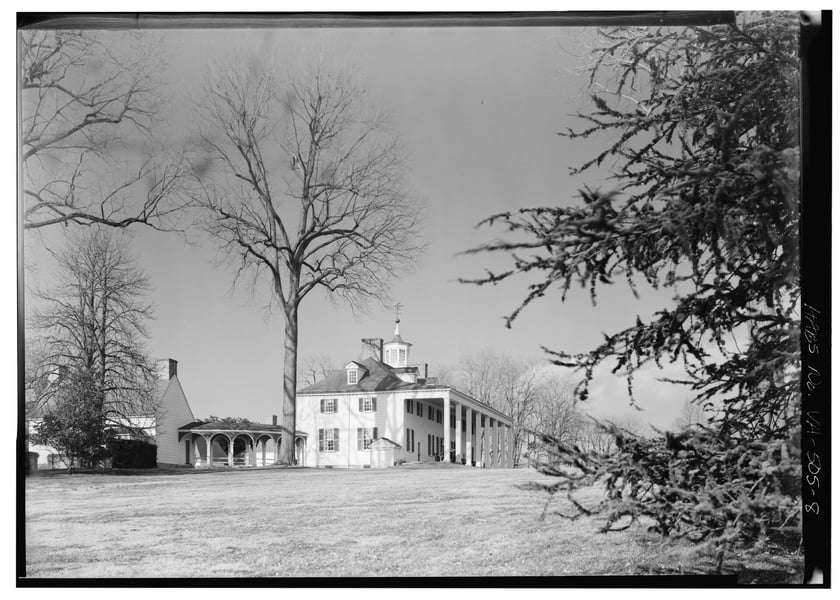
For almost two years the house itself was shut. Mount Vernon closed the Mansion to visitors in January 2024 and did not open it again until 10 December 2025, after a privately funded restoration costing about $40 million, the most extensive preservation work the estate has attempted. Doug Bradburn, its president and chief executive, put the case for spending that on a building rather than an exhibit plainly enough in the estate’s announcement: the founding of the United States cannot be understood without George Washington, and George Washington cannot be understood without Mount Vernon. The wider project does not finish until October 2026.
The work was structural before it was cosmetic. Carpenters, engineers and conservators strengthened the framing that carries the house, dealt with moisture and termite damage underneath it, repaired the windows and the piazza, and brought the first and second floor rooms closer to their condition in 1799. Those rooms are open again for the first time since the closure, which is the part visitors notice. The framing is the part that decides whether there is a house here in another 250 years.
The most striking thing the restoration turned up was not architectural. Excavating the cellar, Mount Vernon’s archaeologists opened five storage pits and lifted out 35 glass bottles, 29 of them intact and still holding fruit. Most of it is cherries. The rest looks like gooseberries or currants. The bottle shapes belong to the 1740s and 1750s, and the pits were sealed under a brick floor laid during an expansion of the house before 1775, which both dates the deposit and explains the survival. Corked and buried under heavy clay, food meant to keep for a single season kept for two and a half centuries.
| Date | Event |
|---|---|
| January 2024 | The Mansion closes to visitors for the revitalization |
| April 2024 | First sealed bottles of preserved fruit announced from the cellar |
| June 2024 | The total reaches 35 bottles from five storage pits, 29 of them intact |
| 10 December 2025 | The Mansion reopens; all first and second floor rooms accessible |
| 4 July 2026 | Semiquincentennial programme; the education centre exhibition opens |
| October 2026 | Full project scheduled to complete |
| Dates as announced by George Washington’s Mount Vernon and reported contemporaneously. The DNA and germination work on the recovered fruit had not reported results at the time of writing. | |
Jason Boroughs, the estate’s principal archaeologist, called the find beyond extraordinary, and was careful about whose work it actually was, describing the bottles to NPR as testimony to the knowledge and skill of the enslaved people who managed the food preparation from tree to table. The documentary record backs him closely. A woman recorded only as Doll, thirty-eight when she was brought to Mount Vernon in 1759, was put in charge of the kitchen and appears in the estate’s papers distilling rose and mint water and drying fruit, cherries among it. In 1795 Martha Washington wrote that she wanted some of the morello cherries dried and added that she should think old Doll cannot have forgot how to do them. The bottles in the cellar are about as close as archaeology gets to that instruction being carried out.
What the fruit can still be made to say is unsettled. Mount Vernon is working with the US Department of Agriculture on DNA testing that might identify the cherry variety, and on chemical testing that might show which spices went into the preserving. Benjamin Gutierrez, a USDA plant geneticist, rated the chance of germinating anything from the pits low, because seeds keep best dry and most of these came out waterlogged, and the first ones tested were not viable. More than two years after the discovery was announced, no DNA result and no successful germination have been published. The most direct physical evidence of daily labour at Mount Vernon is sitting in a laboratory, and the analysis that would make it talk is unfinished.
The timing of the reopening was not accidental. The estate treated it as its contribution to the country’s 250th anniversary, and on 4 July 2026 marked the Semiquincentennial with Revolutionary War encampments, a naturalisation ceremony, readings of the Declaration, military drills and fireworks over the Potomac. A new education centre exhibition, George Washington: A Revolutionary Life, opened alongside it, and the estate’s distillery released its first bourbon, Spirit of ’76, on the same day. All of it lands in a year when the anniversary is being marked by a country whose youngest adults have largely stopped believing in the promise it commemorates, and when the commemorations themselves have become political set pieces.
There is an argument buried in that programme. An estate that spends $40 million on the fabric of a house and tells visitors, in the same season, that the most valuable thing in the cellar is a record of enslaved labour is trying to hold two things at once. Whether the second reading survives contact with an anniversary crowd is a different question from whether the curators meant it.
George Washington: frequently asked questions
When was George Washington born and when did he die?
Born 22 February 1732 at Popes Creek, Westmoreland County, Virginia, and died 14 December 1799 at Mount Vernon, aged 67. His birth was recorded at the time as 11 February 1731 under the Julian calendar.
How long was George Washington president?
Two terms, from 30 April 1789 to 4 March 1797. His first inauguration was late because the new government took months to assemble.
Did George Washington have wooden teeth?
No. His dentures were made of ivory, animal teeth, lead and human teeth, some of them purchased from enslaved people at Mount Vernon. The wood story appears to come from the staining of ivory over time.
Did George Washington free his slaves?
He freed the 123 he owned outright, by his will, effective after Martha’s death; she brought that forward to 1 January 1801. He had no legal power over the 153 dower slaves of the Custis estate, who were not freed.
Did George Washington have children?
None of his own. He raised Martha’s two children from her first marriage and later two of her grandchildren.
Why did George Washington refuse a third term?
He never gave a single reason. The Farewell Address frames it as a matter of the country no longer needing him in particular, and he was 64, in poor health and exhausted by the partisan attacks of his second term. The two-term limit stood as custom until 1940 and became law with the Twenty-Second Amendment in 1951.
Was George Washington unanimously elected?
Twice. He received every electoral vote cast in 1789 and again in 1792, the only president ever to do so.
Is George Washington’s Mount Vernon open to visitors?
Yes. The Mansion reopened on 10 December 2025 after a $40 million privately funded restoration that had kept it closed since January 2024, and all first and second floor rooms are accessible again. Work on the rest of the estate is scheduled to finish in October 2026.
What military rank does George Washington hold today?
General of the Armies of the United States, the senior grade in the US Army. Congress passed a joint resolution, Public Law 94-479, approved on 11 October 1976 and backdated to 4 July, giving the grade rank and precedence over all other Army grades past or present. Until then Washington was carried on the Army rolls as a lieutenant general and was technically outranked by later four and five star officers.